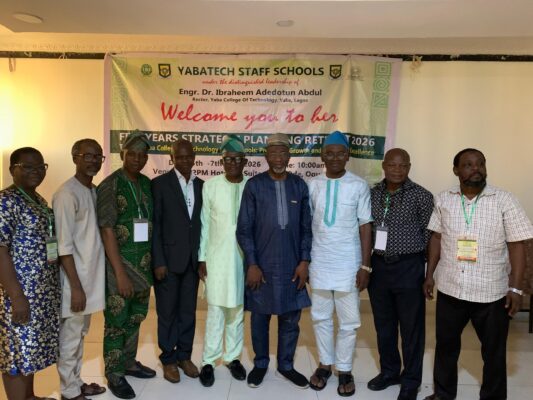
Ibraheem Abdul, the rector at Yaba College of Technology (YABATECH), has outlined a comprehensive reform plan for the institution’s staff schools, placing strong emphasis on strategic planning, institutional sustainability, and a renewed culture of academic excellence.
Abdul made this known while declaring open the 2026 retreat programme of YABATECH staff schools at Ijebu Ode in Ogun State; themed, “Yaba College of Technology Staff Schools: Prospects, Growth and Academic Excellence,” which brought together members of the board of governors, school administrators, and staff to develop a five-year strategic plan that will guide operations from 2026 to 2030.
The rector stressed that the staff schools remain a vital component of the college’s ecosystem, serving as the foundation for nurturing disciplined, academically sound, and morally upright individuals.
“The schools represent the first point of engagement for many young learners with the YABATECH brand, making their quality and standards a matter of institutional priority,” he said.
Abdul charged participants to approach the retreat with a sense of urgency and purpose, noting that the exercise goes beyond routine deliberations to shaping the future of the schools.
Read also: Global Investment Shifts as Sports and Entertainment Converge in Emerging Gaming Markets
“This retreat is not just about discussions; it is about making decisions that will define the trajectory of our staff schools over the next five years. We must think boldly, plan practically, and commit to implementation,” he said.
Besides, he identified key reform priorities to include strengthening financial systems for sustainability, expanding student enrolment, improving internally generated revenue (IGR), and enhancing leadership and administrative efficiency across the schools.
The rector further emphasised the strategic integration of vision, people, and processes, calling for synergy among stakeholders to ensure that policies are effectively translated into measurable outcomes.
“Over the course of the retreat, participants are expected to engage in intensive sessions covering school finance and sustainable growth, leadership and conflict management, and the alignment of institutional goals with operational realities,” he emphasised.
Abdul urged participants to fully engage in the discussions and contribute meaningfully to the development of practical and achievable strategies that would reposition the schools within Nigeria’s competitive education landscape.
“Let this retreat mark the beginning of renewed dedication to building stronger, more resilient schools that will continue to uphold the values and legacy of Yaba College of Technology,” he stated.
Abiodun Ashiru, the chairman of the board of governors, described the retreat as a deliberate effort to institutionalise forward-looking policies that recognise staff as central stakeholders in the education ecosystem.
Ashiru noted that evolving global standards in education demand continuous capacity building, digital adaptation, and a supportive work environment that enables teachers and administrators to perform optimally.
Read also: Why global startups struggle to scale after entering Nigeria – Itana CEO
“Strategic planning must reflect the realities of those who implement it. Our teachers and school leaders require not just direction, but support systems, clear policies, and opportunities for professional advancement,” Ashiru said.
The retreat featured policy-driven sessions focusing on leadership accountability, conflict management, and performance evaluation systems designed to promote fairness and transparency. Participants examined how institutional policies could better support staff retention, motivation, and overall wellbeing.
Through a series of structured workshops, participants developed actionable frameworks addressing critical areas such as staff training and retraining, performance-based evaluation systems, and the establishment of measurable Key Performance Indicators (KPIs) tied to both institutional goals and staff development.
A key outcome of the retreat was the consensus that staff welfare must go beyond remuneration to include continuous professional development, inclusive decision-making, improved communication channels, and a conducive work environment.
Participants noted that empowering staff through clear policies and structured support systems would enhance accountability, improve teaching quality, and ultimately lead to better student outcomes.
Education facilitators at the retreat further emphasised the need for a culture of excellence built on trust, collaboration, and shared responsibility, where staff are not only implementers of policy but active contributors to institutional growth.

Join BusinessDay whatsapp Channel, to stay up to date
Open In Whatsapp