Education serves as the primary growth engine for global mobility and human capital development. Yet, the federal government’s recent move to increase registration fees for the West African Examinations Council (WAEC) and the National Examinations Council (NECO) examinations reveals a troubling disconnect between policy formulation and the socioeconomic realities facing ordinary Nigerians.
Although the administration swiftly suspended the planned hike of the secondary school examination fees following fierce public backlash, the mere existence of the proposal raises fundamental questions about the government’s approach to basic education. Policy analysts argue that floating such a regressive pricing strategy during a severe cost-of-living crisis indicates a flawed advisory framework that ignores both domestic economic distress and global human capital trends.
“Whoever is advising this administration to take this line of action is an enemy to education,” Stanley Alaubi, senior lecturer at the University of Port Harcourt, said.
“My advice to the federal government is that education should be subsidised. All over the world, governments help the citizens by subsidising goods and services that are unreachable to the masses. Nigeria government should follow suit,” he added.
He emphasised that this should not have been considered a policy while the country is battling with the out-of-school crisis.
Under the aborted framework, NECO’s internal examination fee would have surged 67 percent from N30,000 to N50,000, while WAEC’s fee was slated for a staggering 85 percent jump from N27,000 to N50,000.
Attempting to enforce a N50,000 examination levy in an economy where the newly negotiated minimum wage sits at just N70,000 is a huge burden for millions of households. Surging consumer prices have already decimated purchasing power, forcing families to drastically shrink their basket sizes and prioritise basic survival over long-term investments like education.
Nubi Achebi, director of academic planning at Nigerian University of Technology and Management (NUTM), describes the suspension as a good step, but warns against reverting policy later.
“It’s good the government is changing course because of backlash. Unfortunately, the government is jumping steps in policy formulation – consultation.
“I hope the policy pullback is not temporary; it should be permanent,” he said.
The World Bank report on Nigeria’s Human Capital Index (HCI) indicates that a child born in Nigeria in 2020 will likely grow up to achieve only 36 percent of the productivity they could have achieved with quality education and full health.
Nigeria’s inadequate investment in human capital development is demonstrated in the fact that while countries such as Ghana, Egypt, Algeria, Tunisia, Morocco, Mauritius, and Botswana heavily subsidise or officially waive tuition fees up to tertiary institutions for domestic citizens, Nigeria is busy going to and fro over a secondary school examination fee hike.
Ghana, for instance, launched the ‘No-Fees-Stress’ policy, fully covering academic fees for first-year students in public tertiary institutions.
Besides, the government introduced a free tertiary education initiative for persons with disabilities and is expanding free special needs education from kindergarten to the tertiary level.
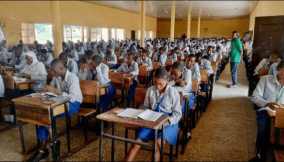
A UNICEF report published in 2024 revealed that Nigeria has the highest tally of out-of-school debacle globally.
The report stated that no fewer than 10.2 million children are not in school at the primary level, while 8.1 million others are similarly absent at the junior secondary school level. The dataset noted that 66 percent of this huge figure is from the North-West and North-East geopolitical regions.
Jessica Ousere, chief executive officer at RubiesHub Educational Services, said the suspension of the proposed WAEC and NECO fee increase is a welcome decision.
“It gives credence to the fact that this government never thinks anything through; they just jump out with policies without consultation with parents, students, educators, school proprietors, examination bodies and other stakeholders to arrive at a fair, transparent and evidence-based decision,” she said.
Osuere emphasised the need for the government to explain the factors driving the proposed increase and explore ways to improve efficiency before transferring additional costs to poor families.
Stanley Boroh, an associate professor at the Federal University, Otuoke, described the initial plan to increase the fees as sad because, according to him, President Bola Tinubu, while he was Lagos State governor, made WAEC free.
Stakeholders are worried that many students from indigent families may not be able to afford secondary education with the minimum wage at N70,000. This is in addition to low purchasing power forcing households to spend a larger share of their income on necessities like food, transportation, and healthcare.
According to S&P Global, higher consumer prices could weaken household spending and dampen overall economic growth despite the economy’s expected resilience.
The agency made this known in its latest assessment, ‘Economic Outlook Emerging Markets Q3 2026: Inflationary Pressures Will Persist.’ It also lowered Nigeria’s gross domestic product (GDP) growth forecasts for 2026 and 2027 by 30 basis points each to 3.7 percent and 3.5 percent, respectively.

Join BusinessDay whatsapp Channel, to stay up to date
Open In Whatsapp