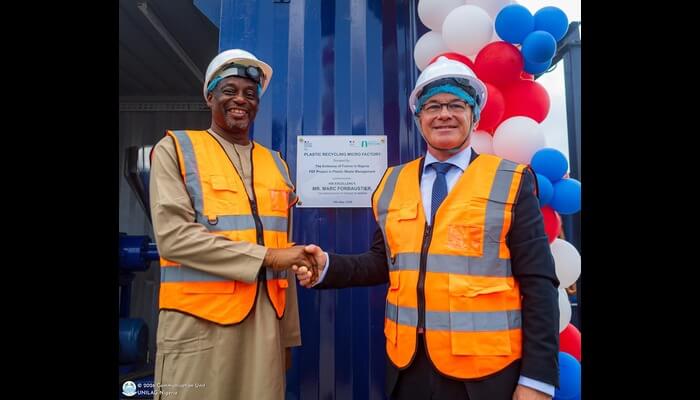
The University of Lagos (UNILAG) has commissioned a French embassy-backed micro-plastic recycling plant aimed at promoting environmental sustainability and advancing innovative waste management solutions.
Folasade Ogunsola, the vice-chancellor at UNILAG, represented by Afolabi Lesi, the deputy vice-chancellor in charge of development services, speaking at the unveiling ceremony held on Wednesday, said the facility is a practical demonstration of the institution’s shared belief that universities are not only centres of learning, but also engines for innovative solutions that address pressing environmental and societal challenges.
Ogunsola emphasised that the project is a symbol of the deepening collaboration between the French Embassy and the University of Lagos.
“It reinforces our institutional vision of fostering meaningful international partnerships that advance research, innovation, sustainability, and development,” she said.
The vice-chancellor explained that on June 14, 2024, the French Embassy, through its cooperation and cultural department, launched a comprehensive plastic waste management initiative under the French Embassy Fund (FEF).
“With a total project value of €753,000, the initiative strategically engages 13 Nigerian universities committed to promoting sustainable environmental practices on their campuses.
“I am particularly proud that the University of Lagos emerged as one of the two universities selected to co-design and host this innovative micro-plant facility,” she disclosed.
Besides, she noted that the timing of the initiative is highly significant, and that with the university generating an average of 32.4 tonnes of solid waste daily, plastic pollution remains both a local and global environmental challenge that demands urgent and innovative interventions.
Bola Oboh, the project coordinator for the micro-plastic plant, said that through continuous inclusive and innovative approaches to waste and environmental management, the University of Lagos has demonstrated strong leadership and community commitment towards transforming waste into valuable resources.
“As a university committed to research, innovation and social impact, UNILAG recognised the need to move beyond awareness campaigns into practical, scalable and sustainable solutions.
“Over the years, the university has developed and implemented a strategic waste management framework that has introduced several impactful initiatives, including the UNILAG Sustainability Challenge, refresher waste management orientation programmes, Green Eco Hubs and other environmental sustainability projects,” she said.
Oboh, who is the immediate past deputy vice-chancellor in charge of academics and research at UNILAG, emphasised that it was the collective efforts that have positioned UNILAG for the milestone achievement.
“Through the generous support of the French Embassy Fund and the technical collaboration of Plastic Odyssey, UNILAG was selected as one of only two universities in Nigeria to host this innovative recycling micro-plant.
“We are deeply grateful for this partnership and shared vision for a cleaner and more sustainable future. This facility is more than just a recycling plant; it is a symbol of innovation, sustainability and community impact,” she said.
Besides, he said that the plant will transform plastic waste generated within and beyond our campus into valuable products such as tiles, planks and school furniture.
“In doing so, we are not only reducing environmental pollution but also creating social and economic value for underserved communities. Importantly, this project aligns with the third phase of UNILAG’s Zero Waste Strategy.
“From awareness campaigns and recycling hubs across campus to strengthened waste collection systems, the university has progressively built a framework that now allows us to close the loop by converting waste into useful products directly on campus,” he said.
Moreover, he said that the project further demonstrates that waste is not merely an environmental burden but a resource capable of creating jobs, supporting education and driving community development.
“By converting recycled plastics into durable school furniture, we hope to contribute meaningfully to improving learning environments for children in less-privileged communities while promoting circular economy practices,” she noted.

Join BusinessDay whatsapp Channel, to stay up to date
Open In Whatsapp