


Transnational Corporation Plc (Transcorp) reported a profit after tax of N54.37 billion for the first half of 2026, underscoring the resilience of its diversified business model despite weaker revenues, largely caused by operational challenges in Nigeria’s power sector.
The conglomerate’s earnings were supported by lower financing costs, tighter cost management, and improved operating efficiency across its businesses, despite gas supply disruptions and grid constraints affecting electricity generation.
The group’s profit after tax declined 16.6 percent from N65.17 billion recorded in the corresponding period of 2025, while profit before tax fell to N75.88 billion from N85.70 billion a year earlier. Revenue also declined 13.4 percent to N241.53 billion, reflecting lower electricity output from its power subsidiaries, which remain the group’s largest earnings contributor.
Despite the decline in top-line performance, Transcorp improved the quality of its earnings by reducing costs across several expense lines.
Cost of sales declined to N131.79 billion from N148.76 billion, while administrative expenses fell by nearly 13 percent to N30.81 billion from N35.32 billion. Finance costs more than halved to N6.41 billion from N14.16 billion, significantly easing pressure on earnings. The group also recorded a N2.77 billion foreign exchange gain on financing activities compared with a N1.36 billion loss in the previous year, further supporting profitability.
These improvements lifted operating efficiency even as revenue contracted. Gross profit remained above N109 billion, while operating profit stood at N81.55 billion, demonstrating the company’s ability to preserve margins through disciplined cost optimisation.
The company said the results reflected operational discipline rather than favourable market conditions.
According to a statement by the company, Nigeria’s power sector continued to face gas supply shortages and transmission infrastructure constraints, resulting in lower electricity supply across the country. Nevertheless, management said disciplined cost management and operational efficiency enabled the group to maintain resilient profitability while strengthening its balance sheet. Owen Omogiafo, president and group chief executive officer, said the group remained focused on creating value despite the difficult operating environment.
She noted that “Despite disruptions to power transmission infrastructure and a challenging macroeconomic environment, Transcorp delivered a strong profit and an even stronger balance sheet, a reflection of our operational discipline and efficiency.”
She added that Transcorp continued to invest in sectors critical to Nigeria’s development, including power and hospitality, while working with strategic partners to improve electricity delivery despite grid limitations.
Power business remains the earnings engine
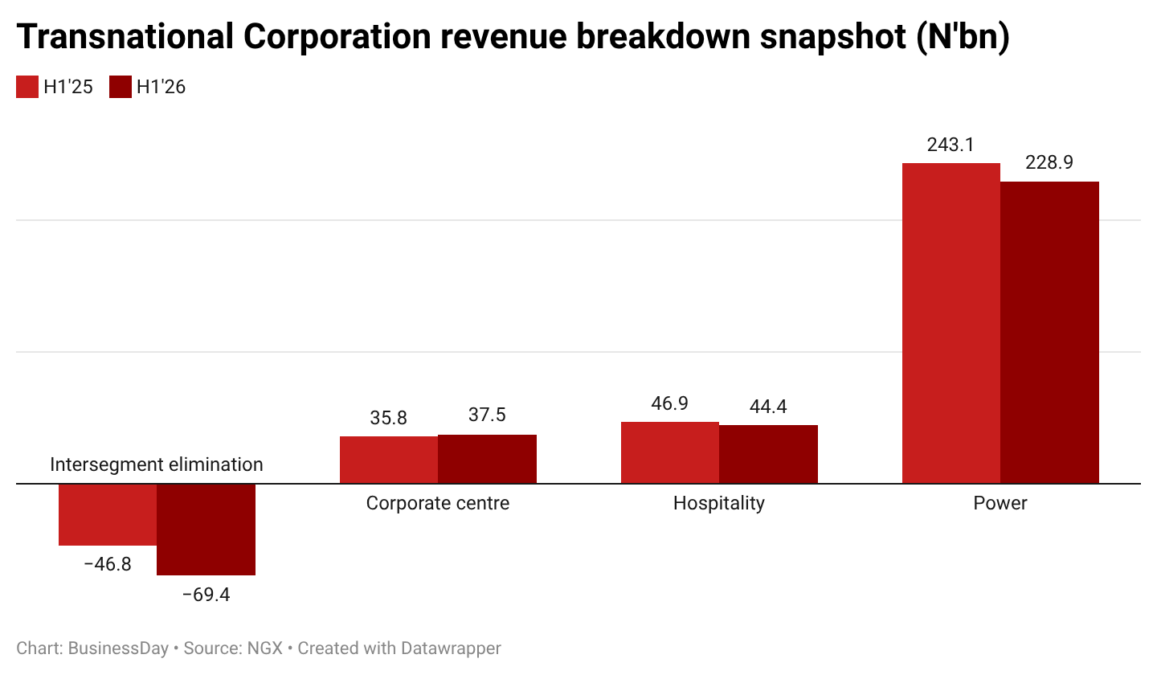
Segment reporting showed that the power business remained Transcorp’s dominant contributor, generating N228.96 billion in revenue during the half year, representing about 95 percent of consolidated segment revenue before inter-company eliminations.
Hospitality generated N44.43 billion, while the energy business remains in its development phase without commercial revenue. Agro-allied operations also made no meaningful revenue contribution during the period.
The breakdown illustrates how heavily the group still depends on electricity generation for earnings, making sector-wide operational challenges immediately visible in its consolidated financial performance.
Revenue analysis further showed that electricity sales remained the largest income source, with energy sent out contributing N150.59 billion, while capacity charges generated N46.50 billion. Hospitality revenue was led by room income of N30.33 billion and food and beverage sales of N11.78 billion, highlighting the continued resilience of Transcorp Hotels despite softer consumer spending.
Hospitality offsets pressure from power
Management said the hospitality business continued to innovate and maximise its assets despite the difficult macroeconomic environment.
The company highlighted the performance of the Transcorp Hilton Abuja and the 5,000-capacity Transcorp Centre, which continued attracting business conferences and events, helping support earnings while the power business navigated supply constraints.
Festus Izevbizua, Group Chief Finance Officer, said the diversified structure of the business helped cushion the impact of lower electricity output.
According to him, although revenue declined because of industry-wide infrastructure challenges, the group’s profit-before-tax margin improved to 31.4 percent from 30.7 percent due to cost optimisation. He also disclosed that the hospitality business recorded 21 percent growth in profit after tax, providing additional support for group earnings during the period.
Stronger balance sheet despite higher borrowings
Beyond earnings, Transcorp ended the half-year with a stronger financial position.
Total equity rose to N367.84 billion from N353.39 billion at the end of December 2025 as retained earnings increased to N197.78 billion. Total assets expanded almost 10 percent to N1.10 trillion, driven largely by higher trade receivables and investment growth.
Read also: Guinness Nigeria to pay N7 dividend as half-year profit rises to N25.3bn
Long-term borrowings, however, increased sharply to N106.62 billion from N35.18 billion, reflecting fresh financing obtained during the period. Nevertheless, short-term borrowings fell substantially to N10.04 billion from N40.28 billion, suggesting a shift toward longer-tenor funding. Overall, finance costs still declined significantly because of lower interest expenses and improved financing efficiency.
Cash and cash equivalents stood at N20.76 billion, broadly stable compared with N21.88 billion at year-end despite dividend payments, capital expenditure and debt repayments during the period.
Interim dividend signals confidence
Although earnings moderated from last year’s performance, the board declared an interim dividend of Forty Kobo (40 kobo) per ordinary share, subject to appropriate withholding tax deduction, and approval will be paid to shareholders whose names appear in the Register of Members as at the close of business on Thursday, July 23, 2026.

Join BusinessDay whatsapp Channel, to stay up to date
Open In Whatsapp


