


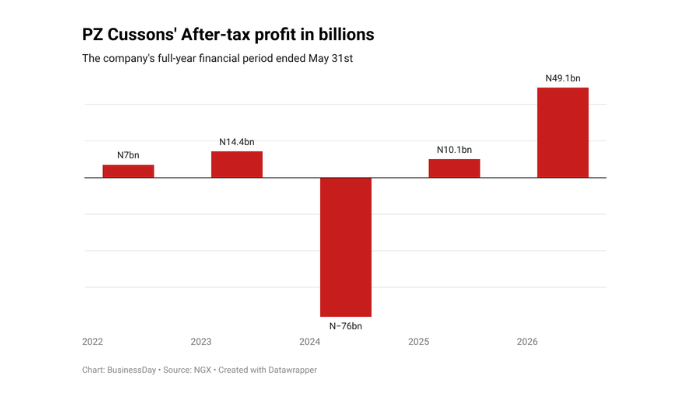
In the financial year ended May 31, 2026, PZ Cussons Nigeria Plc delivered one of its strongest performances in five years, underscoring how disciplined capital allocation, operational efficiency, and a recovery in consumer demand can restore profitability even in a challenging operating environment.
The maker of household and personal care brands, including Imperial Leather, Carex, Cussons Baby, Morning Fresh, Premier Cool, and Canoe, grew revenue to N260.4 billion, a 22.5 percent increase from N212.6 billion in the same period of 2025 and a 161.7 percent jump from N99.5 billion recorded in May 2022.
After-tax profit rose almost fivefold to N49.1 billion in the financial year ended May 2026 from N10.1 billion a year earlier, marking a dramatic turnaround from the N76 billion loss reported in 2024 when the naira devaluation triggered massive foreign exchange losses across corporate Nigeria.
According to the company, revenue growth was driven by a healthy combination of higher sales volumes and pricing initiatives.
“The business grew volumes in both the electrical and consumer business, leveraging investment in our brands and sharpening our route-to-market capabilities. The result has been market share gains by our major brands and increased household penetration,” it said in a notice signed by Oghenekevwe Ogefere, the company’s secretary
The earnings have also been rewarded by investors. PZ Cussons’ share price has surged 103 percent year-to-date, rising from N44.30 at the beginning of 2026 to N90 at the close of trading on July 3, outperforming many consumer goods stocks on the Nigerian Exchange. The company now commands a market capitalisation of about N357 billion, making it the 39th most valuable listed company on the NGX.
The performance also comes as Nigeria’s consumer goods sector gradually recovers from one of its toughest periods in decades. After absorbing the impact of currency devaluation, soaring inflation, rising energy costs, and weaker consumer purchasing power in 2024, manufacturers have increasingly focused on cost efficiency, local sourcing, and stronger distribution networks to restore margins.
Several listed consumer goods firms have returned to profitability in 2026 as foreign exchange pressures ease and pricing strategies begin to offset higher operating costs.
Make yearly capital investments
One striking feature of PZ Cussons’ recovery is that it continued investing throughout the difficult years rather than scaling back expansion.
Capital expenditure increased steadily from N725 million in 2022 to N911 million in 2023 before jumping to N2.95 billion in 2024. The company further increased investment to N4.99 billion in 2025 and N5.07 billion in 2026.
In five years, annual capital investment grew by almost 600 percent, providing additional manufacturing capacity, improving operational efficiency, and strengthening its route-to-market strategy. Those investments coincided with consistent revenue growth every single year, even during periods of macroeconomic uncertainty.
The FX story changed everything
The biggest swing in the company’s fortunes came from foreign exchange.
PZ Cussons recorded foreign exchange losses of N4.15 billion in 2022 and N4.93 billion in 2023 before the naira devaluation pushed FX losses to a staggering N157.9 billion in 2024. Those losses completely erased operating gains and forced the company into a N76 billion net loss.
As exchange-rate volatility eased, the pressure reduced significantly. FX losses narrowed to N7.7 billion in 2025 before the company reported an N11.8 billion foreign exchange gain in 2026.
The swing from an N157.9 billion loss to an N11.8 billion gain, a movement of almost N170 billion within two years, was one of the biggest contributors to the company’s return to profitability.
Resilience rewarded shareholders
PZ Cussons’ five-year performance mirrors the evolution of Nigeria’s consumer goods sector.
The company returned to positive equity after two years of losses. In the financial year ended May 2026, PZ Cussons reported N70.5 billion, compared to a negative of N17.3 billion in the same period of 2025.
Despite total assets declining to N161 billion from N169 billion, liabilities also fell to N89 billion from N185 billion during the period surveyed.
The statement added that the balance sheet was further de-leveraged and strengthened through a cash-accretive P&L and efficient working capital management.
“The impact has been the improvement in net asset position from negative N17.3 billion at the beginning of the year to N70.6 billion at year-end. The Board is confident that despite geopolitical uncertainties and their attendant economic shocks, the business is sufficiently resourced with strong brands, an adaptive operating framework, and a culture of disciplined execution that supports the consistent delivery of value to stakeholders,” it said.

Join BusinessDay whatsapp Channel, to stay up to date
Open In Whatsapp


