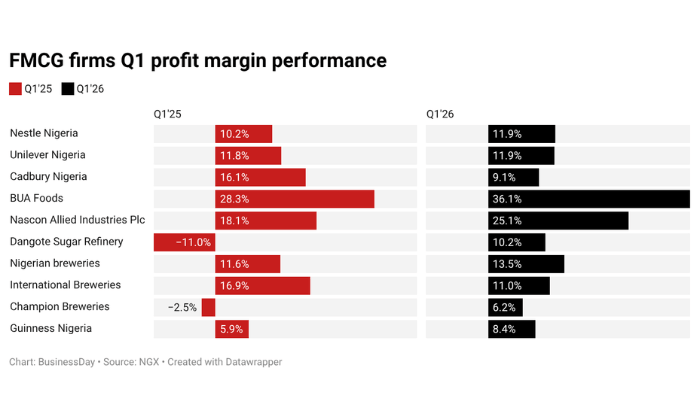
Nigeria’s fast-moving consumer goods (FMCG) companies are making more profit from every naira they earn, signalling that aggressive cost controls, price increases, and operational efficiencies are beginning to outweigh the impact of weak consumer demand.
An analysis by BusinessDay of 10 listed consumer goods companies shows that their combined profit margin expanded to 17.32 percent in the first quarter of 2026, from 13.15 percent in the corresponding period of 2025.
Profit margin measures how much profit a company keeps from every naira of revenue after all expenses have been paid.
The improvement came even as combined revenue was flat, inching up by less than one percent to N1.78 trillion from N1.76 trillion over the period.
Combined profit after tax jumped 32.9 percent to N307.5 billion, from N231.4 billion a year earlier, indicating companies generated substantially higher earnings without relying on strong top-line growth.
The numbers suggest the sector has entered a new phase where profitability is being driven less by volume growth and more by pricing discipline, efficiency gains, and easing production costs following Nigeria’s macroeconomic reforms.
Companies that expanded margins the most included BUA Foods, whose profit margin rose to 36.06 percent from 28.32 percent, making it the most profitable company in the sector by margin. Nascon Allied Industries improved its margin to 25.14 percent from 18.11 percent, while Nestlé Nigeria increased its margin to 11.93 percent from 10.21 percent despite continued pressure on household purchasing power.
One of the biggest turnarounds came from Dangote Sugar Refinery, which moved from a negative margin of 11.03 percent in the first quarter of 2025 to a positive 10.18 percent this year after returning to profitability.
Among brewers, Nigerian Breweries improved its margin to 13.54 percent from 11.60 percent, while Guinness Nigeria strengthened profitability to 8.39 percent from 5.93 percent. Champion Breweries also returned to profit, recording a 6.16 percent margin after posting losses a year earlier.
Not every company benefited from the trend. Cadbury Nigeria’s profit margin fell to 9.12 percent from 16.05 percent, while International Breweries saw profitability weaken to 10.97 percent from 16.88 percent, reflecting continued cost pressures and competitive pricing within the beverage segment.
The stronger profitability comes after two years of intense restructuring across Nigeria’s consumer goods industry. Companies have redesigned product sizes, increased prices, localized sourcing, renegotiated supplier contracts, and invested in more efficient production processes to protect earnings against inflation, currency depreciation, and elevated borrowing costs.
The operating environment has also become relatively more predictable. Inflation has moderated from the peaks recorded in 2024 and 2025, while foreign exchange volatility has eased following reforms in the currency market.
Manufacturers are now able to plan production more efficiently and reduce the large foreign exchange losses that severely eroded earnings over the past two years.
The NESG’s Current Business Performance Index rose to 104.6 points in May 2026 from 102.1 points in April 2026, indicating continued expansion across the economy. While the reading was stronger month-on-month, it remained below the 109.8 points recorded in May 2025, suggesting that businesses are still operating below the levels seen a year ago.
The most significant development was the return of manufacturing to expansion territory. The sector’s performance index increased to 114.1 points in May from 98.7 points in April, marking one of the strongest improvements among all sectors surveyed.
According to the report, subsectors including food, beverages, and tobacco; textiles, apparel, and footwear; pulp and paper products; and basic metals recorded particularly strong gains.
For investors and policymakers, the manufacturing rebound is noteworthy because it signals improving domestic demand in Africa’s most populous economy.

Join BusinessDay whatsapp Channel, to stay up to date
Open In Whatsapp