It is obvious that Nigeria needs to broaden its tax base to enable it finance the much desired infrastructure development that is broadly lacking in the country.
Nigeria’s tax revenue as a percentage of GDP fell to 12 percent after the recent rebasing exercise, which is one of the lowest in Africa as well as for a country of its economic size.
The Federal Government’s revenue as a percentage of GDP also fell to 4.6 percent from 8.7 percent previously.
This compares with Kenya and South Africa where total government revenues as a percentage of GDP were equivalent to 26 percent and 28.3 percent respectively for yearend 2012, according to IMF data.
The Nigerian government can use tax revenue to diversify the economy and stimulate economic growth rather than relying solely on proceeds from oil revenue or increasingly issuing new debt, which is unsustainable in the long term.
Standard & Poor’s(S & P) recently placed Nigeria’s credit rating on negative outlook, on heightened political risks and oil theft and pipeline shutdowns which cost the country $12 billion last year.
Source: CBN, FBN Capital
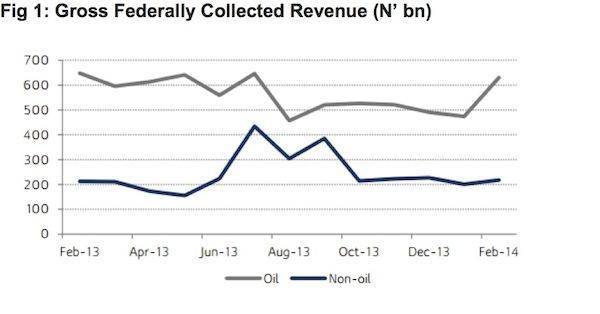
The FG gets 70 percent of its budget from oil earnings, and only about 30 percent from non-oil taxes. In 2013 non-oil revenue collections amounted to a low 3.6 percent of GDP.
The tax administrator (FIRS) reported a shortfall in collections from the non-oil sector in the first quarter of 2014, where it collected a total of N418 billion against a target of N558 billion.
Nigeria’s current tax laws, characterised by multiple and inefficient taxation often discourages local trade and investment, increases the cost of doing business and gives a negative perception of the Nigerian business environment to foreign investors, Finance Minister Ngozi Okonjo-Iweala Minister, said recently.
Nigeria needs to simplify its tax codes, get rid of exemptions and waivers, and ultimately begin the process to capture more individuals as federal income tax payers.
A cut in the corporate tax rate, to say 20 percent may help to encourage more companies to voluntarily file tax returns, as well as to give a boost to the economy in the process.
The few Nigerian companies that pay taxes who are often targets of multiple- taxation are beginning to push back.
Sunil Mittal, the chairman of Bharti Airtel, recently said Nigerian taxes are very high and telecommunications companies are unfairly taxed in the country.
On a positive note for improving the countries tax ratio’s two big Nigerian firms will this year pay more taxes as their tax waivers expire.
Dangote Cement, Nigeria’s largest company by market value, paid N5.39 billion in taxes in the first quarter of 2014, compared with a tax credit of N51.32 million in the prior period of 2013.
In the same vein, Nigeria Liquefied Natural Gas (NLNG), plc will this year pay more income tax than any corporate entity in Nigeria and Sub-Sahara Africa, according to the firm on expired tax credits.

Join BusinessDay whatsapp Channel, to stay up to date
Open In Whatsapp