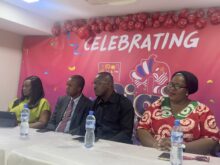
Eruani Azibapu Godbless is a medical doctor, but his profession has not, in any way, limited him from steeping into wealth. Godbless is the founder of Azikel Group, a conglomerate with investment interests in dredging, aviation, power, and crude oil refinery, among others.
In this interview with ODINAKA ANUDU, he shares his experience as an entrepreneur and how he hopes to meet certain societal needs through his solutions, especially with his refinery commencing operations later this year.
Give us an insight into how you became an entrepreneur despite being trained as a medical doctor.
I started life as a child in my village, a remote village in Ogbia Local Government in Bayelsa State. The village is called Emadike. As a child, I grew up seeing what my father did and I learnt a whole lot from my father, both in leadership and in business. I actually saw the art of business from my father. My mother was also a trader. She traded well and part of the proceeds of that trade was used in sending me to secondary school.
After growing up in the village, I went to the University of Port Harcourt in a quest to become a medical doctor. It came a time when my father had some business challenges and he couldn’t cope with a lot of financial obligations. This led me into all sort of legal jobs in the university.
I became a doctor, enjoyed my medical practice and i decided to do a special training in surgery at the University of Port-Harcourt Teaching hospital. I later moved on to the United States, specialising in a family medicine. I became a member of the American Academic Pharmacy & Physicians, after which I returned to Nigeria and had a wholesome interesting medical practice. I also worked in Nigerian Agip Oil Company as well as with some revered politicians. Thereafter, I became a commissioner. After working in the ministry of health in my early medical days, I became an adviser to the then governor who became president of Nigeria after I had left the oil company. I was a special adviser on HIV/AIDS in the country. So, when he left to become a president, and a new governor came on, the governor was quite very close to me and he wanted to make advances in the medical sector and I took that challenge and tried to change the nature of medical practices back in Bayelsa and in Nigeria as well. And after going through all of these careers from civil service to oil and gas and then to the political space, I decided to become an entrepreneur.
Considering the transition from civil service to entrepreneurship, how did you manage to scale through the hurdles?
One of the hurdles I had to overcome while doing the dredging business was to convince people that we have the best sand despite controlling some market share. After our technical partners left, we had to go out of our comfort zone to hire machines to remain in operations. We saw an opportunity, identified and dissected it by looking at our systems vis-à-vis the future of Bayelsa, the Niger-Delta and the demand for sand, and we knew that we can play this when we maximise our machinery and available human resources. Having study that there is a huge potential here, we decided to invest in our first dredging machine. When we got that machine, we realised that we could outplay everybody, because everybody was playing small. We knew the demand of sand in Yenagoa.
Yenagoa, in its dire infrastructural time, consumes more than a million cubits of sand a month. That is N1 billion. And as at the time we started, we could produce about 1 million cubits of sand in 40 days. So, if I can make a billion naira in 40 days, that was a lot of money back then in 2005 or 2006. Not many people knew that.
Azikel dredging business has impacted a whole lot on the Bayelsa economy and that of the Niger/Delta. We have provided employment to the people in the region and in Bayelsa. Azikel dredging is one of the biggest tax paying companies in Bayelsa State and in the Niger delta. We have re-engineered the economy of Bayelsa state. We have also taken on huge infrastructural development critical to Bayelsa state and the region.
There have been challenges with refining crude oil in the country despite many people having marginal oil fields. What do you hope to do differently to change the narrative?
The question is, why has the rest of the world succeeded and Nigerians failed? If the rest of the world succeeded, I do not see any reason why we should fail. The refined products we use in Nigeria today come all the way from far India, Brazil, and Europe. We sell our crude oil to Brazil, India and china, they refine it and sell it back to us. There is no reason why we should fail. Over time, we have noticed that government businesses are really not done with the best private sector-driven rules and that is why the refineries operate in a civil service pattern.
Azikel Refinery, which is a full hydro-scheming plant, is going to be the best hydro scheming plant that will commence operation in Nigeria. We are operating this refinery in line with best international best practices. And the scenario here is this, we are selling the refined products to Nigerians. The market is available here. We are buying the crude oil from the same Nigerian market. There is not going to be freight charge on the crude oil, so the economy of freight is already going to come to us.
When should Nigerians expect your refinery to commence operations?
In terms of commissioning and operation, we are looking at late 2018 or early 2019. But in the worst scenario, we are coming on stream in 2019. But this is a very dynamic process; it takes a whole lot. It is draining all the staff and they are also ready for this ride and we are very excited seeing the progress that we have achieved so far.

Join BusinessDay whatsapp Channel, to stay up to date
Open In Whatsapp