


Conoil Plc delivered a strong first-quarter performance in 2026, reporting a profit after tax of N3.90 billion, representing an increase of 1,235.3 percent from N292.1 million recorded in the corresponding period of 2025.
According to the company’s Q1 financial report, strong earnings growth was achieved despite a decline in revenue, reflecting significant improvements in cost management and operating efficiency.
The petroleum products marketer generated revenue of N71.45 billion during the quarter, down 9.8 percent from N79.26 billion reported a year earlier. While the decline in turnover may suggest softer sales volumes or pricing pressures within the downstream oil sector, the company more than compensated through stronger gross margins.
Read also: Conoil reports weakest profit in five years on rising finance costs
Cost of sales fell by 17.7 percent to N60.84 billion from N73.94 billion, substantially outpacing the drop in revenue. As a result, gross profit doubled to N10.61 billion from N5.32 billion in the prior-year period.
The improvement in profitability was driven primarily by the company’s ability to procure and manage inventory more efficiently, resulting in a wider gross profit margin. Gross margin rose to approximately 14.9 percent from 6.7 percent in the previous year, highlighting stronger pricing discipline and cost control in a challenging operating environment.
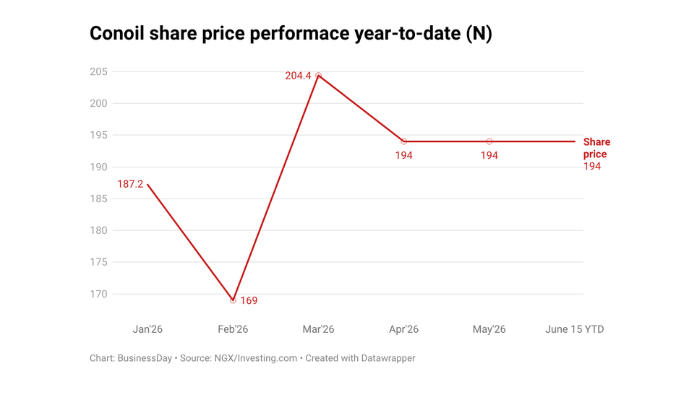
The share price of the company began trading at N187.2 on January 2 and is currently trading at N194, gaining over 3.63 percent on that price valuation, ranking it 92nd on the NGX in terms of year-to-date performance, which indicates investor appetite for the company’s stock.
Further analysis of the financial statement shows that the company’s operating expenses presented a mixed picture. Distribution expenses declined significantly by 55.8 percent to N527.3 million from N1.19 billion, helping to support earnings growth. However, administrative expenses increased by 21.6% to N1.78 billion from N1.46 billion, reflecting higher overhead costs.
Finance costs also rose sharply to N4.10 billion from N2.29 billion, underscoring the burden of borrowing costs amid elevated interest rate conditions. Despite this increase, the company generated a profit before tax of N4.20 billion, representing a 1,029.7 percent increase from N372 million recorded in the first quarter of 2025. Tax expense rose to N303.4 million, leaving net profit at N3.90 billion. Earnings per share consequently climbed to 562 kobo from 42 kobo a year earlier.
On the balance sheet, Conoil maintained a solid capital position. Shareholders’ funds increased by 9.9 percent to N43.14 billion from N39.24 billion at the end of December 2025, driven entirely by retained earnings generated during the quarter. Retained earnings rose to N38.97 billion from N35.07 billion, reflecting the strong profitability achieved during the period.
Total assets stood at N137.91 billion, slightly lower than the N139.37 billion reported at year-end 2025. The composition of assets, however, changed significantly. Inventories declined by 41.9 percent to N13.00 billion from N22.39 billion, suggesting stronger inventory turnover and product sales.
Meanwhile, trade and other receivables increased by 9.9 percent to N99.52 billion from N90.59 billion, indicating that a larger proportion of sales were made on credit. Cash and bank balances decreased modestly to N12.30 billion from N12.91 billion.
Read also: Conoil sustains growth trajectory, reassures investors with N2.43bn dividend
The liability profile improved during the quarter. Total liabilities fell by 5.3 percent to N94.77 billion from N100.13 billion at the end of 2025. Short-term borrowings reduced slightly to N53.96 billion from N54.90 billion, while trade and other payables declined by more than N4.3 billion to N36.48 billion. The reduction in obligations helped strengthen the company’s equity ratio and overall financial position.
Cash flow performance also improved considerably. Net cash generated from operating activities rose to N4.43 billion compared with just N269.6 million in the previous year.
This was largely driven by the substantial reduction in inventory holdings, which released N9.39 billion in working capital. However, the benefit was partly offset by an N8.92 billion increase in receivables, reflecting extended customer credit.
Financing activities consumed N4.10 billion, mainly due to interest payments, while no major capital expenditure was recorded during the quarter. Consequently, the company reported a modest positive net cash inflow of N326.1 million.
The company has a market value of N135 billion.

Join BusinessDay whatsapp Channel, to stay up to date
Open In Whatsapp


