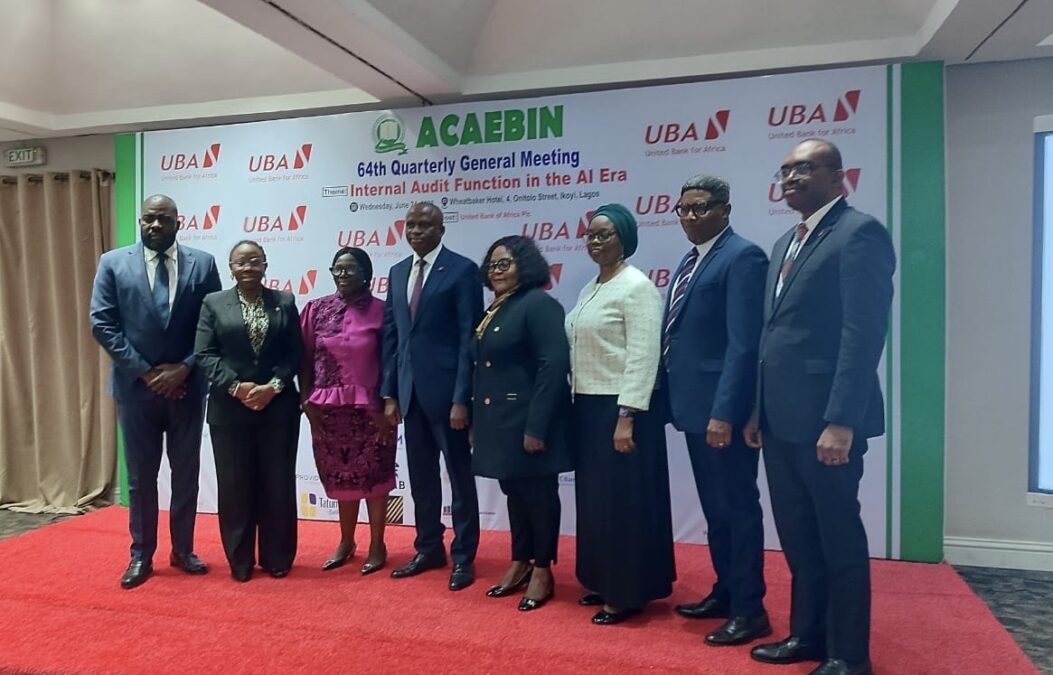
Nigerian banks are facing a new generation of risks as artificial intelligence (AI) becomes increasingly embedded in lending, customer service and operational processes, prompting calls for stronger governance, continuous auditing and board-level oversight.
Industry leaders who spoke at the 64th Quarterly General Meeting of the Association of Chief Audit Executives of Banks in Nigeria (ACAEBIN) under the theme, ‘Internal Audit Function in the AI Era,’ said traditional audit methods are no longer sufficient to manage the rapidly evolving risks associated with AI adoption in the financial sector.
The meeting, which brought together players from different sectors of the economy, including Fast Moving Consumer Goods, banking, and finance, was held in Lagos on Wednesday.
Chioma Obaru, partner at PwC, said AI has become a core component of banking operations, with virtually all Tier-1 banks already deploying the technology through chatbots, automated loan approvals and customer analytics.
According to her, advances in AI have enabled banks to approve loans within minutes based on customers’ behavioural patterns, a process that previously took days or weeks.
“That is the power of AI,” Obaru said. “The question now is how do we ensure that in adopting these technologies, we are not exposing our organisations to cyber threats, governance failures and other emerging risks.”
She identified governance risk, data risk, model risk, cybersecurity risk, third-party risk and compliance risk among the major challenges facing banks in the AI era.
Of particular concern is what she described as “model drift”, a situation where sudden economic or geopolitical developments render AI models and assumptions inaccurate.
Using the recent tensions involving the United States and Iran as an example, Obaru said risk assessments conducted before major global events can quickly become obsolete if institutions fail to continuously review and update their models.
“Gone are the days when an audit plan approved at the beginning of the year remains the audit plan for the entire year,” she said. “Our audit plans must become dynamic tools.”
She also warned that banks must pay closer attention to third-party technology providers, noting that weaknesses in vendor systems could expose sensitive customer information even when a bank’s internal controls are strong.
The PwC partner further called for stronger AI governance frameworks across the banking industry, including clearly defined risk appetites, accountability structures and potentially dedicated board oversight for AI initiatives.
Similarly, Ugo Nwagbodoh, executive director for Finance and Risk at United Bank for Africa (UBA), who represented Oliver Alawuba, the bank’s group managing director, said artificial intelligence is fundamentally reshaping banking and challenging conventional assurance frameworks.
According to him, AI is already transforming fraud detection, transaction monitoring, customer engagement, risk management and operational efficiency across financial institutions.
However, he warned that the technology also introduces new vulnerabilities, including automated cyberattacks, algorithmic bias, deepfake fraud and data governance failures.
“The question is no longer whether AI will transform banking,” Nwagbodoh said. “The question is whether our governance, risk and assurance frameworks can evolve quickly enough to keep banking safe, trusted, and future-ready.”
He argued that traditional audit approaches based on periodic reviews and transaction sampling are becoming inadequate in a world where risks emerge and evolve in real time.
Instead, he said, auditors must become more predictive, technology-enabled and data-driven, shifting their focus from identifying past failures to anticipating future risks.
UBA has already begun integrating AI and advanced analytics into its audit processes, enabling the bank to review entire populations of transactions and identify anomalies more effectively, he disclosed.
Nwagbodoh stressed that AI should not replace human judgment but rather enhance auditors’ ability to provide strategic assurance and risk oversight.
He identified capability building, independence and collaboration as the three priorities for internal audit functions, urging banks to invest in training auditors on AI, cybersecurity, machine learning and data governance.
The executive director also called for stronger collaboration between audit, compliance, risk management, technology and legal teams, noting that AI risks cannot be managed in isolation.
Both speakers agreed that governance would ultimately determine whether AI becomes a competitive advantage or a source of operational and regulatory failures.
As banks increasingly deploy AI-powered products and services, they urged internal auditors to become involved during the design and development stages rather than after systems have gone live.
For Nigeria’s banking sector, where digital transformation is accelerating amid rising cybersecurity threats and regulatory scrutiny, the message from the conference was clear: innovation must be matched by equally robust controls.
“The future of banking will not be judged only by what technology can do,” Nwagbodoh said. “It will be judged by the quality of the decisions institutions make with that technology.”

Join BusinessDay whatsapp Channel, to stay up to date
Open In Whatsapp