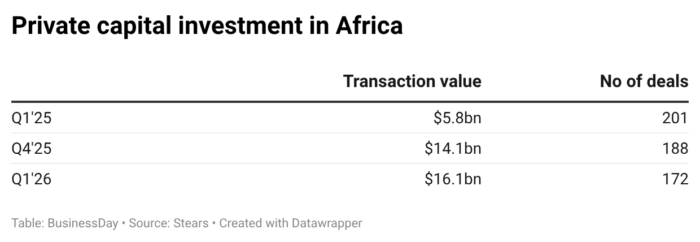
Africa’s private capital market delivered a strong opening to 2026, with total disclosed deal value rising to $16.1 billion in the first quarter, signalling renewed investor confidence in large-scale opportunities across the continent.
This is despite a moderation in deal volume, which fell to 172 transactions from 188 in the fourth quarter of 2025 and 201 a year earlier, according to the Q1 2026 Private Capital in Africa Activity Report.
Stears, an African research platform, said the figures point not to weakness, but to a shift in capital allocation toward larger, more strategic investments.
The report revealed that the quarter’s performance was driven by major infrastructure and energy transactions in Nigeria. It said that the increase in disclosed deal value was largely driven by the $6.2 billion MTN–IHS transaction and the $4 billion Dangote Refinery financing.
It further explained that these transactions accounted for approximately 63 percent of the total disclosed deal value in the quarter.
“The concentration of value in a small number of large-scale transactions underscores the continued investor appetite for opportunities that address critical infrastructure gaps in Africa’s largest economy, particularly in telecommunications and energy,” it said.
Beyond mega deals, the report points to a strengthening mid-market segment. It noted that while the share of mega deals declined, large transactions ($25 million–$75 million) increased modestly, indicating a broader base of mid-sized deal activity.
Egypt emerged as a key beneficiary of this trend. The report stated that Egyptian companies accounted for 55 percent of all large transactions, with a cluster of real estate financing deals highlighting strong capital deployment into urban development.
Overall, the Big Five—Nigeria, Ghana, Kenya, Egypt, and South Africa- led the way in terms of overall deal activity, but Ghana’s deal count was matched by Uganda, while it was usurped by Morocco and Zambia in single-country transactions.
“This suggests that while Ghana remains an attractive investment destination, a significant share of activity in the country is linked to multi-country investments originating from Nigeria, such as British International investment $15 million mezzanine debt financing for Starsight Energy, a Pan-African Commercial & Industrial (C&I) solar provider and a $24 million fundraise by Metro Africa Xpress Inc. (MAX), a logistics and transportation company that began in Nigeria,” the report disclosed.
Financial services lead sectoral activity
Sectoral trends remained consistent, with financial services leading deal activity. The report stated that “Financial Services accounted for 29 percent of all transactions, with MSME lending alone representing nearly a tenth of total deal activity.
It also highlighted regional dominance, noting that West Africa accounted for 48 percent of all Financial Services transactions, reinforcing its position as the continent’s primary hub for fintech and lending activity.
More broadly, transaction activity was even more concentrated among the dominant five—Industrials, Energy & Utilities, Information Technology, Consumer Discretionary, just trailing behind, with these sectors collectively accounting for the majority of deals.
New investment themes continued to gain traction across the continent. The report observed that mobility investments concentrated in East Africa, with strong investor interest in electric vehicles, battery-swapping, and vehicle financing platforms.
At the same time, early-stage AI investment continued to gain traction, with startups such as Cybervergent and KNOT Technologies securing funding.
These trends point to a gradual broadening of Africa’s innovation landscape beyond traditional fintech.
M&A activity signals consolidation
Mergers and acquisitions (M&A) continued to contribute to private capital activity across Africa in Q1 2026, accounting for nearly a quarter of all recorded transactions.
M&A transactions were most prominent in Communication Services (31 percent) and Industrials
(30 percent), with notable deals including the oft-mentioned IHS Holdings acquisition, as well as Fera Science’s acquisition of Qotho Minerals’ operations in South Africa.
Other mergers and acquisitions include African fintech unicorn Flutterwave, which acquired Mono, a Nigerian open banking infrastructure company; Moneipoint acquired Orda (Star Kitchens Group Inc.), etc.
Development finance institutions take the lead
Institutional investors played a pivotal role in sustaining momentum. The report noted that “Multilateral Development Banks came to the fore at the start of 2026, with African Export-Import Bank (Afreximbank) leading the way with 12 transactions.”
It added that Afreximbank’s activity was tied to the launch of the inaugural Afreximbank Accelerator Programme, which provided $0.25 million in seed capital to eight African startups, including OnePort 365, a multi-country digital freight management platform and Zowasel, a Nigeria-based digital agricultural marketplace.
Even with this, though, the bank still participated in some of the most significant transactions in the quarter, including the $4 billion Dangote Petroleum Refinery debt deal, a $50 million term loan for Spiro, further highlighting the investment appeal of e-mobility solutions in East Africa, and a $1.75 billion syndicated investment in Sonangol, Angola’s state-owned national oil company.
“All three investments show Afreximbank’s focus on boosting energy and transport infrastructure to enable greater intra-Africa trade. Beyond these multi-lateral agencies, Amethis Investment Fund Manager was highly active in the quarter, leading investments across commercial fund managers, with investments in Côte d’Ivoire (ADEMAT), Egypt (Tiba Starch & Glucose Manufacturing), and Francophone Africa (Overseas Catering Services),” the Stears report added.

Join BusinessDay whatsapp Channel, to stay up to date
Open In Whatsapp