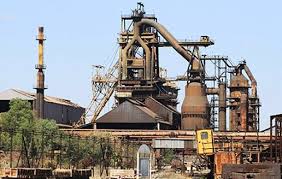
As Nigeria’s largest steel making factory, located at Ajaokuta in Kogi State, remains standstill, the country continues to lose N2.5 trillion annually on the importation of steel required for construction works in various sectors of the Nigerian economy.
On June 16, at an address to the Senate Committee on Privatisation, Joseph Isah, sole administrator of Ajaokuta Iron and Steel Complex, said N23 trillion worth of steel products had been imported in the past nine years.
A further analysis of this figure shows that the amount expended each year for such imports of steel amount to a whopping N2.5 trillion, whereas the company itself requires only N80 billion to make the steel plant work at full capacity.
The light mill section of the plant alone, which would require only N43 billion to become functional, the company’s authorities say, could produce 400,000 tons of steel per annum at full capacity and generate an average annual income of N80 billion.
“About $513 million is needed to complete the project, while the total investment for the entire project from inception is $4.6 billion,” Isah said, adding, “The first phase of the project has reached 98 percent completion but was abandoned in 1994.”
According to Otori Maliki, the steel plant stopped functioning since 2005, when it was sold to Global Steel, an Indian company, a situation that led the government to taking the company back from Global Steel.
There is an ongoing litigation at the International Court of Arbitration instituted by Global International Nigeria Limited (GINL) against the Federal Government for what it called “unlawfully abrogating a sale agreement for the management of the Steel plant without due process.”
A credible source from the Ministry of Solid Minerals in Abuja told BusinessDay on phone that the Federal Government, through the Presidency and the ministries of justice and solid minerals, was currently engaging all parties involved in the various litigations in order to resolve the matter amicably.
According to the source, it will be make no legal and economic sense to ignore any of the parties.
“I can assure you that Ajaokuta is going to work and we are reasonably confident that we will do it, and the President has spoken about it,” Kayode Fayemi, minister of solid minerals, told BusinessDay in an exclusive interview recently.
“I have been there and I have seen what I described as “the shame of the nation” and I do not think that we would be able to hold our heads high up if we do not fix Ajaokuta in the course of our time in office,” he said.
Built on an 800-hectare portion of its 24,000-hectare landmass, the multi-billion dollar Ajaokuta Steel Complex was started by the Shehu Shagari administration in the late seventies and early eighties, but was later abandoned by subsequent past administrations for over two decades.
There are 43 plants installed in the steel complex, a single one of which is credited with the capacity to produce 600,000 metric tons of steel annually (mtpa).
This quantity, the factory’s sole administrator confirmed, is enough to cover the 10,000 kilometres of rail network across Nigeria.
The Federal Government currently has contracts for the rehabilitation and extension of 8,000 kilometres of the nation’s rail network at the cost of $80 billion.
In contrast, the Ajaokuta Steel itself is not yet connected to the main railway system of Nigeria, except by river.
Although an isolated standard gauge railway connects the steelworks to its source of iron ore at Itakpe, a connection of this railway to the Warri sea port is unfinished but connects the west of Nigeria to the east and the north to the south.
Another economic point of note is that the thermal plant of the factory, which has an installed capacity of 110 megawatts of electricity, requires N5 billion to become fully operational and would generate N18.7 billion yearly upon completion, powering the entire 43 plants in the complex and supplying power to at least three states, including Kogi and the FCT.

Join BusinessDay whatsapp Channel, to stay up to date
Open In Whatsapp