Before reading this, you should read Ayisha Osori’s excellent article about Daniel Bwala’s suboptimal performance at Mehdi Hassan’s Head-to-Head. All I will say about that car crash is this: ever since 11 February, the day of the recording, anything you have read for me, was written by my ghost. I died of shame that day.
From Ayisha’s piece, I learned the Hausa word, kunya, which roughly translates as shame or embarrassment. But the real shame, as Ayisha rightly noted in her Substack post, is not Bwala’s alone. It belongs to those who put a clearly unprepared individual in position. It is important to note that as of the time of writing this, he has not been let go, which says a lot about the fact that Nigeria’s political elite are very comfortable with square pegs in round holes.
At least since Murtala Mohammed infamously swapped Adamu Ciroma and Aliko Mohammed, sending the historian and editor, Ciroma, to head the CBN, and the chartered accountant, Mohammed, to head the Daily Times, Nigeria has maintained an unfortunate history of placing square pegs in round holes for the sake of political convenience.
We reward loyalty over competence, and we demand that our appointees publicly consume their own words as proof of fealty. The result is a government populated by people whose primary qualification is their willingness to humiliate themselves on demand.
The diplomatic debacle
The current impasse over ambassadorial postings offers a textbook example. President Tinubu recalled all 83 career and non-career ambassadors in September 2023. Twenty-seven months later, after leaving 109 missions without substantive heads, he finally nominated replacements. Now India and other countries are signalling they may refuse to accept them because Tinubu has less than two years remaining in his first term.
India has a standing policy: it does not accept ambassadors from administrations with less than two years left. This is not personal; it is pragmatic. Why invest in a diplomatic relationship when the principal could be replaced within months? The government’s hope, according to officials who spoke to The Punch, is to convince New Delhi that Tinubu will win re-election. That is not a strategy. It is a prayer dressed up as diplomacy.
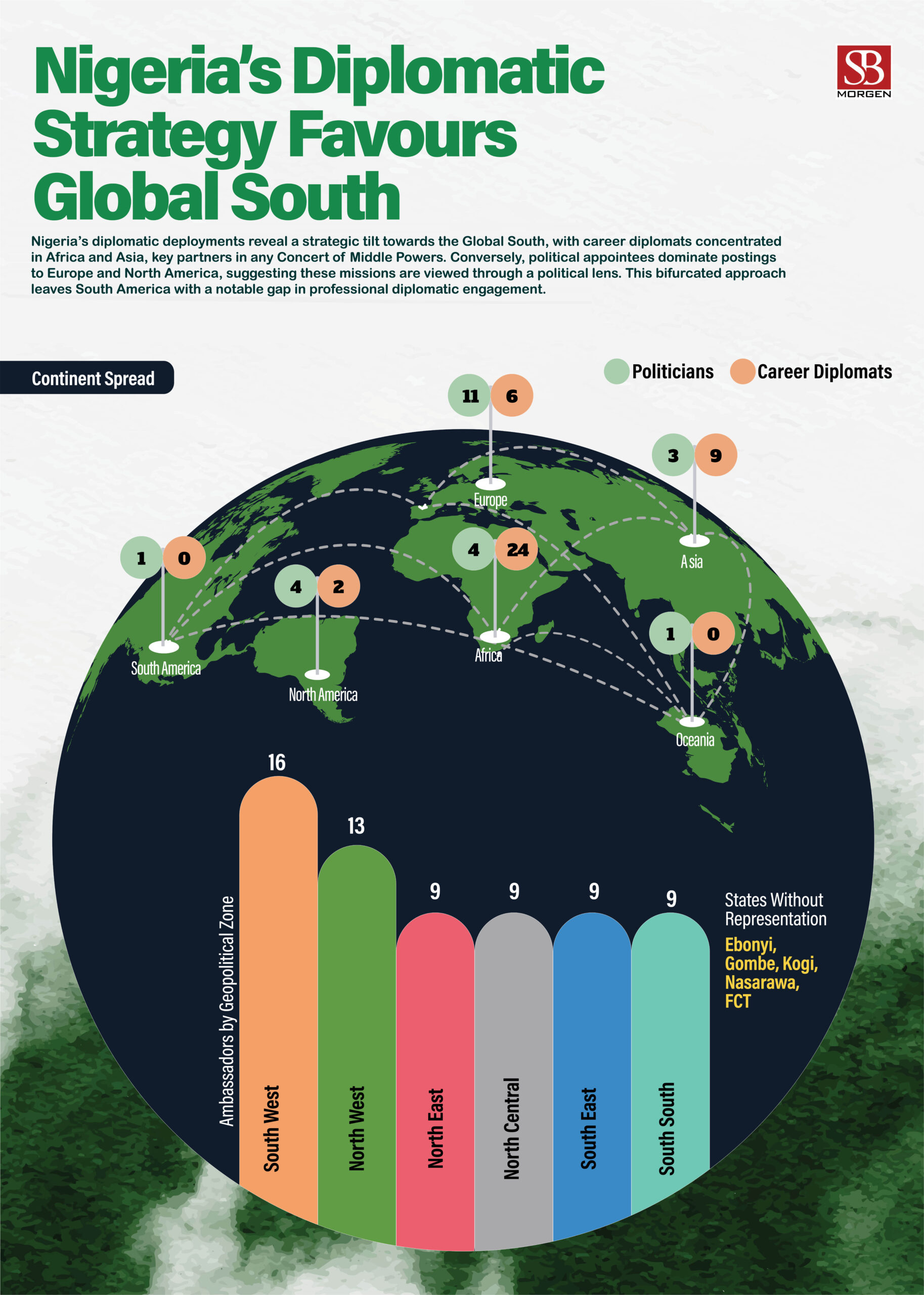
63 of the 65 nominees have not yet received agrément. Only the envoys to the UK and France have been accepted. The rest face the prospect of spending months in limbo, assuming they ever get to their posts at all. And if they do, some may not arrive until August, leaving them barely nine months before the next election cycle begins.
The former envoy to Singapore, Ogbole Amedu-Ode, put it plainly: the administration’s delay in nominating ambassadors was a mistake. But mistake implies accident. This was not accidental. It was the predictable outcome of a system that prioritises political patronage over institutional continuity.
The tragedy is that Nigeria once understood the value of strategic diplomatic thinking. When Bolaji Akinyemi served as foreign minister in the Babangida era, he articulated a vision of Nigeria as a great power projecting influence beyond Africa. His proposal for a “Concert of Medium Powers” in 1987, bringing together countries like Algeria, Brazil, India, Indonesia, Mexico, and Nigeria to act independently of the global superpowers, was a bold and sophisticated initiative. The Lagos Forum that resulted from this vision demonstrated that Nigeria could convene nations and shape global discourse.
That ambition has withered. Today, rather than convening a concert of medium powers, we struggle to secure acceptance for our envoys from the very nations Akinyemi sought to align with. India, which Akinyemi identified as a natural partner, now views our diplomatic overtures with caution.
BRICS, essentially a variation on the medium powers concept Akinyemi proposed decades ago, has expanded to include Egypt and Ethiopia, while Nigeria watches from the sidelines. The strategic irony is crushing: a foreign policy vision that could have positioned Nigeria as a leader among emerging economies lies abandoned, replaced by a patronage-driven approach that cannot even get ambassadors to their posts.
When we abandon professional diplomats for political appointees whose primary qualification is loyalty, we lose more than institutional memory. We lose the capacity for strategic thought itself. The square pegs we insert into round holes do not merely fail to perform their functions; they actively foreclose the possibility of visionary policy.
The Cost of Politics
This is the deeper tragedy. Every square peg we appoint, every Bwala we send to defend the indefensible, every ambassador we post with nine months to serve, reinforces the message that governance is a game. The players understand the rules: loyalty matters more than competence; public humiliation is a feature, not a bug; and the interests of ordinary Nigerians are incidental to the real business of politics.
Meanwhile, insecurity worsens. Kidnapping has become a structured industry, with over a billion dollars paid in ransom in 2024 alone. Poverty deepens, with more than 120 million Nigerians living in multidimensional deprivation. And the government’s primary response is to send people like Bwala to television studios to deny reality.
The irony is that Bwala probably considers his performance a success. He has shared the video with his followers, confident that his real audience, the man who appointed him, will see how willingly he debases himself. And Tinubu, one imagines, will be pleased.
But for the rest of us, watching from the outside, there is only the familiar sensation of kunya. The shame is not theirs alone. It belongs to a system that rewards submission over substance, and to a country that has learned to expect nothing else.
Nwanze is CEO of SBM Intelligence

Join BusinessDay whatsapp Channel, to stay up to date
Open In Whatsapp