Global supply disruptions driven by escalating geopolitical tensions and a surge in oil prices have once again exposed Nigeria’s heavy reliance on foreign technology, underscoring a significant outflow of capital tied to ICT imports and digital services even as the country seeks to deepen its digital economy.
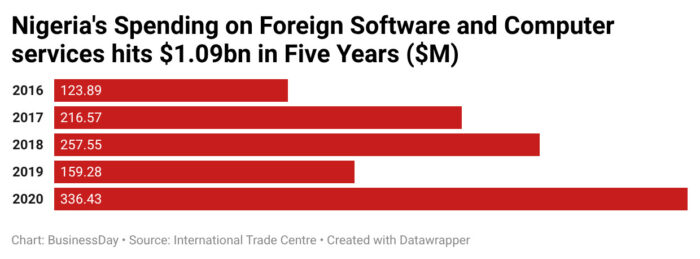
Data from the International Trade Centre (ITC) illustrates the scale of this dependence, showing that Nigeria spent about $1.09 billion on software acquisition and computer service imports between 2016 and 2020. The figures reveal a steady rise over the period, from $123.89 million in 2016 to $216.57 million in 2017 and $257.55 million in 2018, before dipping to $159.28 million in 2019 and surging sharply to $336.43 million in 2020, reflecting growing demand for foreign digital solutions.
This vulnerability has come into sharper focus amid renewed global shocks, as rising tensions in the Middle East pushed oil prices above $100 per barrel, driving up domestic fuel costs despite Nigeria’s position as a major crude oil producer.
Read also: Nigeria’s $850m foreign cloud bet leaves fintechs exposed to global shocks
The disruption linked to the Strait of Hormuz has highlighted a long-standing weakness in Africa’s largest economy: deep reliance on imports, even in sectors where it holds natural advantages.
Fuel prices at Nigerian pumps have climbed sharply, feeding inflation that hovered around 27 percent in 2025 and squeezing households and businesses.
The paradox is stark. Nigeria produces crude oil and now hosts the continent’s largest private refinery, yet remains vulnerable to external supply disruptions and pricing shocks.
This reflects structural gaps that go beyond energy and extend into the country’s broader industrial base.The technology sector offers a clear example. Nigeria is one of Africa’s largest markets for digital devices, but most of its hardware is imported, exposing the economy to foreign exchange pressure and supply chain risks. As demand for technology rises, so does the cost of dependence.
A baseline study commissioned by the Nigerian Communications Commission (NCC) reveals that 84 percent of hardware components and equipment used in the Nigerian telecoms sector are imported, with only 16 percent manufactured locally.
Critical infrastructure such as Base Transceiver Stations (BTS) remains overwhelmingly sourced from overseas manufacturers (around 88 percent foreign dominance in some assessments). On the software side, the ratio stands at 77 percent foreign to 23 percent local. These imbalances carry significant national security risks and drain scarce foreign exchange.
This heavy dependence underscores the urgency for local manufacturing. A notable success story is the ban on the importation of fully assembled (whole body) SIM cards, announced at the inaugural Nigerian Telecommunications Indigenous Content EXPO (NTICE) in 2022.
One year later, the NCC reported that local SIM card manufacturing had grown into a market valued at over N55 billion. This policy eased pressure on foreign exchange demand while creating direct and indirect jobs.
Umar Garba Danbatta, former executive vice chairman of the NCC, highlighted the broader impact: the telecom sector has been a major driver of socio-economic growth. It is also home to two of Nigeria’s most valuable listed companies, with a combined market capitalization exceeding N10.45 trillion.
Danbatta emphasized that sustaining quality of service requires embracing indigenous content across the value chain. He noted the establishment of the Nigeria Office for Development of Indigenous Telecoms Sector (NODITS) to focus on manufacturing, human capacity, R&D, and software/services development.
Isa Pantami, former director general of the National Information Technology Development Agency (NITDA), pointed out that Nigeria loses approximately $2.8 billion annually on the importation of ICT goods and services, including about $1 billion spent yearly on software imports.
Locally manufactured or assembled computers accounted for less than eight percent of total usage at the time.
The Nigeria Startup Bill (signed into law in 2022) was positioned as a key measure to retain such capital flight by fostering a supportive ecosystem for tech startups, innovation, and local software/hardware development.
Stakeholders, including tech expert, Chinenye Mba-Uzoukwu, stressed that success depends on government and private sector patronage of local solutions, ecosystem-wide support (including access to finance and markets), and avoiding policy inconsistencies.
In recent years, indigenous ICT firms have proved capability in both software and hardware engineering, and multinationals including Microsoft, Oracle, Google, and IBM are becoming more interested in hiring young Nigerians.
Zinox Technologies, founded by Leo Stan Ekeh, represents one of the country’s earliest attempts to build domestic capacity. The company operates a digital assembly plant in West Africa, producing computers and related devices locally.
Its model goes beyond hardware. Through its subsidiaries, Zinox has expanded into renewable energy and home electronics, offering solar-powered systems and backup solutions tailored to Nigeria’s unreliable power environment. This reflects a broader shift toward integrated local solutions rather than isolated imports.
Leo Stan Ekeh has warned that import reliance leaves Nigeria dangerously exposed. In the context of global energy and supply shocks, he described the tech sector as a clear case study in both the costs of dependence and the potential of local capacity for economic stability and technological sovereignty.
He has advocated for policies that support indigenous manufacturers, noting the multiplier effects on jobs, skills, and ancillary industries, while stressing that “technology is no longer just a commercial tool; it is a defense tool and a national asset.”
Economists and industry leaders argue that scaling such efforts, though still limited, offers a viable pathway to reduce exposure to global volatility. Every device or component produced locally conserves foreign exchange, creates employment, builds technical skills, and enhances resilience.
Chris Uwaje, a fellow of the Nigeria Computer Society, said the Indian government, few years ago, imposed immediate restrictions on the importation of laptops, tablets, all-in-one personal computers, ultra-small computers and servers.
He described the move as a form of product nationalism, where countries deliberately promote the use of locally made products and services to boost domestic productivity, create jobs, build technical capacity and reduce capital flight.
Uwaje therefore urged President Bola Ahmed Tinubu to adopt a similar policy, including making it mandatory for foreign computer manufacturers to establish local production facilities in Nigeria in partnership with indigenous firms.
Similarly, ICT expert Mr. Dotun Ali-Balogun called on the president to mandate that all government ICT operations run on locally assembled computers. He added that such a policy would help curb the importation of computer services, strengthen the naira, and reduce pressure on the dollar.
The benefits extend beyond economics. Control over technology supply chains is increasingly linked to national security, data protection, and long-term competitiveness.
Read also: Nigeria’s import lifeline faces shock as strait of Hormouz closure disrupts global trade
Countries with stronger domestic production are better equipped to withstand disruptions and safeguard critical infrastructure.
There are early signs of a policy shift. Policymakers are emphasizing local content through initiatives like public procurement preferences, the National Policy for the Promotion of Indigenous Content in the Nigerian Telecommunications Sector, and incentives for manufacturing (e.g., corrugated optical ducts for fibre protection). Support for MSMEs, R&D, and innovation events such as NTICE continues.
However, challenges persist. Scaling manufacturing demands reliable power, improved infrastructure, affordable financing, skills development, and sustained government-private sector collaboration.
Stakeholders also call for consistent patronage of local solutions by government agencies and the private sector.
The stakes are rising. As global uncertainty persists, from geopolitical tensions to currency volatility, heavy import dependence amplifies risks, while investment in domestic capacity builds resilience.
For Nigeria, the latest oil shock is more than a temporary disruption. It is a reminder that long-term stability depends less on natural resource endowments and more on what the country can design, assemble, and innovate locally. Initiatives like the SIM card ban and the Startup Bill demonstrate that targeted policies can yield tangible results in reducing capital flight and fostering self-reliance.

Join BusinessDay whatsapp Channel, to stay up to date
Open In Whatsapp