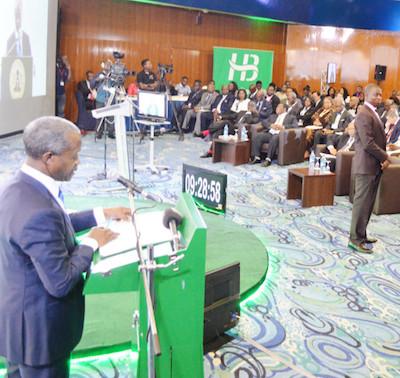
Improving Infrastructural Financing
Infrastructural deficit is among the key factor hindering the Nigeria economy from providing inclusive growth for all. Nigeria’s economy growth rate has been hovering around 7-8 percent between the periods of 2008 to 2013 but much has not been done in terms of job creation for his teeming population.
According to Kunle Elebute head, Advisory services, KPMG Professional Services in his scenarios analysis he presented at the summit, Nigeria GDP could easily surpass $700 billion by 2020 if proper infrastructure finance plan is put in place among other factors to bridge the infrastructural deficit that is estimated to $300 billion by the Africa Development Bank.
Reforming public institutions
For Nigeria to actualize its dream of inclusive growth and curb corruption, priority should be given to public institutional reform.
According to Vice president Yemi Osinbajo, public institution reform is critical for efficient and transparent use of public resources as well as sustainable delivery of public goods at national and sub- national levels.
He further said that non- discrimination, equality of access, impartially, fairness and due process in services to the needs of users, professionalism aimed at promoting a culture of integrity, effective and efficient use of public resources, respect for human rights, due process and rule of law as well as creating the enabling environment for enhanced competitive in the private sector are the major objectives of the institutional reforms.
Increasing the Value Added Tax (VAT)
According to Temitope Oshikoya, Chairman, NESG Faculty of economics, in another presentation at the summit, for Nigeria to boost its revenue base to cushion the effect of oil price down fall, there is a need to increase the Value added tax from its current 5 per cent to 10 per cent.
If done properly, VAT could raise government revenue by $17.9 billion, according to Oshikoya.
Nigeria pays the lowest Value Added Tax among its peer countries.
Take for example, Cameroon pays 19.25 per cent as a VAT on goods and services, 14 per cent is paid in South Africa and 17.5 per cent in Zambia.
In Egypt, 10 per cent is charged on standard goods and services while 25 per cent is charged on luxury items and zero on exports.
VAT in Kenya ranges between 12-16 per cent while in India, it is between 5.5 per cent and 14.5 per cent.
Petroleum subsidy reform
Nigeria is one of the leading world oil producers – producing about 2.5 million barrels of crude oil per day and yet, the country is unable to refine its crude oil locally due to the rent seeking behaviour of the players in the industry as result of the current subsidy regime.
Plugging this huge loopholes and avoidable wastages in government finances in the form of colossal fuel subsidy payments currently estimated between N800 billion and N1 trillion yearly, thereby potentially freeing the much needed resources for investment in pressing areas of critical national infrastructure renewal and development, including social infrastructure and vital security architecture that could boost economic growth.
Increasing budgetary allocation to education
Education is the bedrock of social- economic development which raises people’s productivity, creativity and in turn raises national output.
For Nigeria to develop its human capital it has to raise its budgetary allocation to education from the current 9 percent to 20 percent.
Retraining and training of its teachers from primary to higher institutions, reducing the ratio of students to teacher numbers, and raising the quality and standards of Universities to redress outflow of Nigerian students to foreign schools will enable the country save its scarce foreign reserves, said Temitope Oshikoya.
ADEBISI NOFIU

Join BusinessDay whatsapp Channel, to stay up to date
Open In Whatsapp