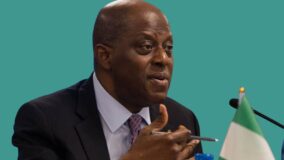
Minister of budget and national planning, Udoma Udo Udoma, has alluded that the Federal Government’s drive on economic diversification away from the oil sector stemmed from the far reaching recommendations it got from the Nigerian Economic Summit Group (NESG).
The minister also informed that some of the policy recommendations that were initially resisted had now been taken and owned by government.
As contained in a statement signed by Charles Dafe, the ministry’s director of information, the minister was quoted as reiterating government’s support and continued partnership with the NESG to develop the economy of the country.
Udoma, on Tuesday, during the former presentation of the report of the 21st Nigerian Economic Summit held in October last year, commended the group for their resilient and painstaking efforts in organising the Summit consistently up to the 21st edition.
He also appreciated them for not giving up even when some of the Summit recommendations were not given rapid attention, while pointing out that the impact of the annual Summit on Government “has been most impressive.
The report of the Summit was presented by the chairman of NESG, Bukar Abba Kyari, who led a delegation of the group including its CEO, Laoye Jaiyeola.
“One of the most important thing taken from last year’s Summit is to diversify the nation’s economy away from oil,” The minister was quoted as saying.
The minister in his address also identified the role of the private sector in economic development stating emphatically “the country cannot grow its economy unless the private sector is stimulated.”
The minister also told the delegation that some of the recommendations presented after the summit were already part of Government’s policies and some other ones will be looked at and also taken on board.
Earlier, the Chairman of the board of directors of NESG, Kyari Bukar Abba, while presenting the summary of the 21stSummit, said the theme “Tough Choices: Achieving Competitiveness, Inclusive Growth and Sustainability” was consistent with the NESG’s commitment to continually focus on contemporary issues of public policy, which constrain improvement and the welfare and well-being of our people.
According to the Chairman, the main objective of NES 21 was to examine and facilitate stakeholders’ consensus on the tough choices that needed to be made in order to address the economic situation that the country had found on the heels of commodity price shocks, chart a practical roadmap to achieving competitiveness and inclusive growth in a sustainable way, through measurable outcomes.
He went further to state that the Summit engaged in high-level and in-depth discussions and debate which included Current State Analysis of the Economy; Country Scenario Presentation; National Budget Framework to Aid Competitiveness, Inclusive Growth and Sustainability; Sustainable Solutions for Peace and Threats to Human Security, among others.
On the recommendations from the Summit, Bukar listed Institutions, Infrastructure, Legislations, Tackling Corruption, Security, Energy, Education and Skills, Health, Job Creation and MSMEs as the key recommendations that hold the thrust for tough choices.
He however, concluded that if the Summit recommendations be taken into account and appropriately implemented, all growth poles in the Nigerian economy will unleash their potential for employment generation and economic productivity which are critical to Nigeria’s overall economic and human prosperity.

Join BusinessDay whatsapp Channel, to stay up to date
Open In Whatsapp