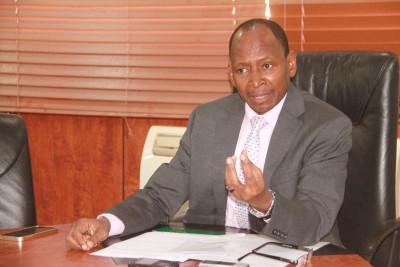
In a bid to fulfil the aim of the current administration in its fight against corruption, the Accountant General of the Federation (AGF), Ahmed Idris has said that the Treasury Single Account (TSA) will assist in making this a reality.
He enumerated the benefits of the TSA to a global audience in London, saying the Federal Government had stopped borrowing from itself as commercial banks use MDAs idle balances to buy treasury bills and other short-term instruments.
The AGF, who spoke at the ICAN UK International Zonal Conference, said as of the end of March 2016, total inflows into TSA was about N3 trillion ($15bn) while the number of MDAs on TSA had risen to 976.
According to him, successful TSA implementation rests on a tripod, which includes the collection of MDA receipts, payment by MDAs and budgetary control of MDAs spends.
He explained that two core systems supported TSA, the Government Integrated Financial Management and Information System (GIFMIS) at OAGF and the CBN Payment Gateway called Remita at CBN. The two systems were integrated and deployed in 2012.
He said: “TSA became fully operational in April, 2012 with 93 pilot MDAs accessing their allocations directly from the Consolidated Revenue Fund Account. Incrementally, MDAs on TSA went to 225 in the year 2013, 345 in 2014 and 706 in 2015. Currently over 900 MDAs are on TSA.”
With the Treasury Single Account, the government is in a position to know the total cash position at any point in time. There was a time there were over 17,000 hidden accounts in different banks, but now Nigerian government have a platform that can bring all accounts together for government to know exactly the cash position via Remita, a platform developed by SystemSpecs.
However, John Obaro, CEO, Systemspecs, has said that it is unfortunate that the company, which has been described as core to the TSA, has been accused of fraud instead of being supported and encouraged as an indigenous software company to grow Nigeria’s economy.
“While our currency is struggling and Naira’s exchange rates against major currencies have almost doubled in less than a year, we still have to source enormous foreign exchange to service the huge foreign-owned software assets in use by government at all levels and across the private sector.
“The beneficiaries are those countries that have nurtured their software industry and caused us to be dependent on them even in critical areas of our national life. Let us imagine what would have happened if GIFMIS and IPPIS at OAGF are powered by indigenous software and not one from Estonia and USA respectively. If ITAS at FIRS is an indigenous software and not from Canada; if Bank Verification Number (BVN) platform deployed by NIBSS is powered by an indigenous software and not from Germany; if Real Time Gross Settlement (RTGS) platform at CBN is powered by indigenous software, and not one from Sweden,” he said.
He added that; “patronising indigenous software companies by the government will assist the federal government’s objective of providing employment to teeming talented Nigerian youths. Others are the conservation of the huge foreign exchange currently lost when paid as annual software maintenance fee to foreign software providers and the retention of 100 percent annual maintenance fees within the Nigerian economy.”
Listing the benefits of the TSA, Idris said the adoption of the system provides better information on the cash resources available to government at any point in time and the financing gap that needs to be met.
JUMOKE AKIYODE

Join BusinessDay whatsapp Channel, to stay up to date
Open In Whatsapp