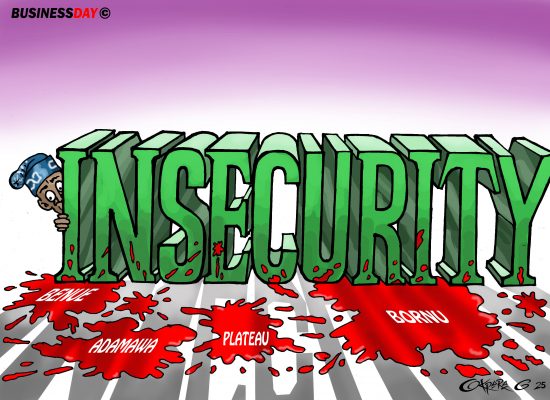
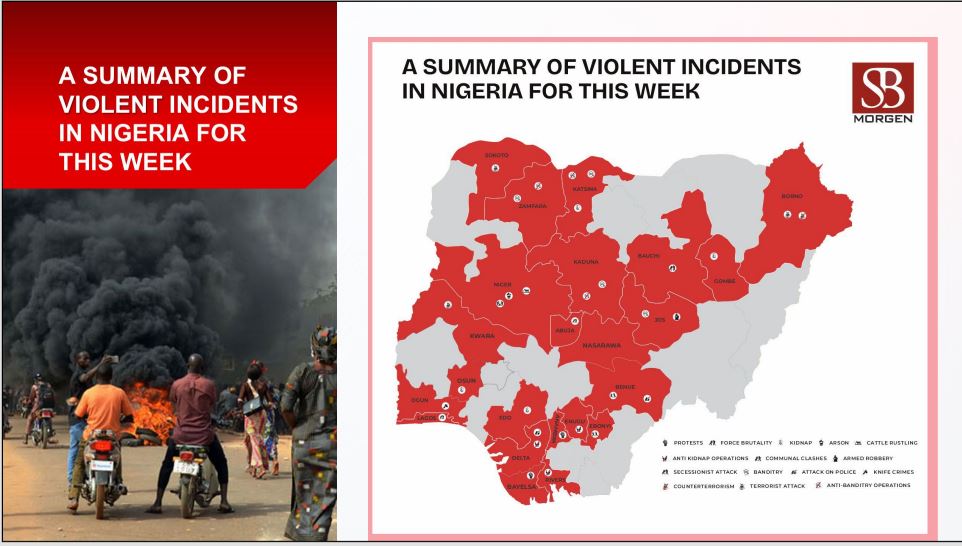
As Nigeria grapples with persistent security challenges, businesses and investors could face mounting risks to supply chains, trade routes, and market access. The latest SBM Intelligence weekly security report, covering 30 January to 5 February 2026 highlights how evolving threats across Nigeria’s geopolitical zones could reshape the economy in the coming weeks.
Data from the weekly violence tracker shows a clear pattern: armed actors are moving beyond sporadic attacks toward forms of economic control, while state responses remain uneven. For businesses, policymakers and investors, the implications are becoming harder to ignore.
Violent levy collections could disrupt Lagos-border trade routes
In the south west, the issue of state-sanctioned levy collections along the transport routes is gradually blurring into violent extortions. SBM noted that the killing of a motorcyclist in Ijoko, a town in Sango/Ijoko Local Council Development Area of Agege, Ogun State, signals a worrying change in the tide.
“Over the next two weeks, renewed levy enforcement without visible policing could trigger organised flash attacks on union offices across Ogun’s Lagos-border communities, escalating localized unrest into sustained instability” the report noted.
The Security and Political Economy report also referred to the kidnappings and intelligence-led home invasions along Ora-Igbomina axis as a demonstration of how criminals are exploiting ungoverned areas to perpetuate their acts, especially in the Osun-Kwara corridor. The recent kidnap of a retired customs officer also suggests that higher-value victims may be the targets in the coming weeks, as the criminals shift from roadside abductions.
Insecurity on Benin–Ore–Lagos Expressway endangers neighbouring communities
Communities around transport corridors are gradually feeling the heat as the violent accidents creep in from the highways to their homes. The recent kidnap of nine members of an extended family along the Eko–Abeku–Iyowa Road, a busy route linking Benin and Akure shows rising confidence among the criminals.
SBM security report states;
“Although joint police and vigilante operations secured the release of four victims, the ₦260 million ransom demand highlights the growing confidence and profitability of kidnapping-for-ransom networks operating from nearby forests. Without sustained corridor patrols, forest surveillance, and intelligence-led disruption, kidnapping is likely to remain the dominant threat in the short to medium term.”
In fresh developments suspected to be linked with the political season, IPOB-linked violence appears to be resurfacing in Oshimili South area of Delta state. Oredo local government area of Edo state has also recorded recent attack on an ADC office in a suspected case of political intimidation. SBM noted that the absence of credible arrests and prosecutions could see an increase in such incidents as elections draw closer.
Southeast presents a mix of economic recovery and threatened investments
In Anambra, the reopening of Onitsha Main Market signals a pragmatic recalibration by the traders, and a shift towards economic recovery for Nigeria’s retail powerhouse. Commerce has resumed, but under fragile informal understandings rather than restored institutional trust. Any shock—selective enforcement, renewed attacks, or political missteps—could quickly reverse gains.
Yet Ebonyi’s Oso Edda-Amasiri clashes, rooted in 1960s boundaries, sustain lethal violence, deterring manufacturing investments. Enugu’s Udenu kidnappings along Benue corridors test rapid-response efficacy and SBM recommends sustained border-focused and forest surveillance to curb the situation.
Absence of constant security presence to threaten agribusiness logistics routes in North central
In the North Central region, violence around Kaiama, Agwara and surrounding rural corridors points to a more organised insurgent presence with economic intent. Militants linked to Boko Haram factions and Sahelian jihadist groups are exploiting ungoverned forest zones, particularly around Kainji Lake, to build logistics networks.
“If troops establish a credible hold-and-protect posture within two weeks, plans for insurgent courts and leadership purges will likely be disrupted. Failure to secure surrounding villages, however, will push militants toward economic strangulation through mobile attacks on key roads and revenue points” SBM warns.
The immediate risk is not only mass displacement but disruption to transport routes linking agricultural producers to markets in Kwara, Niger and beyond. For agribusiness operators and traders, this raises transport insurance costs, increases post-harvest losses and reinforces the reliance on informal security arrangements, all of which erode margins.
Unpredictable security in the North West remains the biggest cost drivers for businesses
The North West tells a similar story of economic fragility masked by tactical military gains. Despite intensified operations against bandit groups in Katsina and Zamfara, high-fatality reprisals continue, suggesting that armed groups remain resilient, using ceasefires and negotiations to regroup.
“SBM Violence Tracker data shows more military operations than attacks since January 2025, yet bandits retain the ability to mount high-fatality reprisals, indicating a reactive security posture rather than sustained area control” the report read.
The economic consequences are already visible. Kidnapping hubs along state borders facilitate organised ransom systems that function as parallel economies. Ransoms continue to drain household savings in the region’s herding and farming economy, deterring foreign agribusinesses. Communities lose productive labour, markets shut intermittently, and capital formation stalls. For manufacturers and distributors dependent on overland transport between Sokoto, Katsina and Kaduna, unpredictability—not outright shutdown—remains the biggest cost driver.
Farmer-herder arrangements collapse, triggering violence in North East
In the North East, insecurity is directly reshaping local markets. The informal farmer–herder arrangements reached in 2024 has collapsed, with Darazo now emerging as a high-risk flashpoint where minor disputes can escalate into full-blown communal raids, threatening food production and water access.
Despite intervention from the state authorities, peace remains fragile with a reprisal attack from Makiya youths imminent. SBM warns of crop destruction and displacement that could tighten local food supply chains ahead of the next planting season.
Further east in Borno, insurgents are enforcing “economic policing” in forest economies, targeting charcoal traders through killings and abductions. The result is price volatility, reduced market participation and deeper insurgent control over resource flows. These dynamics undermine state revenue and entrench non-state taxation systems that outlast individual military operations.
Across regions, a common theme is emerging. If Nigeria’s insecurity will be resolved, the actors will have to pay attention to governance of space—forests, transport corridors, markets and borderlands—rather than isolated attacks. Armed groups are embedding themselves in economic systems, while state responses remain reactive.
For businesses and policymakers, the takeaway is clear. Security is no longer a background risk to be managed episodically. It is a central factor shaping investment decisions, pricing, labour flows and regional competitiveness. Without a shift toward sustained area control and economic protection, Nigeria risks normalising insecurity as a permanent cost of growth.

Join BusinessDay whatsapp Channel, to stay up to date
Open In Whatsapp