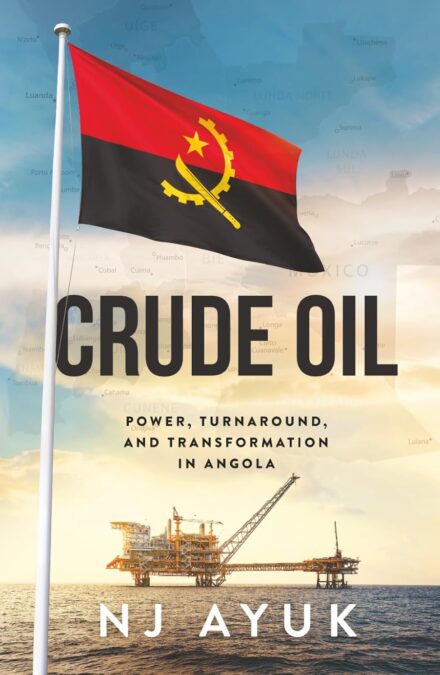
A review of NJ Ayuk’s Crude Oil: Power, Turnaround and Transformation in Angola
NJ Ayuk’s Crude Oil: Power, Turnaround and Transformation in Angola is written around Angola’s petroleum journey, but its significance travels far beyond Angola. For Nigeria, one of Africa’s most important but most troubled hydrocarbon economies, the book reads as both a warning and a mirror. It raises a question that Nigeria’s oil and gas sector can no longer avoid: how does a country move from crude oil production to genuine national transformation?
That question gives the book its wider African importance. Ayuk is not only interested in oil blocks, barrels, reserves, export earnings or corporate transactions. He is interested in power — the power of natural resources, the power of political leadership, the power of institutions, and the power of reform to redirect an industry that has carried both wealth and disappointment. In that sense, the book’s title is not merely descriptive. It captures the arc of the story: crude oil as the starting point, power as the contest, turnaround as the policy challenge, and transformation as the ultimate test.
For Nigeria, this framing is deeply relevant. Like Angola, Nigeria has lived for decades with the contradiction of hydrocarbon abundance and development frustration. It has crude oil, vast gas reserves, global energy relevance, experienced operators and a long history of international oil company participation. Yet it also continues to struggle with production losses, crude theft, underinvestment, regulatory uncertainty, gas underutilisation, weak refining history, fiscal pressure and the inability to translate oil wealth into broad-based prosperity.
Ayuk’s book matters because it presents Angola as a country attempting to confront that old African oil paradox.
The Book’s Strongest Link to Nigeria
The part of the book most relevant to Nigeria’s oil and gas sector is the discussion of Angola’s reform agenda, particularly the sections on local content, the Natural Gas Law, the Gas Monetization Law and the Permanent Offer Regime. These parts of the book speak directly to the same issues now shaping Nigeria’s post-Petroleum Industry Act environment: regulatory credibility, investment attraction, national oil company reform, gas development, indigenous participation and the need to convert petroleum resources into wider economic value.
The book also becomes especially useful where it examines Angola’s renewed investor appeal, refining ambition and attempt to reposition itself as a more credible petroleum jurisdiction. These are not distant concerns for Nigeria. They are central to the future of the country’s oil and gas industry.
Oil Wealth and the Burden of Dependence
One of the strengths of Crude Oil is that Ayuk does not present oil wealth as an automatic blessing. He recognises its value, but he also shows how easily petroleum dependence can expose weak governance, poor planning and fragile institutions.
Angola’s oil wealth brought growth, attracted foreign investment and gave the country strategic relevance. But dependence on crude also made the country vulnerable to price shocks, production decline and institutional failure. That is a story Nigerian readers will recognise immediately.
Nigeria has lived through the same cycle many times. When oil prices rise, fiscal pressure eases. When prices fall, structural weaknesses return to the surface. When production declines, government revenue suffers. When investment slows, reserves replacement becomes a problem. When regulation is unclear, capital looks elsewhere. And when oil earnings do not improve citizens’ lives, public trust weakens.
Ayuk’s Angola is therefore more than a national case study. It is a reminder that crude oil can create wealth without creating development, unless the institutions around it are strong enough to manage its power.
Why Institutions Matter More Than Announcements
The book’s most important message for Nigeria is that reform is not simply about new laws or policy declarations. It is about whether institutions behave differently after those laws are passed.
Ayuk highlights Angola’s move to separate Sonangol’s commercial role from the state’s regulatory function through the creation of the National Agency for Petroleum, Gas and Biofuels. For Nigeria, this point is especially significant. The Petroleum Industry Act created new regulatory and commercial structures, but the real test is implementation. The credibility of NUPRC, NMDPRA and NNPC Limited will depend on whether regulation, commercial decision-making and political influence can be properly separated.
Investors do not invest only in reserves. They invest in rules, predictability and trust. They want to know that fiscal terms will remain stable, licensing processes will be transparent, approvals will be timely, and disputes will be resolved fairly. Ayuk’s account of Angola’s reforms reinforces a basic lesson for Nigeria: oil in the ground is not enough. Without institutional credibility, even rich reserves can become stranded opportunity.
Local Content as a Tool for Industrial Development
Another Nigeria-relevant strength of the book is its treatment of local content. Ayuk presents Angola’s local content policy as part of a broader effort to protect national interest, integrate Angolan companies into the oil sector, create employment, support technology transfer and deepen domestic participation.
This connects directly with Nigeria’s own local content experience. Nigeria has made considerable progress through the Nigerian Content Development and Monitoring Board, and indigenous companies now occupy a more important place in the oil and gas value chain. But the Angolan example, as presented by Ayuk, reminds us that local content must not become a mere slogan, quota system or instrument of political patronage.
The real test is capacity. Are local companies becoming technically stronger? Are Nigerian engineers, fabricators, service providers, and financiers moving higher up the value chain? Are indigenous operators becoming globally competitive, or are they surviving mainly on regulatory protection?
Ayuk’s discussion encourages Nigeria to treat local content not just as participation, but as a serious industrial development strategy.
Gas Monetisation and Nigeria’s Big Unfinished Business
The strongest connection between the book and Nigeria may be gas. Ayuk’s discussion of Angola’s Natural Gas Law and Gas Monetisation Law shows a country trying to move gas from the margins of the petroleum industry into the centre of national development.
That lesson is crucial for Nigeria. Nigeria has far larger gas reserves than Angola and has repeatedly described gas as its transition fuel, industrial fuel and development fuel. Yet the gap between ambition and execution remains too wide. Gas flaring, weak infrastructure, pricing disputes, pipeline constraints, power-sector bottlenecks, insecurity and delayed projects continue to limit the sector’s impact.
Ayuk’s treatment of Angola’s gas reforms brings Nigeria back to an uncomfortable truth: gas does not become transformative merely because it exists underground. It must be supported by infrastructure, bankable contracts, pricing discipline, regulatory consistency and a domestic market capable of absorbing supply.
Nigeria’s “Decade of Gas” will only matter if it moves beyond slogans into power generation, petrochemicals, fertiliser, industrial clusters, domestic LPG expansion, transport fuel and export competitiveness. In that sense, Angola’s example is not just about gas policy. It is about turning gas into an economic platform.
The Investment Lesson in Angola’s Permanent Offer Regime
Ayuk’s discussion of Angola’s Permanent Offer Regime is also relevant to Nigeria. The regime allows Angola to keep oil and gas blocks continuously available for negotiation outside the limitations of traditional bid rounds. This creates flexibility and helps maintain investor interest, especially in a market where capital is selective and competition for upstream investment is intense.
Nigeria should pay attention to that point. The global upstream environment has changed. Investors now compare opportunities across jurisdictions. They look at fiscal terms, project timelines, security risks, regulatory certainty, political stability and energy-transition pressures. Angola is repositioning. Namibia is attracting major frontier interest. Guyana has become a global upstream success story. Nigeria can no longer depend only on its legacy status as an established oil producer.
Licensing must be transparent, competitive and commercially realistic. Bid rounds should not be slow, politicised or uncertain. Marginal fields must not remain trapped in legal, financial or operational paralysis. If Nigeria wants fresh investment, it must make the investment process clearer, faster and more credible.
Refining and the Crude Export Paradox
The book’s attention to Angola’s refining ambition also carries obvious relevance for Nigeria. Angola’s effort to expand refining capacity speaks to a familiar African contradiction: oil-producing countries that export crude and import refined products.
Nigeria has lived with this paradox for decades. The Dangote Refinery has changed the strategic conversation, but it has not removed the need for wider downstream reform. Nigeria still needs efficient distribution infrastructure, secure pipelines, functional depots, transparent pricing, modular refining capacity and a clear export strategy for refined products.
Ayuk’s discussion of Angola’s refining plans reinforces a simple but important lesson: the real value of oil is not captured by crude exports alone. Transformation comes when producing countries move deeper into the value chain.
Investor Confidence as a Reform Dividend
One of the most useful ideas in Crude Oil is the connection between reform and investor confidence. Ayuk presents Angola as a country trying to become more predictable, more open to investment and more pragmatic in its energy policy.
This is directly relevant to Nigeria. Nigeria’s oil and gas sector does not lack opportunity. What it lacks is sufficient confidence. Investors want assurance that contracts will be respected, fiscal terms will remain stable, regulatory approvals will not become endless bureaucratic obstacles, divestments will be processed efficiently, and security risks will be addressed.
The lesson from Angola, as Ayuk presents it, is that reform must be visible to capital. Government cannot merely announce change. Investors must believe it, experience it and price it into their decisions.
Energy Transition Without Energy Denial
Ayuk also uses the book to make a broader African argument about energy transition. He insists that Africa should not be forced into a transition model that ignores energy poverty, industrialisation and the continent’s right to develop its own resources.
This argument speaks clearly to Nigeria. Nigeria must take the energy transition seriously, but it cannot do so by abandoning oil and gas before alternatives are ready. The country still needs hydrocarbons for fiscal stability, gas-fired power, industrial growth, petrochemicals, fertiliser, transport and export earnings.
The real challenge is not whether Nigeria should transition. It is how Nigeria can use today’s oil and gas resources to finance a cleaner, more diversified and more productive economy tomorrow. That is the balance Ayuk’s book defends: Africa must develop responsibly, but it must not be denied the right to develop.
The Book’s Limitation
The main limitation of Crude Oil is that its admiration for Angola’s reform journey sometimes gives the narrative a strongly optimistic tone. A more sceptical reader may want a deeper interrogation of whether Angola’s reforms are strong enough to survive political change, whether local content is producing genuine technical capacity, whether investor momentum can be sustained, and whether petroleum reform will meaningfully improve the lives of ordinary Angolans.
These questions also apply to Nigeria. The Petroleum Industry Act was a major milestone, but legislation alone does not guarantee transformation. Nigeria’s real test is execution. Will NNPC Limited become commercially disciplined? Will regulators remain independent? Will host communities feel real benefits? Will crude theft be reduced? Will gas infrastructure expand? Will oil revenue support productivity rather than consumption?
Ayuk’s book does not answer Nigeria’s questions directly. But it provides a useful comparative lens through which Nigeria can examine itself.
Why the Book Matters for Nigeria
Crude Oil: Power, Turnaround and Transformation in Angola should interest Nigerian policymakers, oil executives, regulators, investors and energy journalists because it treats oil as a national development issue, not merely an industry subject.
Its real value lies in the way it connects petroleum governance to broader transformation. It shows that oil-sector reform must be coherent. Upstream licensing, gas monetisation, refining, local content, regulatory independence, national oil company restructuring, host community development and energy transition cannot be treated as disconnected issues. They are all part of one national energy strategy.
For Nigeria, this is the book’s central message.
Conclusion: From Crude Oil Power to National Transformation
The strength of Ayuk’s book lies in how it links crude oil to power, power to reform, and reform to transformation. That is why the title works so well for a Nigerian reading of the book. Nigeria’s own oil and gas sector stands at the same intersection.
The country has reserves. It has the gas. It has the companies. It has the market. It has the legislation. What it still needs is disciplined execution, institutional credibility and a development vision that ensures petroleum wealth does not remain trapped in export terminals, government accounts and elite networks.
Angola’s story, as told by Ayuk, does not offer Nigeria a perfect model. But it offers a warning, a mirror and a possibility.
For Nigeria, the issue is no longer whether oil and gas still matter. They do. The real question is whether the country can finally turn crude oil power into national transformation.

Join BusinessDay whatsapp Channel, to stay up to date
Open In Whatsapp