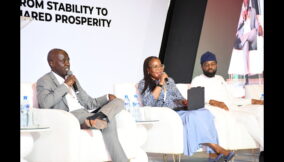
She started with a dream of paediatrics and a failed exam. She is now the Technology Operations Manager keeping Nigeria’s financial infrastructure alive, and one of the most consequential engineers working in African fintech today.
The girl who wanted to save lives
Temitayo Alade grew up in Nigeria with a clear idea of what her future looked like. Medicine. Specifically, paediatrics. The desire was not abstract; it was rooted in something concrete, the drive to diagnose, to intervene, to fix what was broken before it became irreparable.
She watched medical dramas and recognised in them something she already carried, a temperament built for problem-solving under pressure.
Life interrupted the plan.
After performing below her own expectations in her first Joint Admissions and Matriculation Board (JAMB) examination, she found herself in a preparatory period she had not anticipated. It was during that time, visiting a brother-in-law who worked as a full-stack developer in Lagos, that a door opened that she had not known existed.
He sat her down and showed her something simple but, for Alade, transformative: how code, invisible strings of logic typed into a terminal, could produce something a human being could see, use and depend on. The backend became the front end. Instruction became the interface. She was completely transfixed.
She rewrote the JAMB examination and performed exceptionally. She gained admission to study Computer Science at the University of Ilorin, graduating in 2018. The destination had changed. The instinct, to understand how things work and to fix them when they break, had not changed at all.
The long walk to finding where she belonged
University was not straightforward. Computer Science presents students with a vast terrain and offers little guidance on where to plant a flag. Alade began where most beginners begin, drawn toward full-stack development by the memory of what had first captivated her. But it was the workforce, not the classroom, that would reveal her true discipline.
In 2017, during her studies, she took her first professional step as a Junior Web Developer at NERVE IT, building a debt management web application and learning the fundamentals of how software is constructed and deployed. It was disciplined, exacting work, and it gave her the foundations that would underpin everything that followed.
In 2019, one year after graduating, she joined Qore, one of Nigeria’s foremost fintech infrastructure companies, as an Application Administrator intern. The shift was decisive.
For the first time, she was not building applications. She was responsible for keeping them alive, for the microfinance banks and financial institutions that ran their daily operations on Qore’s platforms. She worked on real-time monitoring, strengthened business continuity systems and designed a comprehensive log management framework that tracked how services behaved across thousands of daily events.
She was, without yet knowing the formal name for it, practising Site Reliability Engineering. And she was noticing something that would take years to fully articulate: the data her monitoring systems produced contained far more intelligence than anyone around her was extracting from it.
A discipline with a name, and a purpose
Site Reliability Engineering (SRE) is a practice pioneered at Google and now standard at technology organisations worldwide. It sits at the intersection of software engineering and infrastructure operations. Its central question is not how to build a system, but how to ensure that a system, once built, continues to serve the people who depend on it, under real-world conditions, at scale, under stress.
In Nigeria’s fintech sector, where a payment system failure means a microfinance bank cannot process withdrawals, where a card outage means someone cannot access their own money at 11 pm before a journey, reliability is not a technical preference. It is a social contract. Alade understood this from her first week.
Her performance as an intern led to her promotion within Qore in 2022 to Function Lead, App Admin Operations, managing a team of four engineers and taking full ownership of the systems she had previously only monitored. The title was new. The drive was the same as when she had wanted to be a paediatrician: understand the system, identify where it can fail, intervene before it does.
“Once you understand a system properly, you begin to understand where it can fail and how to prevent it. That is the entire discipline.”
Temitayo Alade, Technology Operations Manager, Qore
Five years, five breakthroughs
Over five years at Qore, Alade led a series of engineering initiatives whose outcomes have been formally documented and corroborated by the organisation’s internal performance records. Each built on the last. Together, they constitute a body of work that would be remarkable in any technology market. In Nigeria’s fintech infrastructure sector, they represent a measurable step change in what resilient operations can look like.
Her verified contributions between 2020 and 2025:
• Observability and service reliability (2020-2021): Alade designed and deployed a real-time graphical dashboard representing Service Level Objectives (SLOs) across Qore’s live services, giving leadership and engineering teams their first unified view of system health. The platform transformed the team’s posture from reactive to anticipatory, delivering a 30 per cent improvement in proactive incident management within months of deployment.
• Self-healing systems architecture (2022): By systematically mapping failure patterns and studying system behaviour at scale, she developed automated self-healing implementations that could identify and remediate faults before they reached end users. The approach reduced recurring operational issues by more than 90 per cent, freeing engineering teams to build rather than firefight.
• Incident resolution and service continuity (2022-2023): Redesigned monitoring frameworks and escalation protocols cut the average incident resolution time by approximately 40 per cent. Critical outages that had previously endured for close to two hours were brought to under ten minutes. For microfinance bank customers transacting on Qore’s platform, those ninety minutes are the difference between a normal working day and a crisis.
• Disaster recovery and cloud resilience (2023): As Qore accelerated its migration to cloud environments, Alade led the design and implementation of multi-region failover strategies and disaster recovery plans. Recovery and switchover time fell by more than 80 per cent. Regional cloud failures, previously capable of causing extended service outages, became contained, managed events.
• Autoscaling architecture for peak financial traffic (2023-2025): Financial platforms experience sharp, unpredictable transaction spikes during salary cycles, public holidays and festive periods. Alade designed an autoscaling architecture that dynamically allocates compute resources in real time. The implementation improved Qore’s transaction handling capacity by more than 80 per cent, protecting customer experience during the moments it was under greatest pressure.
Each figure has been confirmed by Qore’s internal operational records and is attributable to Alade’s direct engineering and leadership interventions, as attested by her employer.
What her colleagues say
Alade’s impact at Qore is not a self-assessment. Those who have worked alongside her, and above her, speak to a consistent pattern of technical excellence combined with an unusual capacity for institutional improvement.
“Temitayo is an exceptional technology leader whose work has significantly improved system reliability and operational resilience at Qore. Her ability to combine deep technical expertise with strategic thinking and leadership has made a lasting impact on both the organisation and the customers we serve.” Boluwatife Lawal, Group Head, Technology and Service Operations, Qore
“Temitayo demonstrates outstanding technical and operational excellence. Her contributions to automation, incident management, and reliability engineering have strengthened our technology platforms, while her thought leadership continues to influence the wider technology community. Ola Soladoye, Function Lead, App Admin Operations, Qore.
The writer who found a new audience
Some engineers accumulate expertise and keep it inside their organisations. Temitayo Alade has chosen a different path. In the past year, she has published two substantial analytical articles in major Nigerian national newspapers, establishing herself as a public thinker in her field at a time when Nigeria urgently needs more of them.
The first, published in ThisDay in April 2026, was titled “When Reliability Signals Become Fraud Signals.” Its central argument was striking: the most powerful early warning signals for financial fraud are not found in transaction data, where every fraud detection team is already looking. They are found in infrastructure monitoring data, the API call spikes, authentication failure bursts, and rapid retry patterns that Site Reliability Engineers read every day but rarely share with fraud teams.
The second article, published in BusinessDay in May, 2026, addressed a different but equally pressing question: how organisations can fundamentally transform the way they handle system failures. Drawing on her years of hands-on production experience at Qore, Alade proposed a five-stage operational framework she named DMSLL, standing for Detect, Measure, Stabilise, Scale and Learn.
The framework provides a disciplined sequence for managing system failures from the moment they are detected to the point where the organisation has extracted learning that prevents recurrence. “Detect” identifies the failure early, before it cascades. Measure establishes the precise scope and impact. Stabilise contains the damage and restores minimum viable service. Scale ensures the fix can absorb future load. Learn closes the loop by embedding the knowledge gained into the organisation’s processes and systems.
What distinguishes DMSLL from standard incident response playbooks is its insistence on the fifth stage. Most teams, under pressure to restore service quickly, stop at stabilisation. Alade’s argument is that the learning phase is where the real value lies, and that organisations that systematically skip it are condemned to face the same failures repeatedly.
Leading from the front
Today, Alade leads cross-functional teams at Qore spanning technical support, service monitoring and application administration. She has built a department concerned not just with keeping systems running, but with continuously improving the processes and frameworks that govern how the organisation responds when things go wrong, and ensuring that those improvements persist rather than being forgotten in the next crisis.
She has sat in emergency meetings with executive leadership during live outages, translated cascading system failures into clear decisions under pressure, and then rebuilt the processes so those failures became progressively less likely to recur. This combination of deep technical competence and operational leadership is uncommon at her level of seniority and rarer still among women in infrastructure engineering.
Her enthusiasm for automation connects rigorous engineering thinking to broader design philosophy. “Automation almost feels like understanding how magic works,” she says. “You give a system instructions and it responds exactly how you designed it to.” This is not the language of someone managing processes. It is the language of someone architecting intelligent systems.
What she is building beyond Qore
Alade’s contributions extend beyond her employer and beyond the pages of national newspapers. She has become an active presence in Lagos’s technology community, participating in industry forums and mentorship initiatives focused on building the next generation of reliability engineers in Nigeria. She is particularly committed to the visibility of women in technical infrastructure roles, a field where female practitioners are a small minority globally and a still smaller one on the African continent.
“Women bring creativity, empathy, innovation and different perspectives into problem solving,” she said. “These qualities matter in engineering. The field is better when women are in it, at every level.” She is not content to say this in interviews. Her two published frameworks, both proposing structural changes to how engineering organisations operate, are themselves a demonstration of the kind of thinking the industry gains when women lead.
To young women considering careers in technology infrastructure, her message is direct and evidenced: Site Reliability Engineering is not an alternative option for those who could not find another path. It is a discipline that demands some of the most rigorous systems thinking in the industry. It is where Nigeria’s financial infrastructure is built, maintained and protected. And it is a field where women can, and do, lead.
What her career means for Nigeria
Nigeria’s technology conversation is frequently dominated by consumer-facing products: payment apps, lending platforms, digital banks. Less visible, but more foundational, is the infrastructure layer on which those products depend. When a fintech application processes a transaction at midnight without interruption, when a fraud attempt is caught before a single naira is lost, when a system failure is detected in minutes rather than hours, it is because someone with Alade’s expertise has been working to make it so.
She has published two frameworks that advance the practice of reliability engineering in Nigeria and propose structural changes that organisations in any sector can adopt. She has built and runs a team that has measurably reduced failure rates, incident durations and recovery times across one of the country’s most critical financial platforms.
She started from a preparatory year she had not planned for, drawn into technology by watching a family member make code produce something useful, and found a discipline by accident on her first day of work. She has spent the years since building, improving, writing, teaching and leading.
She started wanting to save lives. By a different route, and with a different kind of medicine, she is.

Join BusinessDay whatsapp Channel, to stay up to date
Open In Whatsapp