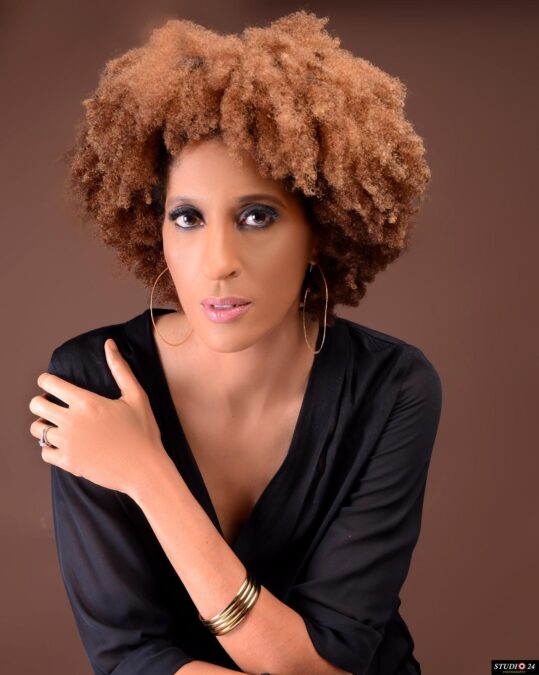
Tonye Faloughi-Ekezie is a Nigerian entrepreneur, storyteller, and special needs advocate whose work sits at the intersection of creativity, research, and systems change. Inspired by her daughter Simone’s Down syndrome diagnosis and recovery from life-threatening heart complications, she created Ugo and Sim Sim, the world’s first picture book series featuring a Black main character with Down syndrome, and later founded the Simone’s Oasis Foundation.
A former TV and film producer, Faloughi-Ekezie has worked on productions including Tinsel, Big Brother, Idols, Naija Sings, and Kunle Afolayan’s October 1. Through Simone’s Oasis, she uses books, animation, music, podcasts, and community programming to challenge stereotypes and celebrate neurodiversity. Faloughi-Ekezie has spoken at the United Nations, the World Bank, the Dear Mom Conference in the USA, and the INSAR Annual Conference. She was named by The Guardian UK as one of the “Ten Most Inspiring People” of 2024 and is a recipient of awards from American Express and the Tides Foundation.
In this interview with IFEOMA OKEKE-KORIEOCHA, she opens up about transitioning from prime-time film sets to grassroots advocacy, the systemic cultural and colonial biases holding back Nigerian publishing, and how her newly launched Neurodiverse Creators Lab is structurally carving out career pathways for neurodivergent youth within Nigeria’s multi-billion naira creative economy.
Your background includes producing major African entertainment hits like Tinsel and October 1. How did your experience in prime-time television shape the specific way you approach advocacy through the Simone’s Oasis Foundation?
My career in television and film production, I really believe however, unintentional was a foundation on which I built and developed my advocacy. As a producer you have to be extremely disciplined. You have to be able to interact with different teams and back then it was really very much a male dominated space and I had no problems in navigating, leading and garnering the respect of teams that were often majority made of men.
So I think I had to be quite resilient because sometimes we were travelling in isolated places in the country. I learned to be disciplined and extremely hard-working because the hours in production are not normal hours. Sometimes you’re on sets or production 18 hours 20 hours.
If I hadn’t had first the experience in production, dealing with creatives, thinking creatively, editing scripts, giving feedback and sitting with editors in postproduction, I don’t think I would have ventured into the style of the foundation that we do, which is from a creative perspective.
When I wrote my first book; while I wrote it because it was for a personal reason, it was me pulling on my previous experience and skills. It gave me the initial confidence to venture into the space then make that the basis of our advocacy as a foundation.
You have noted before that media representation for Black and African children with disabilities was virtually non-existent when you started. Through the foundation and the Ugo and Sim Sim series, what were the immediate cultural walls you had to break down within the Nigerian publishing and media landscape?
I think there were two major challenges that I had to deal with. One was the attitude that publishers in the media landscape had and some still continue to have about the quality of Nigerian books. I was literally told by retail outlets and distributors that they didn’t carry Nigerian books that they only carried for foreign books. I really couldn’t understand that because if I was doing the same thing, for example in England, there was no way that a retail outlet or distributor would tell me that they do not carry British books. It would be unfathomable. However, here they said it to me without hesitation as if I was the one who was crazy. The hangovers of colonial mentality are still very much alive in how publishers and distributors approach Nigerian works in my case Nigerian children’s books. The fact that they weren’t even willing to consider, they just assumed.
I remember doing videos in 2021 to shame retail outlets and rating them in terms of what books they carried, if they carried Nigerian books, how many they had et cetera. I think I also surprised a lot of people because my books are not only creatively hundred percent Nigerian; they are printed in Nigeria too. People always think that the books are printed abroad. We’ve never done that. One of the points I like to make is that our books are 100 percent made in Nigeria end to end so that people can see that they deserve to sit on the shelves in Nigeria and have prime placing with foreign books. Proof that Nigerian made means quality.
Secondly a big wall I came across was the prejudice and stigma regarding disability. I was literally told by publishers and some outlets that no sane parents would buy a book for their child featuring an abomination. I was honestly shocked to hear that but in a way also grateful to know what I was fighting against and I was ready for that fight.
I therefore had no choice but to take the self-publishing route which was a steep learning curve. But it means I understand what it takes and have a deeper understanding of how publishing actually works. So while I was turned down by every publisher I applied to, I had the independence, the drive and the power to make decisions on my own. It was after selling 5000 books that publishers in Nigeria began to look for me. I now have an amazing editor and publisher in Lola Shoneyin and Ouida books who really understand my mission in using creative advocacy to make real life impact.
How do you balance the vulnerability of sharing your personal family journey with Simone with the professional, strategic demands of running an expanding foundation?
To be honest, the two are very much intertwined and it is this personal journey that often feeds the focus of the work of our foundation. It is important that I share aspects of Simone and myself and our journey but I’m very conscious to not share every single detail of our lives. It is important for us to still have some aspect of privacy, especially keeping in mind the consideration of my husband and my son.
I’m a busy Mum. I don’t make slick videos about what we’re doing. I share openly and authentically when I do. I’m not trying to be someone I’m not. Sometimes I have to share things that are difficult and I really have to think about that before I do. But because I am actually living this, it’s important to share to show the context to show the journey and hopefully be able to give others insight and hope.
So I’ll give you an example: Simone is growing up. She’s 10 and I can see her growing up and that made me think about her future. What pathways are available to her for a career for a life? When I researched, it was so disappointing to see the lack of inclusion in programs and training in Nigeria for teenagers and young adults with Down syndrome, autism and other challenges. I felt for my daughter and others like her that we needed to form a template and ecosystem to begin to build inclusive pathways into Nigeria’s creative industries. That’s how our Neurodiverse Creators Lab was born.
In the first quarter of 2026, the foundation launched the pilot Neurodiverse Creators Lab, partnering with heavyweights like Kunle Afolayan Production Academy, Chocolate City Music, and SMIDS Animation Studio. What was the blueprint for bringing these corporate creative giants to the table, and what have been the early milestones of this lab?
Over the years I think I’ve built a strong and good reputation on any job I’ve done. I make sure to work hard and treat people with respect whatever their level. I always try to give it my best. People remember that effort and I’ve kept relationships over the years even though I was no longer having a career as a producer in the mainstream industry.
To be honest, bringing the giants to the table was pretty easy as a result. Kunle and I have kept our friendship over the years. Him trying to draw me back into the industry, me refusing, but he has continuously encouraged me with my advocacy and has kept up with what I was doing. I too whenever I get a chance visit him at his office in KAP HUB and make sure I eat from his restaurant which does the best ‘Amala’ and it was over one of these ‘Amala’ visits that I informally pitched the idea of NCL to him and his business partner Seun Soyinka. Before I even finished, they were excited and said yes.
As regards Chocolate City; that was easy too because co-founder Paul Okeugo has a son with autism. It was his wife, Esther, who connected us when I was struggling to find dads to come on to my Special Mums Africa podcast back in 2023 and we have become firm friends and allies since so much so that I encouraged him to write a children’s book and introduced him to my publisher. Last year he and Esther authored their first book ‘ Zizah Does Things Differently’.
SMIDS Animation again was easy. I have so much respect for founder Dami Solesi and in fact SMIDS is part of our foundation story from the beginning when we started to make our animated music videos for YouTube, SMIDS helped us to do that. So it felt only natural for them to be our partner in NCL.
Many NGOs focus strictly on immediate clinical support, but Simone’s Oasis intentionally bridges creativity with advocacy (animation, podcasts, music, literature). Why do you believe creative media is a more effective tool for systems change in Nigeria than traditional advocacy models?
To be honest, I just think there are far more qualified people in better positions to offer clinical support. That is not my area of specialisation. My mindset was how could I add to the already good work that’s being done? How could I change perceptions and mindsets? And I felt and still do feel that the best way to do this is through storytelling. Everyone loves a good story. Without preaching without lecturing you can open people’s minds into different lived experiences and begin to have them think about what that means for them and for others.
For example with the books, if a child loves the character of Sim Sim (which most do) and begins to understand the concepts around that character, when they encounter such in real life, they have an awareness and can be advocates not only in their home, because their parent has to read the book to them, but also in their school and beyond.
When listeners, viewers, readers connect with a story it can cause a mind shift which feeds into change in behavior and attitudes that have real life impact, leading to changes in policy for example and inclusive education for the better. If we’re able to get this connection young, it means that these young people grow up to not think it’s strange for someone like my daughter be to be in class with them, or to be at work with them, or to have access, or to be at the decision-making table with them using their own voice advocating for themselves.
Operating a special needs foundation in Nigeria’s current macroeconomic climate comes with intense challenges. How is Simone’s Oasis navigating funding, sustainability, and scaling its community programming amidst rising costs?
Funding is so difficult. It is our biggest problem. In the last year we’ve been able to scale from just me being the only employee, to now us being three as well as having a team that we employed during projects as well as volunteers. The only reason I’ve been able to do that is because we received two international grants last year; one from American Express and one from Tides Foundation (both US organizations). To date we have not received any significant funding or sponsorship from any Nigerian organisation. We run basically from my hustle and kind donations from individuals and occasional small sponsorship.
What organisations fail to see is that the special needs community and ecosystem is huge and growing. On average families raising special needs children spend 30-40 percent more than those raising neurotypical children. Yet there are no products or incentives catered for us. It’s a real lack of vision from corporate organizations.
It is extremely challenging, but this past year has taught me that we must keep going because the impact we are making is significant, and at some point, with our foundation becoming more known both here and abroad, we should be able to get the substantial support that is very much needed.
In the meantime, we continue to apply for grants, pitch to organisations and are now for the first time providing services to clients who are interested in supporting our organisation by hiring us to implement some of their creative work as a way of supporting our inclusive NCL team and the mission to build inclusive pathways into Nigeria’s creative industries. It is quite exciting.
You recently presented research at the INSAR 2026 Conference examining how media narratives impact the well-being of parents raising autistic and neurodiverse children in Nigeria and the diaspora. What were the most striking or unexpected findings from that data?
I think it confirmed for me just how important media narratives are for parents in this situation. We need to make it easier for them to get the information they need and whilst social media seems to be the most used area for them to source the information, it also shows that it’s extremely toxic and adds to their stress. The context of the Nigerian and black perspective matters also. So it’s both about making it easier for them to find the information they need, but also creating that information in a culturally appropriate context. To be honest I would love to work with a corporate organisation for example a Telco in creating and aggregating this content for these parents.
You contributed directly to the Creative Industries Development Bill under the Office of the Presidency. How does this bill explicitly safeguard or support inclusive education and career pathways for neurodiverse youth within Nigeria’s booming creative economy?
I was brought into this a few years ago specifically for this perspective in making sure that in all the elements that were put in, we were also thinking in an inclusive manner; looking at inclusive practices within the industry, inclusive practices within the education and career pathways. In supporting special-needs practitioners in the creative industries.
However, to date we’re yet to see this bill implemented even though some of the elements have been adopted in the new administration. Government takes a long time and to be honest as a foundation we’ve not even received any support from the government. It certainly has its place, but because time is such an issue in the success of people with disabilities, we can’t wait and so we do what we can now. Hopefully one day Lagos state or Federal government will support, with funding, the work we do.
From speaking at the United Nations and the World Bank to seeing your books placed permanently in London archives and galleries—how has this international recognition changed the foundation’s leverage back home in Nigeria?
It has given me so much more confidence and it means that people take what we do more seriously. I think people have a concept of what an NGO does and how they do what they do, and we don’t operate in that mold at all. We are definitely piquing interest as a result and people are curious. I come from the perspective that we’re not begging for money, we’re not begging for support. We actually add value to any organisation that wants to support us, that wants to work with us. Their investment comes back to them and can be measured and seen through data.
We’re about to start another pitching cycle and with the work we’ve done this past year the shift in attitudes is noticeable. Why? It’s the same old story here in Nigeria. We have to have foreigners like us before our own people pay attention. It’s quite unfortunate and a hangover from colonial days.
When you look at the landscape of education, media, and policy in Nigeria today, what does a future look like where inclusion is truly ‘designed in from the very beginning’ rather than treated as an afterthought? What is the next major mountain for Simone’s Oasis?
The landscape…everything is intertwined, it’s intersectional and within that we have to also include the health sector as well. Recently I was invited to CCHubbs EdTech Mondays to discuss the rethinking of inclusive and accessible learning for all. The challenges are really a lot, but I was also extremely hopeful looking at some of the efforts that are being made by individuals and small entrepreneurs, like Victor Ogunbiyi of Dawn AI, in building from the very beginning a.k.a. inclusion by design, technology to bridge the gap in access to healthcare and education.
But even within that, there’s still a huge hurdle to be able to have access to those technologies in the first place. The onus cannot just be on individual parents like me. Government must do their part. Corporate organisations must do their part. I know that entrepreneurs are trying and to be honest, like parents we can only do so much on our own to bring that deeper felt impact to a wider population.
As for the foundation, things are really challenging financially, but at the same time it is really exciting too for several reasons:
1. As I mentioned earlier, having our first service client.
2. Two of our NCL students are interning with Trace media as a result of their successful participation in our Neurodiverse Creators Lab pilot. We have literally shown and built a pathway to skills and careers in the creative industries.
3. Two new Ugo and Sim Sim books in the pipeline
4. We are developing a creative project to build a tool to assist neurodivergent children in learning skills and adapting behaviours.
At the end of the day I am blessed to be doing what I love with a committed and passionate Simone’s Oasis team. We also have an oga, in Simone, who inspires us every day with her attitude to life. When we feel low, we get energy from seeing her approach to life and its challenges. It’s from her we have learned to be kinder, to care about others, to be generous and live a life seeing value in the smallest of things.
I am certain we will conquer the financial mountain that is restricting us from reaching our fullest potential and making the kind of impact that changes lives on a larger scale.

Join BusinessDay whatsapp Channel, to stay up to date
Open In Whatsapp