The sweeping reforms introduced by the Central Bank of Nigeria (CBN) under Olayemi Cardoso, it’s governor are increasingly reshaping investor perception of Africa’s largest economy, with renewed foreign capital inflows, improved exchange rate stability and rising confidence in Nigerian assets signaling a gradual return of global investors to the country.
After years of foreign exchange distortions, weak investor confidence, dwindling reserves and concerns over policy credibility, Nigeria’s financial markets are beginning to witness a reversal in sentiment as reforms aimed at restoring transparency, market confidence and macroeconomic stability take root.
The reforms, which include exchange rate unification, tighter monetary policy, improved foreign exchange market transparency, strengthened financial sector regulation, clearance of foreign exchange backlogs and banking sector recapitalisation, are creating fresh optimism around the Nigerian economy despite mounting global uncertainties and geopolitical tensions.
The renewed confidence is coming at a time when global markets are facing heightened volatility triggered by the ongoing Middle East crisis, rising debt pressures across emerging economies and slowing global growth. Yet, Nigeria appears to be regaining the attention of international investors seeking opportunities in frontier and emerging markets.
For years, foreign investors had remained cautious about Nigeria due to multiple exchange rates, limited access to foreign exchange, policy uncertainty and concerns about the repatriation of funds. These challenges weakened foreign portfolio investment inflows and reduced investor participation in the country’s debt and equity markets.
However, the current administration, working closely with the CBN, embarked on far-reaching reforms shortly after assuming office over two years ago. The reforms included liberalising the foreign exchange market, ending Central Bank financing of fiscal deficits, removing fuel subsidies and strengthening revenue collection.
The impact of those policies is gradually filtering across major sectors of the economy.
One of the most significant steps taken by the apex bank was the unification of Nigeria’s multiple exchange rates, a policy long demanded by investors and multilateral institutions. The CBN also moved to clear over $7 billion foreign exchange backlog owed to investors and businesses, a development that restored confidence in the ability of investors to access and repatriate funds.
The reforms significantly improved Nigeria’s investment outlook and strengthened confidence in the country’s financial system.
International reserves have also improved, while stability has gradually returned to the foreign exchange market, helping to reduce uncertainty around the naira.
The renewed stability in the exchange rate has become one of the strongest drivers of foreign investor interest in Nigerian assets, particularly government securities and fixed-income instruments.
The return of investor confidence has also been reflected in Nigeria’s successful return to the international capital market last December, as well as recent upgrades by international rating agencies.
Analysts say these developments are helping to reduce Nigeria’s sovereign risk profile and positioning the economy for stronger capital inflows.
Nigeria’s sovereign risk spread has now fallen to its lowest level since January 2020, effectively erasing much of the premium accumulated during the COVID-19 pandemic and subsequent economic strains.
The improving macroeconomic environment is also being supported by declining inflationary pressures and tighter monetary policy coordination between fiscal and monetary authorities.
Cardoso explained that restoring macroeconomic stability requires collaboration between fiscal and monetary authorities to effectively manage inflation, stabilise the exchange rate and sustain investor confidence.
According to him, “managing disinflation amidst persistent shocks requires not only robust policies but also coordination between fiscal and monetary authorities to anchor expectations and maintain investor confidence. Our focus must remain on price stability, the planned transition to an inflation-targeting framework, and strategies to restore purchasing power and ease economic hardship.”
The CBN’s commitment to orthodox monetary policy has also strengthened investor confidence in the credibility of Nigeria’s economic management framework.
After years of unconventional monetary interventions, the apex bank has focused on restoring policy discipline, tightening liquidity conditions and rebuilding trust in the financial markets.
Cardoso noted that achieving macroeconomic stability requires sustained vigilance and a proactive monetary policy stance.
“As we shift from unorthodox to orthodox monetary policy, the CBN remains committed to restoring confidence, strengthening policy credibility, and staying focused on its core mandate of price stability,” he said.
The improved investor sentiment has translated into stronger foreign capital inflows into the economy.
Cardoso recently disclosed that Nigeria now receives roughly $600 million monthly in diaspora remittances, further supporting external reserves and foreign exchange liquidity.
He explained that recent gains, including lower inflation, exchange rate stability and stronger reserves, have significantly boosted investor confidence and capital inflows into the economy.
According to him, Nigeria’s experience shows that the spillover effects from global economic uncertainties have remained relatively contained due to positive reform outcomes, including stronger reserve buffers and an enhanced monetary policy framework.
Beyond foreign exchange reforms, the CBN has also focused heavily on strengthening the banking sector to ensure long-term financial system stability and support economic expansion.
The apex bank introduced new minimum capital requirements for banks, effective March 2026, as part of efforts to position the banking sector to support a projected $1 trillion economy.
The recapitalisation drive triggered a wave of capital raising activities across the banking industry, with several banks successfully completing rights issues and public offerings ahead of the deadline.
Cardoso said the recapitalisation exercise is aimed at strengthening banks’ capital buffers and improving their capacity to support economic growth through increased lending to critical sectors.
According to him, the banking sector remains resilient, with key prudential indicators remaining within regulatory thresholds.
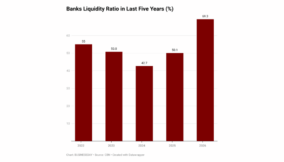
“The non-performing loan ratio remains within the prudential benchmark of five percent, showcasing strong credit risk management. The banking sector liquidity ratio comfortably exceeds the regulatory floor of 30 percent, a level which ensures banks are maintaining adequate cash flow to meet the needs of customers and their operations. The recent stress test conducted also reaffirmed the continued strength of our banking system,” he said.
He added that many banks have already met the new capital requirements ahead of the 2026 deadline.
“I am pleased to note that a significant number of banks have raised the required capital through rights issues and public offerings well ahead of the 2026 deadline. I believe that the banking sector is in a strong position to support Nigeria’s economic recovery by enabling access to credit for MSMEs and supporting investment in critical sectors of our economy,” Cardoso stated.
The broader economy is also beginning to reflect the positive effects of the reforms.
In its latest Global Economic Prospects report, the World Bank upgraded Nigeria’s economic growth forecast for 2026 to 4.4 percent from the 3.7 percent projection announced earlier in June 2025.
The World Bank projected that Nigeria’s growth would strengthen further in 2026 and 2027, driven by expansion in services, improved agricultural output and stronger non-oil sector performance.
According to the report, “Growth in Nigeria is forecast to strengthen to 4.4 percent in both 2026 and 2027, the fastest pace in over a decade. This further firming of growth is anticipated to be underpinned by a continued expansion in services and a rebound in agricultural output, with a modest acceleration in non-oil industry.”
The report added that ongoing reforms, including tax reforms and prudent monetary policy, are expected to continue supporting economic activity, improve investor sentiment and further reduce inflationary pressures.
The CBN itself also projected a positive outlook for the economy in its macroeconomic outlook for 2026.
According to the apex bank, the Nigerian economy is expected to grow by 4.49 percent in 2026, supported by structural reforms and gradually easing monetary conditions.
“The year 2026 presents a realistic window of opportunity for macroeconomic stabilisation. The Nigerian economy is expected to continue expanding, with growth projected at 4.49 percent in 2026. The projection is hinged on continued gains from broad-based structural reforms and a gradually easing monetary policy stance,” the report stated.
Despite the improving outlook, risks to the economy remain.
The World Bank warned that rising geopolitical tensions, high debt service costs and structural constraints continue to pose challenges to growth across Sub-Saharan Africa.
The bank noted that higher fuel, food and fertiliser prices resulting from global disruptions could worsen inflationary pressures and increase hardship for vulnerable households.
Similarly, the International Monetary Fund (IMF) warned that the ongoing Middle East conflict continues to cloud the global economic outlook and disrupt oil and gas markets.
However, the IMF noted that countries like Nigeria that are able to sustain oil and gas exports despite the crisis could face relatively lower risks compared to heavily oil-importing economies.
Kristalina Georgieva, IMF managing director, said the global economy is once again being tested by geopolitical tensions and supply disruptions.
“Our focus remains on how best to weather this latest shock and ease the pain on economies and people. This requires understanding the nature of the shock, the channels through which it affects the economy, the size of the impact, and the policies that can mitigate it,” she said.
For Nigeria, the growing resilience of the economy amid global uncertainty is increasingly being linked to the reforms implemented by the CBN and the federal government over the past two years.
While inflationary pressures and cost-of-living challenges persist domestically, analysts believe the restoration of investor confidence, improved foreign exchange liquidity, stronger reserves and banking sector resilience are gradually laying the foundation for long-term economic stability.
The return of foreign investor appetite for Nigerian assets signals a major shift from the deep skepticism that previously surrounded the economy.
With policy reforms beginning to yield results, Nigeria is positioning itself once again as a key investment destination in Africa, even as global economic uncertainties continue to test emerging markets worldwide.

Join BusinessDay whatsapp Channel, to stay up to date
Open In Whatsapp