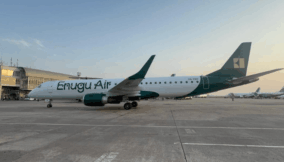
In recent times, the aviation sector has been in the news for not so good reasons. From Adams Oshomole’s clash with Air Peace a few weeks ago to an incident involving popular musician, Wasiu Ayinde (KWAM 1) and ValueJet, and, most recently, the Comfort Emmanson’s incident on Ibom Air, the aviation sector has received a number of reviews in recent times.
In the case of Ayinde and ValueJet, the Nigeria Civil Aviation Authority (NCAA) issued a statement announcing the suspension of Oluranti Ogoyi, pilot-in-command (PIC), and Ivan Aloba, her co-pilot, for breaching safety protocol at the Nnamdi Azikiwe International Airport, Abuja. On the other hand, KWAM 1 was banned from flying for six months.
Emmansion, in her own case, was charged to court and remanded in prison custody pending the perfection of her bail conditions.
Nigerians have continued to describe the treatment meted out on Emmansion as ‘double standards,’ considering that the same treatment was not given to Oshomiole, a senator and former Edo State governor, and Kwam 1.
Read also: Nigeria issues Air Tanzania foreign carrier permit to boost aviation ties
However, there are laws guiding aviation conduct.
The International Civil Aviation Organisation (ICAO) defines an ‘unruly passenger’ as one who fails to respect the rules of conduct at an airport or on board an aircraft. The passenger fails to follow the instructions of the airport staff or crew members and thereby disturbs the good order and discipline at an airport or on board the aircraft.
The Tokyo Convention (1963), also known as The Convention on Offences and Certain Other Acts Committed on Board Aircraft, makes it unlawful to commit “acts which, whether or not they are offences (against the penal law of a State), may or do jeopardize the safety of the aircraft or of persons or property therein or which jeopardize good order and discipline on board.”
Application of International laws in Nigeria
In 2020 and 2021, the U.S. Federal Aviation Administration (FAA) began seeing what it described as “a disturbing increase in incidents where airline passengers have disrupted flights with threatening or violent behaviour.”
On 13 January 2021, the FAA administrator signed an order directing a stricter legal enforcement policy against unruly airline passengers. In extreme cases, the FAA has levied significant civil penalties against unruly passengers.
The Protocol to Amend the Convention on Offences and Certain Other Acts Committed on Board Aircraft (Montréal Protocol 2014 or MP 14) was adopted with the objective of strengthening the capacity of states to curb an escalation in the severity and frequency of incidents of unruly and disruptive behaviour occurring on board aircraft.
International Civil Aviation Organization (ICAO) sets standards for aviation safety and security, which states are required to establish and enforce as national rules.
An unruly and disruptive passenger may be subject to the laws of one or more of these countries. This is dependent upon the national law implemented therein and on whether a country is party to the Montréal Protocol 2014.
While the Nigeria Civil Aviation Authority (NCAA) is not directly derived from ICAO’s laws, it operates within the framework established by ICAO’s Chicago Convention and its associated Standards and Recommended Practices (SARPs).
The NCAA was established in response to ICAO mandates for member states to create civil aviation authorities. ICAO provides the foundational standards, and it ensures these are implemented and enforced within Nigeria’s aviation industry.
Read also: Tinubu’s aviation team targets lasting fix for Nigeria’s airport infrastructure gaps
The Civil Aviation Act 2022 also incorporates the Tokyo Convention 1963, along with other international agreements, to strengthen aviation safety and security in Nigeria.
International law and penalties countries are expected to apply
Each State can identify specific offenses and prescribe particular penalties or charges for them. Guidance material is provided in the Manual on the Legal Aspects of Unruly and Disruptive Passengers (ICAO Doc 10117), which contains a list of offences most likely to be committed on board aircraft by unruly and disruptive passengers, which states may choose to incorporate into their national legislation.
Penalties and sanctions are at the discretion of states. Offences and acts may be penalised through a range of options from criminal prosecution to application of civil and administrative sanctions, depending on the seriousness of the offence or act as well as whether the matter needs to be dealt with expeditiously.
Both airlines and airports may engage with law enforcement and aviation safety authorities to support any administrative or criminal sanctions against a passenger found to have engaged in unruly and disruptive behaviour.
Responsibilities of flight crew
Specifics of the responsibilities of flight crew would be in accordance with national regulatory requirements. More generally, the Tokyo Convention and the Montréal Protocol 2014 provides that the aircraft commander may, when there are reasonable grounds to believe that a person has committed, or is about to commit, an offence on board the aircraft, impose reasonable measures, including restraint, which are necessary to protect the safety of the aircraft, or of persons or property therein, or to maintain good order and discipline on board, or to enable delivery of such person to the competent authorities.
The aircraft commander may require or authorise the assistance of other crew members in so doing. Instructions from a crew member to a passenger are deemed to be given on behalf of the aircraft commander.
Basis in law
The Tokyo Convention provides the authority to the PIC to appropriately deal with an unruly passenger and provides protection, under the law, from any subsequent legal proceedings for actions taken against a perpetrator
“For actions taken in accordance with this Convention, neither the aircraft commander, any other member of the crew, any passenger, the owner or the operator of the aircraft, nor the person on whose behalf the flight was performed shall be held responsible in any proceeding on account of the treatment undergone by the person against whom the actions were taken,” it says.
Read also: Aviation unions call off planned strike
While the Tokyo Convention contains provisions for the prosecution and offloading of unruly passengers, it has a jurisdictional gap, which does not automatically allow most states to prosecute a disruptive passenger who has been removed from an inbound foreign registered aircraft.
The PIC can disembark an unruly passenger in any state without coordination with the local law enforcement authorities.
In this case, the individual is unlikely to face prosecution in that state unless the state itself has enacted enabling legislation allowing it to press charges for the offence.
If the PIC wishes the unruly passenger to face prosecution, he/she must land in a state that is a party to the Tokyo Convention and formally deliver the passenger to the local law authorities.
For prosecution to be successful, it must be proven that the passenger committed a serious offence under the law of the State in which the aircraft is registered.

Join BusinessDay whatsapp Channel, to stay up to date
Open In Whatsapp