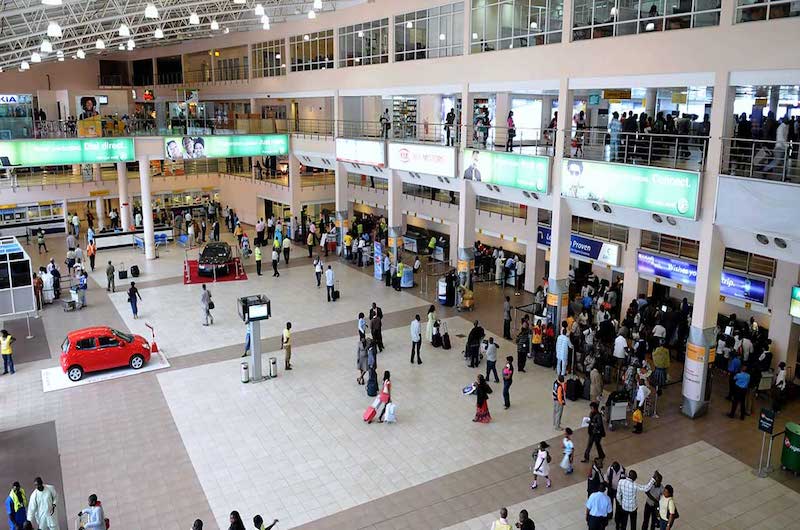
Nigeria’s primary aviation gateway, Murtala Muhammed International Airport (LOS) in Lagos, has broken back into the ranks of Africa’s top ten busiest airports. The hub clinched its position after charting the fastest year-on-year growth rate on the entire continent, driven by a massive surge in local travel demand.
Data released by global aviation analytics firm OAG for June 2026 reveals that Nigeria posted Africa’s largest capacity increase in absolute terms. The country added 130,200 seats to its domestic network—marking a 21.7 percent year-on-year rise in local capacity and signaling an insatiable demand for air travel despite local economic headwinds.
This domestic momentum directly propelled Lagos into the continental top ten, locking in the number 10 spot. According to the OAG data, Lagos recorded a 16.7% increase in total airline seat capacity, with available seats jumping from 357,799 in June 2025 to 417,622 this month.
This double-digit expansion was the highest growth rate recorded among Africa’s top ten busiest hubs. It reinforces Lagos’ position as West Africa’s undisputed aviation engine and highlights a rapid market recovery that is outpacing older, more established regional hubs.
Cairo International Airport (CAI) — Egypt: Offering 1,655,250 seats, Cairo safely retained its title as Africa’s busiest gateway. A 4.0 percent year-on-year increase maintains its massive lead, anchored by major expansions from EgyptAir and local budget carriers.
Addis Ababa Bole International Airport (ADD) — Ethiopia: Driven by the ongoing transit network expansion of Ethiopian Airlines, Addis Ababa posted a robust 8.9 percent growth rate, handling 1,135,516 seats to secure second place.
Tambo International Airport (JNB) — South Africa: Standing as Southern Africa’s primary economic anchor, Johannesburg held onto third place with 1,066,582 seats, representing a steady 2.4 percent year-on-year rise. Notably, South Africa remains the continent’s largest absolute domestic market, providing 1.5 million seats in June.
Mohammed V International Airport (CMN) — Casablanca, Morocco: Handled 665,922 seats, a steady 6.1 percent increase, solidifying its place as a key bridge between Africa, Europe, and the Americas.
Houari Boumediene International Airport (ALG) — Algiers, Algeria: Reached fifth place with 532,381 seats (+2.6 percent), supported by Air Algérie’s strong 11.2 percent capacity push.
Cape Town International Airport (CPT) — South Africa: South Africa’s second gateway handled 515,746 seats (+4.1 percent), proving its growing strength as an independent global tourism magnet.
Marrakech Menara Airport (RAK) — Morocco: Charted an impressive 7.5 percent jump to 496,926 seats, riding a historic wave of leisure and holiday tourism from Europe.
Jomo Kenyatta International Airport (NBO) — Nairobi, Kenya: Held the eighth spot with 486,910 seats (+5.1 percent). Ironically, Nairobi’s hub stayed strong even as Kenya’s internal domestic market suffered a brutal 18.7 percent capacity crash, bleeding 76,400 seats over the year.
Tunis–Carthage International Airport (TUN) — Tunisia: Maintained a stable North African presence at ninth place, managing 422,531 seats (+2.7 percent).
The expansion across these airports directly reflects capacity battle among the continent’s top carriers. Ethiopian Airlines remains the undisputed king of African skies, operating 2 million seats this month alone—a 10 percent jump over last year.
However, North African carriers are closing in fast. Air Algérie logged the fastest growth among top airlines at 11.2 percent, followed closely by Royal Air Maroc at 10.8 percent.
For Nigeria, the 21.7 percent domestic seat jump shows that local airlines are aggressively deploying capacity to capture internal demand. As Lagos reclaims its seat among Africa’s top ten aviation hubs, the focus must now shift to upgrading terminal infrastructure to ensure that this historic growth velocity does not result in ground-level bottlenecks.

Join BusinessDay whatsapp Channel, to stay up to date
Open In Whatsapp