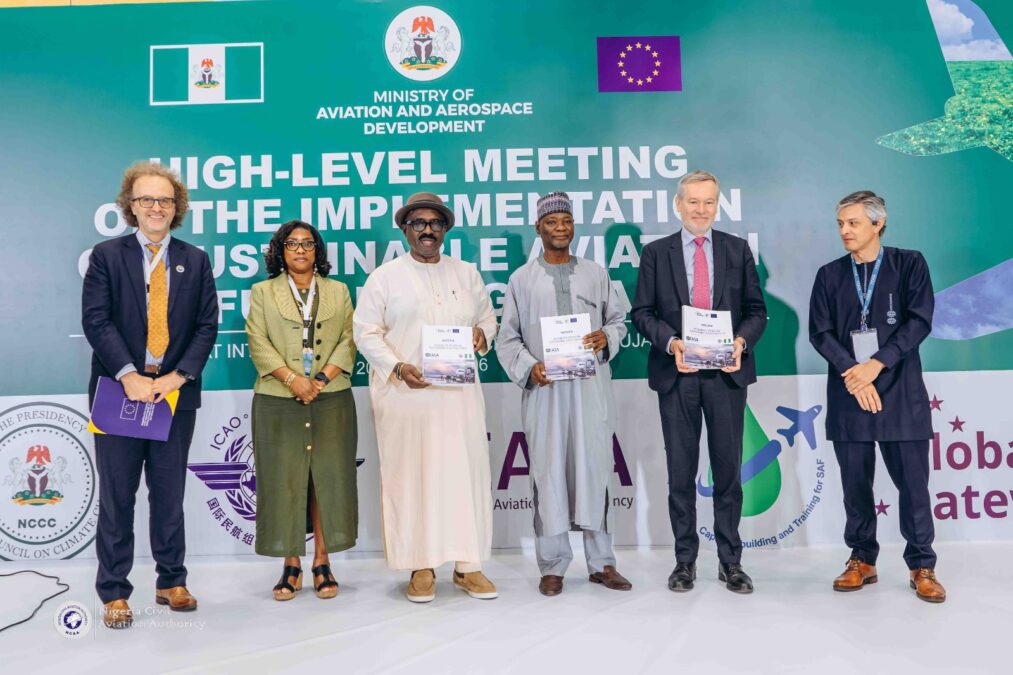
The Federal Government has launched a national Sustainable Aviation Fuel (SAF) programme aimed at reducing carbon emissions from Nigeria’s aviation sector, attracting investment and positioning the country as a leading producer of sustainable aviation fuel in Africa.
The initiative was unveiled on Monday in Abuja, with the inauguration of the National High-Level Sustainable Aviation Fuel (SAF) Steering Committee, the presentation of the National Sustainable Aviation Fuel Feasibility Study and the launch of the International Civil Aviation Organization (ICAO)-supported Sustainable Aviation Fuel Business Implementation Study.
The event, organised by the Nigeria Civil Aviation Authority (NCAA) in collaboration with the ICAO, the European Union (EU) and the European Union Aviation Safety Agency (EASA), brought together government officials, development partners, industry leaders and researchers to advance Nigeria’s transition to cleaner aviation.
Speaking at the inauguration, Festus Keyamo, Minister of Aviation and Aerospace Development, described the initiative as a major milestone in Nigeria’s efforts to build a resilient, competitive and environmentally sustainable aviation sector.
Represented by Ahmed Tijjani Abdullahi, Director of Air Transport Management at the ministry, Keyamo said aviation remains critical to economic growth, trade, tourism and regional integration, but must also contribute to global efforts to reduce greenhouse gas emissions.
Read also: Petrol import habit returns despite Dangote’s growing output
He described Sustainable Aviation Fuel as a strategic opportunity for Nigeria to decarbonise the aviation sector while stimulating investment, creating jobs, strengthening energy security and unlocking value across the country’s agricultural, energy and industrial value chains.
According to the minister, Nigeria possesses significant competitive advantages that position it to become a major Sustainable Aviation Fuel producer on the continent, including abundant feedstock resources, its status as one of the world’s largest cassava producers, extensive agricultural and agro-industrial residues, expanding refining capacity, growing technical expertise and a strategic geographical location.
He commended the ICAO, the European Union, EASA and the NCAA for supporting Nigeria’s Sustainable Aviation Fuel initiative, while also acknowledging the contributions of the technical working groups that completed the National Sustainable Aviation Fuel Feasibility Study.
Keyamo assured prospective investors of the Federal Government’s commitment to providing policy support, an enabling regulatory framework and investment-friendly incentives to facilitate the growth of Nigeria’s emerging Sustainable Aviation Fuel industry.
He said the newly inaugurated steering committee would provide strategic direction, strengthen inter-agency coordination and oversee the implementation of the country’s Sustainable Aviation Fuel programme.
The minister also welcomed the commencement of the ICAO-supported Business Implementation Study, describing it as the next critical phase in identifying commercially viable investment opportunities and developing bankable Sustainable Aviation Fuel projects capable of attracting both domestic and foreign investment.
He reaffirmed Nigeria’s commitment to the ICAO’s environmental objectives and the country’s ambition to become Africa’s leading Sustainable Aviation Fuel production hub while supporting global climate goals.
Read also: Nigeria’s power adviser to headline Sahara energy forum
In his welcome address, Chris Ona Najomo, Director-General of the Nigeria Civil Aviation Authority, said the event marked Nigeria’s transition from planning to implementation in its aviation sustainability agenda.
Najomo noted that the feasibility study, developed under ICAO’s Assistance, Capacity-building and Training for Sustainable Aviation Fuels (ACT-SAF) Programme with financial support from the European Union and technical assistance from EASA, provides the evidence base for transforming Nigeria’s abundant feedstock resources into commercially viable Sustainable Aviation Fuel production.
He reaffirmed the NCAA’s commitment, as the aviation regulator and secretariat of the National High-Level Sustainable Aviation Fuel Steering Committee, to coordinate stakeholders and facilitate successful implementation of the programme.
The event also featured goodwill messages from representatives of the ICAO, the European Union, the Federal Ministries of Innovation, Science and Technology, Agriculture and Food Security, Petroleum Resources, the National Council on Climate Change and NNPC New Energy Limited.
Stakeholders at the event stressed that strong collaboration between government, development partners and the private sector would be essential to developing a sustainable aviation fuel industry capable of supporting economic diversification, strengthening energy security, creating jobs and helping Nigeria meet its climate commitments.
With the inauguration of the steering committee and the commencement of the Business Implementation Study, the Federal Government said Nigeria has entered a new phase in building a national Sustainable Aviation Fuel ecosystem that will support long-term investment and position the country as a regional leader in cleaner aviation fuels.

Join BusinessDay whatsapp Channel, to stay up to date
Open In Whatsapp