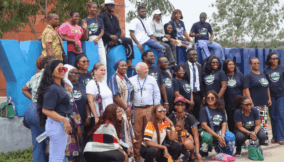
Recently, LINDA MAGAPATON-SANGARET, the new chief marketing officer, Brand South Africa, was in Nigeria with her team to meet and exchange with the Nigerian stakeholders and public. She told OBINNA EMELIKE the efforts of her organisation at managing her country’s reputation, marketing, drawing more investments, visitors among others.
Why Brand South Africa?
Brand South Africa is the reputation management company of the country. It spans everything from investments, manufacturing, tourism and to anything that can have an impact at the national level. We fall under the Ministry of Communication, and also act in the advisory capacity to the Ministry, where we manage reputation. But we also report and do a lot of works with the Presidency.Brand South Africa not only work outside of South Africa, we also work in the country in terms of domestic issues.
Rationale for visiting Nigeria?
We have done a lot of researches recently on the continent. People from our research department have gone around on field research to different countries on the continent to gauge the temperature of what is happening. And effectively, post 1994, we had a lot of goodwill from different countries on the continent, the whole transition process was respected and admired, but dynamism has dived down unfortunately. And in some instances, South Africans have not been very good ambassadors of their country as they moved into different countries on the continent, so, our role now is to fix that because good relations on the continent is a key priority for us and it is one of the reasons for trips such as these to remedy these situations.
Why seek cooperation with Nigeria?
Even in the context of sub region, we cannot develop if our neighbors are not developing. As we go forward with partnerships, that has to be the key consideration. If South Africa and Nigeria; the two economic giants on the continent fail, where is help going to come from. So, we have to be examples to other countries in Africa. We also need to be humble because without the rest of the continent, we are nothing. The rest of Africa are our biggest market, we export to them, they bring their skills and professional competence to our market, we also have lots of things to learn from other African countries.
We in South Africa recognize the need to cooperate and also take the cooperation with Nigeria to a much higher level, we need to take time to learn from each other’s mistakes because I think there are lots to learn from countries that gained their independence long before us.
We are not bringing new things to Nigeria. We do not claim to know it all. We embarked on a nation brand building exercise in 2002 in South Africa, when it became evident that it was extremely important that we have a body that defends the country’s reputation and markets it globally with the view of specifically enhancing investments in the country, and with the view of enhancing our reputation internationally. With that in mind, we are very sensitive with the fact that we are not coming here to bring you something, we are coming here to ask you to cooperate, we are coming here to learn from you, we are coming here to discus potential projects that we can work together on.
Earlier on in our meeting, we were looking at having a marketing summit or conference here in Nigeria that will bring together marketers from different countries in order to share best practices, share what has worked, and what has not worked. So, what we have is a little bit more mileage in terms of nation branding and we like to share that knowledge.
We have also invested in lots of research and sharing the results of the research is something that would be very positive for both countries and we can analyze it together and see how best to put in place solutions to issues that come up. So, it is definitely for me, a learning trip to see stakeholders that do not know me and to reassure you that relations that has been built over the years with brand South Africa will continue and I think Nigeria will remain a priority partner for us.
What is your impression of Nigeria?
I just feel very much that I am in Africa. I see a lot of similarities with South Africa. Sometimes in South Africa, in some areas, you tend to forget that. You can actually walk in the shinny areas and think that everything is great in the country, but if you take time to drive 10 minutes, you will realize that, that is not the reality of the majority of our people. So, it shows me there are lots of similarities. I grew up in Lusaka, and not South Africa. I have been to Tanzania, Botswana, Ivory Coast, among other places. I have a very strong feel for the continent. It is my continent of birth and upbringing. That is why I am strongly aware of how much relations will bring South Africa with our fellow African countries. I felt very welcomed here and Nigerians appear to be very warm people. I look forward to another visit.
Your organisation’s position on MTN Nigeria fine issue?
Though we cannot handle the MTN Nigeria fine issue, but our position on it as Brand South Africa is that South African companies that operate in any country have to respect and abide by the laws of that country. So, the ruling over the problem of MTN is something that has to be respected, you do not question the issue at hand, we are hoping that whatever behavior that caused this to come about by MTN can be resolved and MTN can continue to work and invest in Nigeria.
And if there are fines they have to pay or things they have to change in order to respect the regulations, MTN should do so.
Xenophobia?
It is very important to say that South Africans are not xenophobic. You cannot make that generalization. I think we have a problem of having had a system of apartheid in place that continuously fed a negative information about the rest of Africa to the people, which was either absorbed or not absorbed. If you review what happened in South Africa last year, it was very interesting to note that when you watch the incident on television those are not the average South Africans who left their jobs to go and chase foreigners or who left their schools to go and get involved, you could see that these people were hoodlums, there were on drugs, and the big questions we were asking ourselves was who is inciting this violence in these people because we later on found out that some people were paid to go and do what they were doing. Beyond just the question of foreigners or not foreigners, I think there are certain sensitivities and South Africans and foreigners that live together need to know each other better. I salute the efforts made by the African diaspora in that regard. They do exchange programmes in schools, they bring foreign children to present their countries and these were taking place in different townships among other efforts. So, we see it as a big problem because if there is only one victim, it is unacceptable. It is not something we want to see in our country. I think the only way for us to rule out any future occurrence of this incidence is for us to know each other better, to work better together, to make sure we do not have people who are in position of authority who are not aware of what the rest of the continent is about.
As you saw it that time, I think the big big questions was around the Zulu King and why he had made a statement calling people to remove foreigners from their shops and their areas. So, I believe that it is the role of the government, and different institutions in South Africa to educate us.
The government spoke up very strongly against the incidence and at one point, we even had the army on the streets to make sure people went back to their businesses peacefully.
Is there need to understand South Africa?
Yes, a lot of Nigerians come to South Africa for education among others, but if you look at the South African elites today in the government, most of them were educated here in Nigeria. It is with that education that they were able to play the roles they are playing today. I think, because South Africans were closed up to themselves for a very long time, we need to have a little bit of patience and allow them time to travel and to know the continent also.
I am not saying that we are going to tolerate something like xenophobia, no. But we want people to understand that our democracy is 22 years old. It is a very young democracy and it has been a very short time since we were living in a very painful situation and we were basically encouraged to be ignorant about the continent and to imagine that in South Africa, we have everything that we need. But those things are over. Right now, it is about creating the opportunity for South Africans to learn and that is why education is key to all of these problems. If South Africans know their history with the rest of the continent, I do not think things like xenophobia will happen. When we speak of xenophobia, it is very dramatic and the media will present the level of seriousness or gravity of the situation, but unfortunately, they were not as active in showing the number of South Africans who left their homes went into the streets and took their foreign neighbors into their homes to protect them, they are not showing the number of middle class South Africans who went on a peace march to Constitution Hill to say no to xenophobia, the various movements that were created against the situation, and if you watch the South African social media, you will see how people were feeling and reacting to the situation then. I am highly apologetic for something like that happening in my country. I think it was the first time in my life that I felt ashamed to be South African, before there was no reason. But that has taught us a lesson and it has shown South Africans that they have to get more involved in what is happening in the country.
Are you planning exchanges to further the cooperation?
We are planing exchanges in different areas of the economy and society with the stakeholders that we are meeting here for people to become more aware of similarities than our differences. We areal so taking it further from this visit to other exchanges across both countries that will enable us see Africa’s diverse culture as platform to foster mutual relationships.
OBINNA EMELIKE

Join BusinessDay whatsapp Channel, to stay up to date
Open In Whatsapp