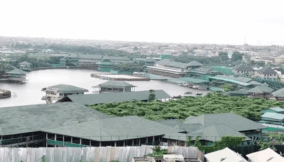
Unarguably, the Dead Sea is the lowest spot on the earth surface where no life exist, yet its belly offers a natural health spa, and once-in-a-lifetime experience to those who dare visit, writes OBINNA EMELIKE, who took a bathe in the sea.
While inside one of the caves at the Qumran National Park in Israel with fellow pilgrims in search of ancient scrolls, I could not help but get interested in an argument between a British microbiologist and an Australian musician.
How can you say there is life in the Dead Sea, when your science confirms that the sea’s water has the highest concentration of salt in the world, about 340 grams per litre of water? The musician asks.
“There is. The therapeutic and healing power of the water and mud are evident. Health experts and tourists alike have confirmed it. You will confirm when we get there,” the microbiologist insists.
What an irony one may say, for something believed to be dead, yet it offers life to those who dare visit.
As our bus set for the Dead Sea, the several perimeter barbed-wire fence separating Israel and Jordan were obvious. Our tour guide says besides being electric, the fence has cameras and microphones, and is monitored 24 hours every day – all to ensure maximum security along the borders, for citizens and tourists like us.
While on transit, our tour guide heightens our interest with a summary of what to expect at the Dead Sea. “At 423 meters (1388 feet) below sea level, the spot of the Dead Sea is the lowest point on the face of earth. It is located on the edge of the Judean Desert, a hot, barren region at the foot of Ha-He’etekim cliff, and also an awesome landscape, and priceless treasure for the nation of Israel. The Western shore (inside Israel’s borders) is dotted with organised beaches and bathing areas that provide convenient access to the water. Beside two of the therapeutic beaches (Neve Zohar and Ein Bokek), large tourism centres have been established, providing the most pampering tourism services,” he explains.
After about 15 minutes drive, our bus arrives the parking bay of the Dead Sea recreation centre. But the door opens to a beautiful recreation centre hosting many gift shops, coffee and restaurants, changing rooms, and shower points. While passing through the ticketing and access route, I discover that our guide pays $30 for each one of us. But considering the notice on the wall that urges visitors to behave in the most civilised way bearing in mind the interest of the over 2,000 visitors that throng the site every day, I marvel at the whopping $60,000 the centre makes averagely in a day.
However, the entrance ushers one into a beautiful sight to behold. Waoh! Exclaims John Musa, a pilgrim from Adamawa State, who keeps wondering aloud the huge depth of the sea – about 423 meters below sea level. But for me, the sea looks intimidating, and not enticing as The Sea of Galilee, which lured David my doctor friend from Adamawa State and I to swim while on a visit.
There were many beach beds that offer visitors resting amid the scorching sun. The scene is a typical beach affair, the difference is just that the swimmers are swimming on purpose – to cleanse their bodies in the sea’s water famed to have healing power.
Enticed by the activities going on in the sea, most of the pilgrims in our bus rush to the changing room to change into swimming suits provided by the centre at a fee, while the well-prepared ones undress to their swimming trunks. But I did not rush to change (though it will cost me $15 to get a swimming suit), I am rather carried away by a few happenings before me. A group of tourists from the US, were rubbing dark substances on their bodies, some swimming with their face up and back on the water, while a few others shouting at the renewal of their skin after washing off the dark substance.
As I move closer to another set of swimmers, I overheard one of them (a very tall fellow with a muscular built), shouting: The mud works!
It is then I realise that the dark substance is mud. I quickly rush to the changing room, pay the $15 for my swimming suit, put it on, and in moment I am in the Dead Sea. The water is warm, may be because of the hot and barren region it is located.
But while in the water, I keep wondering how the spot is the lowest point on the earth because I can still see far from the sea. It is not deep like an ocean, yet it is said to the deepest point. I also keep looking at the cliffs that surround it and try to measure the 423 meters (1388 feet) below sea level. Unable to get the smallest hint, I rhetorically ask: How is this place the lowest point on the face of earth?
But the Dead Sea is truly the lowest point on the face of the earth as proven and undisputed by science and geography. While still wondering, I rush out of the sea to ask a lifeguard a few question, though I query the necessity of his job when the sea is not deep enough to get someone drown.
Before approaching, the beautiful smiles on his face soften his rough-looking face, and assure me of the right answers to my questions.
“Why are people swimming with their back and face up, what why are many rubbing the mud on their body,” I ask preparing to ask more before he cut me short with answers.
“It is called the Dead Sea because its salinity prevents the existence of any life forms in the lake. You do not swim but float with your back to ensure the high concentrate salt water does not enter your mouth, eyes or nose. It is harsh and can harm,” he explains, and hesitates before explaining the health benefits. But I guess he wants to know I am paying full attention to him.
“The Dead Sea is also the lowest health spa in the world,” he says, with emphasis.
“The sea bed has deposits of black mud that is easy to spread on the body and provides the skin with nourishing minerals. The bromide in the air is also beneficial to the body’s systems, thus making the Dead Sea a provider for good health and healing for vacationers from all over the world. A lot of cosmetic companies, especially from the US, come here to source rare materials for their products,” he concludes.
With the explanations, I set back to the sea, bend and scoop the dark mud with my two hands and smear it on my whole body, except the private region. Forgetting once again the amount of time one will wash off the mud, I rush back to the lifeguard. He apologises for not telling me and says 10 – 20 minutes.
After 15 minutes, I wash off the mud in the clean water shower beside the changing room. But I did not notice anything. I hiss in disappointment, and did not follow in tourists ritual of buying Dead Sea souvenir, but join other pilgrims to the bus back to our hotel in Galilee, popularly called Tiberias by the locals.
While mine therapeutic healing did not take place at the Dead Sea, I feel renewed the next morning with baby-like skin. It is my wife’s comment on the pictures I email to her after the Dead Sea encounter that makes me realise the reality of the bathe in the sea.
No wonder cosmetic companies seek the living among the dead at the belly of Dead Sea rich with beneficial minerals. But an encounter with the Dead Sea is not only a once-in-a-lifetime experience, but also discovering life in the depth of lifelessness. What an irony!

Join BusinessDay whatsapp Channel, to stay up to date
Open In Whatsapp