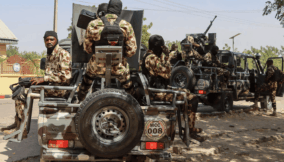
Whether due to dominance of the media or current economic power, the “average” Nigerian is not thinking about the huge economic potential or the breadbasket (agricultural production zones) of Nigeria when they think of Northern Nigeria. On their minds is likely the religious extremism that has been on the rise in the recent past and contributed to the development of one of the region’s bloodiest militant groups in the region– Boko Haram. While it is true that Boko Haram has wreaked havoc on the North, it’s also true that the militant group is one of several difficulties that Northerners have faced for decades. As the current administration continues on its mission to crush Boko Haram and end its season of tyranny, solutions must sought that also address socioeconomic and geographic issues in the North to prevent the resurgence of such groups that thrive in times of desperation and exclusion.
It is undisputable that the economic landscape in Northern Nigeria has been severely affected by Boko Haram. The activities of this Islamist militant group have led to mass migration of Nigerian citizens to areas not affected by the violence. This has in turn resulted in children abandoning school, adults losing jobs, disruption of trade and an overall drop in foreign direct investment (FDI) flows, affecting livelihoods. Boko Haram’s emergence four years ago is estimated to have led to a 21% drop in FDI between 2011 and 2012. The negative effects have largely been dictated by geography and have been felt most acutely among the country’s Northern states. Three states in particular – Borno, Adamawa and Yobe – have borne the brunt of the insurgency leading to a state of emergency being declared in 2013 and running till November 2014.An estimated 3,000 people were killed in 2015as a result of the insurgency and a further 3 million internally displaced to date. Boko Haram and ISIL are jointly responsible for 51% of all claimed global fatalities in the previous year (2014) – with the total figure of those killed through terrorism in 2014 coming to 32,658 with 7,512 in Nigeria alone (23% of all deaths caused by terrorism in that year.)
The region’s problems however began long before the emergence of Boko Haram. Despite occupying the majority of the country’s landmass, Northern Nigeria has consistently ranked lower than the country average on human development indicators. The Northern part of Nigeria consists of 19 states, which geographically occupy 719,435 square kilometers or 79% of Nigeria’s landmass and constitute 53.6% of Nigeria’s population. Long-standing under investment by government and insecurity in the region has resulted in significant slow-down of both educational and commercial activities. Similarly, the Northern states face the highest maternal and infant mortality rates in the country, the lowest school enrolment rates for children, the highest youth unemployment rates, highest levels of poverty and highest inter-ethic and inter-religious conflict, notably the Boko Haram terrorism.
In recognition of the grim situation in the Northern states, a number of government and private initiatives have been put in place. Notable among the national-level interventions are social-protection interventions such as the Presidential Initiative for the North East (PINE), Care of the Poor (COPE), funded initially through the Millennium Development Goals Debt-Relief Gains fund, the Maternal and Child Health Care (MCH) programme, and a Community-based Health Insurance Scheme.Similarly at federal level, interventions around revival of industries, alleviation of poverty, granting access to business loans and development of business and technical skills have been introduced; and cash transfers are being considered by the current administration. A number of donor communities have also provided services in health, education and relief services. These include programs by Save the Children, Oxfam and DfID, among others.
In spite of these initiatives, the economies in Northern Nigeria are not as strong as they could be. Reports indicate that Nigeria’s North is poorer than the South and the situation continues to be exacerbated by the Boko Haram violence.The gross state products (GSP) of different regions show that Northern states, despite occupying majority of Nigeria’s population, accounted for only 38% (15.4 billion Naira) of the country’s GDP in 2012 (prior to the escalation of Boko Haram insurgency). Of this amount, 8.3 billion Naira (55%) and 5.7 billion Naira (37%) were attributable to the North West and North Central states respectively. Comparatively, the North East states where Boko Haram are most active, contributed only 8% of this GSP at a paltry 1.3 billion Naira in 2012.
The sectors of economic growth potential for the North have however remained largely unchanged, the leading one being agriculture. Given agriculture and agro-allied industries’ significant contribution to GDP and workforce, strong growth in the recent past, and Northern Nigeria’s rich agroecology, it is one of the most competitive sectors for development of Northern states. Northern Nigeria since independence has been the source of a significant percentage of the foodstuff consumed in the South. Nearly 50% of food and 47% of livestock consumed in the South were produced in Northern states prior to the Boko Haram insurgence. Two of the region’s strongest economic states – Kano and Jigawa – have highlighted agricultural investments in food crops (sorghum, millet), horticulture (mango, guava, cashew), industrial crops (gum Arabic, sugarcane), livestock and fisheries as key to the development of their respective regions.Across the key Northern states of Kano, Jigawa and Borno, agriculture is the sector that provides the highest employment opportunities at 32%, 33.4% and 52.9% respectively.
Other promising sectors include trade, hospitality, as well as manufacturing. In addition to their strong GDP contribution, trade, hospitality, and manufacturing are significant employers.Within the Northern region, a sample of key states indicates that trade and commerce (including hospitality) account for a significant portion of employment opportunities. In Kano, 20.9% of the population is employed within the hospitality industry while 11.6% works within wholesale/retail trade. In Jigawa, the numbers indicate that 11% of the population work in the hospitality industry and 7.4% in wholesale/retail trade. Finally for Borno 17.6% of the population are employed within the trade sector. In manufacturing, selected representative states of Northern Nigeria – Kano, Jigawa and Borno – depict a similar trend of employment and growth. Manufacturing emerged as a significant source of employment among the population at 14.9%, 20.5% and 11.3% respectively. However, despite these promising figures, several sectors that have a high contribution to the economy are at serious risk because of insecurity.
When thinking of how to deal with the problems in the North, dealing with security concerns must go hand in hand with strengthening of economic opportunities if solutions are going to be sustainable. There are five key factors that have to be taken into account. The first is that whichever initiatives and investments are undertaken in the North, one has to figure out how to separate development work from politics and insecurity. This is in no way an easy feat, but in trying to work both in development and politics in the region, it will be extremely difficult to make headway. One has to find the right way to balance working on the two issues in the region – without getting subsumed in political issues or getting too detached working on development issues without taking into account prevailing political factors. There has been limited/no redistribution of wealth and the situation is starker in northern Nigeria given the poor performance on all development indicators. Disenfranchised youth – who are most at risk of joining Boko Haram need to have a voice in their societies that have typically been hierarchical in structure.
The second factor is to ensure that data-driven approaches are brought into any investments in the region. With an ongoing security crisis, it is very easy to make investments made on hunches or emotion, but in the long term such approaches could be extremely wasteful and even detrimental to sustainable development. Hard facts and data are important for any decision-making in the region. The third factor is to balance short term and long-term development goals. For instance, it is very tempting to work only to increase production of an essential good, with no focus on quality; however long-term development hinges on both. The fourth factor is to take into account that government and companies have few extra resources to devote in the North given the current situation. As such, any initiatives need to be cost-effective as it will always be difficult to source funds for them. The final factor is to remember that some communities are in many cases starting from scratch to build institutions and infrastructure and they require holistic solutions that not only address broad sectors (e.g., access to grants and finance) but also build more specific knowledge among sector players (e.g., training SMEs on leveraging capital).
These five key factors act as guiding principles for ensuring that economic opportunities in the North are strengthened while at the same time dealing with security concerns. It is therefore of utmost importance to not focus on solving economic issues or security issues without taking into account just how co-dependent the two problems are; a society that feels it has no voice, will make its voice heard in whichever way it sees possible. To deal with the ongoing crisis we have to deal with the underlying issues that have created a society where terrorism is an option.
Nneka Eze

Join BusinessDay whatsapp Channel, to stay up to date
Open In Whatsapp