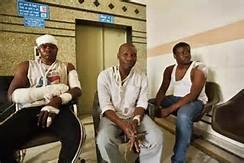
Nigerian students currently studying in India are living in fear as hordes of xenophobic Indians in recent times have attacked Nigerians and other Africans in Greater Noida, a satellite town in New Delhi.
In the past week, five Nigerian students have been attacked by mobs of Indians who accused Africans of being responsible for the disappearance of Manish Khari, a 19-year-old Indian boy who seemed to have died from a sort of drug overdose.
When this could not be substantiated, the accusation soon morphed into Nigerians being cannibals. Consequently, some students of African origin had their privacy violated, their doors kicked in and their fridges flung open while the Indian mob searched for the phantom flesh of the dead boy.
“I got off the auto rickshaw and seconds later a mob attacked me. They beat me up with sticks. I don’t know what they were saying. I lost consciousness for some time and vaguely remember how police brought me to the hospital,” Imran, one of the victims of the attack, told Indian journalists.
What prompted the attacks
Reports say that in the evening of Friday March 24, Khari was seen in the company of some Nigerian students who live only a block away. When Khari didn’t come home early enough, his father went to the Kasna police station and reported that his son had been kidnapped and beaten by some Nigerians. He was still filing the report when he got a call that his son was back.
But Khari showed signs he was unwell and was taken to a local hospital, where he died in the early hours of the morning from suspected drug overdose. His father returned to the police station and accused the five Nigerian students of complicity in the death of the young man and the police detained them.
Following a protest by African students in the area, however, the police released the five Nigerian students for want of evidence. Indians were enraged by this. A wake was organised for Khari two days later. Pent-up emotions soon boiled over and the Indians began attacking Nigerians at Pari Chowk and adjoining Ansal Plaza mall.
In the wake of the attacks, the Association of African Students of India, a body of students of African origin who pursue higher education in India, instructed the students to hunker down and stay indoors. That, however, is not looking like a solution.
Alkahba Solomon, a student in Noida, told the BBC that staying indoors presents its own challenge.
“Everybody is indoors. But the problem we are having right now is some of the landlords are telling African students to vacate from their house. These are the problems,” Solomon said.
Condemnations
The attacks have been condemned by saner Indians and indeed people all over the world. Social media has been replete with messages of solidarity for the affected students.
But this is hardly the first time African students have been attacked in India. In February 2016, a mob attacked a Tanzanian student in Bangalore, which led to the arrest of several people and suspension of two policemen who were complicit in the attacks.
There have also been pockets of xenophobic attacks, like the case of a student of Democratic Republic of Congo who was beaten to death in May last year, and attack on a Nigerian student in Hyderabad also in May last year.
Following the attacks this time, Nigeria’s Ministry of Foreign Affairs summoned the Indian Ambassador, Nagabushana Reddy, on March 29 in Abuja to explain what was going on.
Olushola Enikanolaiye, permanent secretary at the ministry, demanded that India should ensure that those behind the attacks are arrested and prosecuted.
“This is not the first time this would happen, Nigerians have suffered similar attacks in the past,” Enikanolaiye was quoted to have said.
“So, what we will like to see on this occasion is that the perpetrator should be arrested. And we want to see diligent prosecution so that it would serve as a deterrent to those who think they can take laws into their hands and harass students who are going about their studies,” he said.
The Indian government has since said that five persons have been arrested and over 1,000 suspects have been booked through identification of video clips.
Sushma Swaraj, India’s Foreign Affairs Minister, also ordered an inquiry into the attacks on Nigerian students, urging the newly appointed Uttar Pradesh State Chief Minister, Yogi Adityanath, to ensure the safety of Africans in Greater Noida.
Symptoms of a deeper malaise
BDSUNDAY gathers that these attacks are by no means a random or isolated occurrence; they are rather symptomatic of a systemic racial discrimination against people of African descent in India.
A Nigerian studying in India, who requested anonymity, told this newspaper on phone that the reports that make the news are just a tip of the iceberg of what African students face in the country.
“Nobody talks about how we are harassed in public buses, how their bank officials make life difficult for us,” he said.
“The feeling we get over here is that there is no government in Africa, there is no one to fight for us.”
Further inquiry reveals that hundreds of African students languish in Indian jails over accusations of petty crimes or on mere suspicion that they are criminals.
Landlords routinely harass these students and kick them out of their houses for the most flimsy reasons, leading to forfeiture of rents.
African students who study in India are not permitted to work to support their education, be they odd jobs or formal jobs.
“Perhaps they are afraid we will take their jobs, but the locals will never hire us anyway; they are only interested in the money we bring to spend in India,” said Charles Nnadi, a Nigerian studying in a technological institute in India.
Nnadi said some Nigerian students still find a way to render services, but they risk being cheated as agreed fees are never paid and their clients cancel services for very flimsy reasons.
Nigerians studying in India also report difficulties withdrawing money sent to them in India as they accuse Indian bank officials of treating them with contempt.
“You can’t report to the police and hope for justice,” Nnadi said.
“The police do not come to the aid of foreigners in troubled times. The only reason this is making the news is because they were dumb enough to film it,” he said.
Nigeria has a high commission located in New Delhi, but some of the students in India who spoke to BDSUNDAY said it is only a political office and that they find it extremely difficult to even renew passports.
Towards continued peaceful relations
While addressing the Indian Ambassador, Enikanolaiye said the Nigerian Ministry of Foreign Affairs was concerned that such a matter should not be allowed to affect the relationship between the two countries.
India and Nigeria have good reasons to maintain peaceful relations. The Indian High Commission recently said that total trade between Nigeria and India rose to $643.3 billion in 2016, making India Nigeria’s biggest trading partner.
“Crude oil is the largest item exported from Nigeria to India, while vehicles, pharmaceutical products and machinery have been the largest items exported from India to Nigeria,” said Jagdeep Kapoor, head of chancery at the High Commission of India in Lagos during a recent product exhibition.
In 2016, India exported about $419 million worth of vehicles including parts and accessories to Nigeria. Pharmaceuticals worth $393 and machinery and appliances estimated at $267 million also came to Nigeria from India.
In the services sector, thousands of Nigerians made trips to Indian hospitals on medical tourism and several telecoms deals were struck between the two countries.
Nigeria is looking to seal a $15 billion oil deal with India and in exchange it has prioritised Indian companies in crude term lifting contracts.

Join BusinessDay whatsapp Channel, to stay up to date
Open In Whatsapp