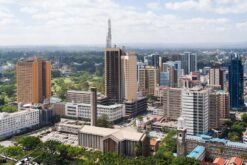
Lagos is bountifully surrounded by water, precisely because water doesn’t have an enemy. We are meant to have the kind of relationship the fishes have with water, but this does not seem to be so in Lagos. The water doesn’t seem to be of any good use to us. Due to health reasons, Lagosians hardly use the water from the ground for anything important, neither is it used adequately as a means of transportation. The only time we feel the impact of the water is when it floods. The flooding of three weekends ago is a good example. The rains, whenever they came, show the true side of Lagos. A friend jokingly compared Lagos during the raining season to some ladies when they take off their makeup. One gets to see their true colour.
Unfortunately, these past months have not been easy for Governor Ambode’s administration. From the kidnap of the students at Epe, who are yet to be released, to the Badoo atrocities, to the arrest and confessions of Evans; Lagos hasn’t been in the good spotlight. The flooding has merely compounded the bad situation. Whatever good that has happened within this period has been over showed by the few bad news.
Some persons have tried to downplay the effect of the floods and the responsibility of the government by stating that other cities like London, Paris and some others in China were also flooded. Some others have argued that even in Nigeria, it wasn’t only Lagos that experienced the floods and other states like Niger and Akwa Ibom and even the FCT, had worse flood and worse effects including deaths. Why the unnecessary attention on Lagos?
No one has argued that floods are exclusive to Lagos, moreover the mere fact that cities like London and Paris were also affected doesn’t mean it’s a status symbol of a “mega city”. But being a resident of Lagos, I can comfortably talk about the Lagos situation. Moreover, the mere fact that other cities around the world also had floods is not sufficient reason to discourage us from engaging in discussions to prevent future floods.
The attention on Lagos is not unnecessary, neither is it accentuated by malice. The places in Lagos that were affected by the floods are the highbrow areas. These areas, houses several rich, intelligent and exposed Nigerians. One expects that their exposure and wealth would translate to them trying to improve their environment to global standards.
The flood issue is a very important issue which needs to be tackled professionally. The normal cliché of governmental officials which was repeated by the Commissioner for the Environment, Babatunde Adejare, “We are on top of the situation” is akin to saying nothing. If they were on top of the situation, then a warning should have come earlier thereby putting people on notice. If they were on top of the situation, what rescue or emergency measures are in place? If they were on top of the situation, the National Institute of Oceanography and Marine Research (NIOMR) that sits graceful in Victoria Island would have been more pro-active. In fact till date we haven’t even heard a word from this institution which claims to be a research body.
Clearly, the State Government is not on top of the situation. The Federal Government is no different, its agency, the Nigerian Meteorological Agency (NiMet) just woke up from their deep somnolence. After we have suffered the effects of the floods, they stated the obvious by warning us to prepare for more floods. These agencies are no different from other Public institutions which have become redundant and best at draining funds.
While it is true that this year’s rain was persistent and the downpour was heavy and torrential, that’s not the sole reason for this year’s floods. We must not forget that places like Lekki and VI still flood with light rainfalls. The reason for this should be our major concern. Several places in Lagos including the highbrow areas like Ikoyi, Victoria Island, Lekki Phase 1 and 2 don’t have effective drainage systems. In some places, drainages are non-existent; in some other places there exist dis-uniform drainage systems. Some places that have drainage system are constructed in a way that makes it extremely hard and almost impossible for the drainages to be accessed and cleaned. In some other places, the occupants build their structures below the level of the road.
With all these situations listed above, how do we expect water to drain effectively? All these are factors that have compounded and will continue to compound the flood issues in Lagos state. If the government was on top of the situation, these urban planning issues ought to have been tackled. They would not merely be solved by destroying structures that have violated the Urban Development code of the state or the State’s master plan. This just punishes the owner of the building alone who is not the only culprit. Since justice is a three-way traffic, the civil servants, who by their omission or commission, consented to the violation of the State’s Master plan and urban development codes should also be disciplined. This would serve as a deterrent to other civil servants.
The failure to strictly adhere to the urban development rules is as a result of short-sightedness, whereby we think only of ourselves and forget about the common good. Unknowingly we forget that at the end we all will suffer it. These floods affected all even those with SUV’s; there is no escape route. It’s high time we get out from our short-sightedness and strive for the common good.
There is also need to checkmate the land reclaiming projects in Lagos and all projects at the coast of Lagos. It is normally said that while God forgets and forgives, nature doesn’t. Actions which tend to tamper with the smooth working of nature normally have repercussions. Fela-referring to water- sang “If you fight am, unless you wan die”. We started the fifth with water and its fighting back.
The government should rise up from its “We are on top of the situation” cliché and invite professionals who would study how best to prepare Lagos for the rains. There is need to take more seriously the Environmental Impact Assessment (EIA) of projects in the state.
Awoke Ogbo, once a team lead of Chevron’s Geographic Information Systems, has this to say “ If the Lagos government would listen, there needs to be an urgent thorough interdisciplinary study of the state involving scientists, geologists, soil scientists, engineers, satellite remote sensing experts, GIS, oceanographers, marine biologist, anthropologists, computer scientists and so on. There are analytical and predictive tools to model the next 5,10,15, 100 year scenarios and plan intelligently”
Until then, water will continue to be an enemy and never a friend to Lagos.
J. B. Nwachukwu

Join BusinessDay whatsapp Channel, to stay up to date
Open In Whatsapp