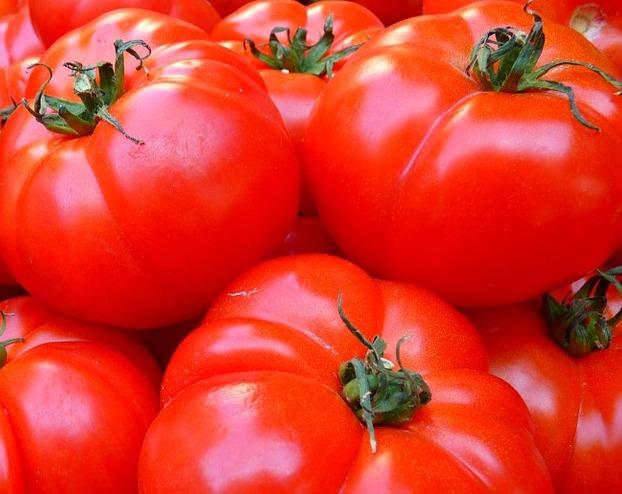
The Federal Government on Tuesday, April 11, 2017 announced a new tomato sector policy to take effect from May 8. Part of the provisions of the new policy is the hiking of tariff on imported tomato concentrate and other concentrates (HS Code 2002 90 11 000) from 5 percent to 50 percent and an imposition of additional levy of $1,500 on each metric tonne of tomato concentrate imported into the country. The policy also intends to restrict importation of tomato concentrates to the seaports in order to address abuse of ECOWAS Trade Liberalisation Scheme (ETLS).
Okechukwu Enelamah, Minister of Industry, Trade and Investment, who announced the new policy at a media briefing in Abuja, said the move was in line with the government’s objective of boosting tomato production, improving the value chain and attracting investment, adding that is expected to create at least 60,000 additional jobs in fresh fruit production and processing. He also explained that the new policy was targeted at increasing local production of fresh tomato fruit required for fresh fruit consumption and processing, increase local production of tomato concentrate, and reduce post-harvest losses.
Ordinarily, there is nothing bad about a policy that purports to encourage local production, stimulate economic growth, create employment, and, ultimately, lead to attainment of self-sufficiency in food production. And to that extent, one supports government’s overall vision for the tomato subsector. However, a deeper analysis of the policy vis-a-vis the current state of the tomato subsector in the country shows that the policy may not after all have been well-thought.
First, there is currently no single company in Nigeria producing concentrate locally. The NASCON (Dangote) factory in Kano, the only concentrate-processing plant in the country, is currently out of production due to non-availability of sufficient tomato fruits to sustain its production plants. Tomato fruits are the major raw materials for the production of triple concentrate.
But assuming that NASCON was even producing at full capacity, its projected production capacity is 13,500 metric tonnes of concentrate per annum, less than 10 percent of the 180,000 metric tonnes required by about nine companies in the country involved in the local packaging and reprocessing of tomato concentrate to produce tomato paste sold in retail cans and sachets.
Under these circumstances, one does not see how a hike in tariff on imported tomato concentrate would impact positively on the economy. Rather, the effect would be idle industries and machinery, loan default to creditors by companies in the sector resulting from lack of production and income, loss of jobs, and increase in retail prices of tomato paste. Ultimately, the economy would be worse for it.
Indeed, the time is not ripe for a tariff hike. For one, local supply of concentrate is grossly inadequate. Secondly, local supply of tomato fruits used in making concentrates is inadequate. Thirdly, local producers of concentrate are not working due to lack of raw materials to produce concentrate. As such, if the tariff hike is meant to protect local producers, then there is really nothing or no one to protect. Local packers of tomato paste are ready to purchase everything the local producers of concentrate have, so there is no issue of dumping or stifling local industry.
As a keen watcher of the industry, I believe the starting point in achieving a vibrant local tomato industry is to first of all improve tomato yield from the growers in order to increase the supply of tomato fruits, the major raw material for concentrate production. We need to first increase local production of concentrate before government can employ the tariff mechanism to discourage further import of concentrate.
The Nigerian farmer’s average yield per hectare of tomato farm is currently 8 tonnes, whereas that of his counterpart in Italy is 30 tonnes per hectare. To achieve improved yield, tomato farmers need to be provided with improved seedlings so that they are able to cultivate the species of tomato more suitable for concentrate production. They should also be provided with adequate fertiliser, loans with favourable interest rates, while there should also be guaranteed off-taking of their harvests.
These steps, in my view, will increase the local production of tomato fruits. With enough local supply of fruits, I believe investors will be encouraged to go into processing, thereby increasing the local supply of concentrate. What is holding up investment in local processing of tomato concentrate is the non-availability of raw materials.
Another worrisome development is that some stakeholders in the tomato subsector who have invested heavily in the sector complain that they were not invited to the meetings and their input was not sought throughout the entire process leading to this policy. Indeed, if such is the case, it is most unfortunate.
Mazi Sam Ohuabunwa, a renowned industrialist, in an interview with BusinessDay in November last year, said the high rate of policy failure in Nigeria was partly because stakeholders are often not carried along in the formulation process.
“When you design a policy as a policymaker, you must get the stakeholders, those that your policy will affect, to test the policy, to adopt it. That’s a critical thing for its execution. Most of Nigeria’s policies come from policy articulation to implementation. They miss the adoption strategy, and that’s why people resist it, fight it, because they don’t understand where this policy will take them to, its benefit,” Ohuabunwa said.
Perhaps it is for this reason that there is apprehension among some stakeholders in the industry that this policy may be a step towards granting quotas to certain entities to import concentrate under the guise of importing against short supply.
As it is, some local companies are already investing in local production. For instance, Sonia Foods Industries Limited, a wholly owned Nigerian company and manufacturer of Sonia Tomato Paste, as part of its short-term goals, is looking to further backward-integrate to processing of concentrate.
“We have reached understanding with equipment suppliers and technical partners. The major constraint is the supply of raw materials. We are also looking into how to assist growers to increase their yield so that when we take off our machines will be rolling in continuous production,” said Nnamdi Nnodebe, its group managing director and chief executive officer.
On restricting import of concentrate to seaports in order to stop abuse of the ETLS, one is concerned that the government may be throwing away the baby with the bath water. Nigeria has benefitted immensely from ETLS and any policy that would be seen to work against the scheme must be avoided.
It is hoped that government would take a second look at this policy and review its stand in order to save an already ailing sector. Raising tariff at this time, amidst scarcity of essential raw material for the production of concentrate, will be counter-productive. It will only make the product more expensive and the additional cost passed on to the final consumer who is already bearing the brunt of economic recession. It is best to improve local production first before talking about raising tariff. We must not place the cart before the horse.
Nnanna Nwafo
Nwafo, a public affair analyst, writes from Lagos.

Join BusinessDay whatsapp Channel, to stay up to date
Open In Whatsapp