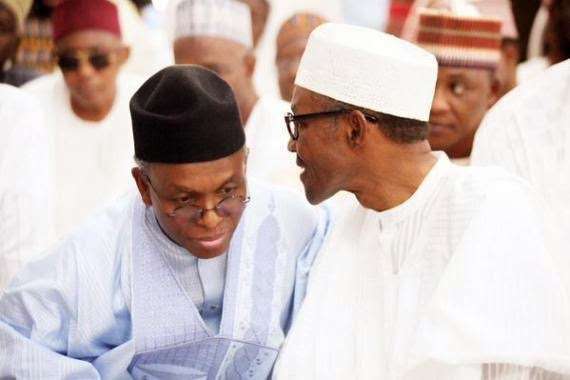
For many Nigerians, particularly loyalists of President Muhammadu Buhari and the leadership of the All Progressives Congress (APC), the recent memo by Governor Nasir El-Rufai of Kaduna State to President Muhammadu Buhari may have confused them of the governor’s loyalty to the chief occupant of the Aso Rock Villa.
Before the recent developments, the talk in town was that President Buhari may be preparing to hand over power to El-Rufai, since both are of the Fulani stock.
El-Rufa, who had in the past tongue-lashed critics of President Buhari and of his style of leadership, made a volte face recently, dragging the president to the classroom for a lecture in governance.
The governor had also recently pooh-poohed the insinuation in the public sphere that he was a member of the cabal, believed to be holding the president hostage.
The former Minister of Federal Capital Territory (FCT) used the auspicious occasion of his parley with editors in Kaduna to clear the air about the limit of his closeness to the President. He said that despite his closeness to President Buhari, he was not part of the cabal, who influenced things in the Villa.
“I am too busy addressing Kaduna problems to be part of it. When I am called for an opinion or when I happen to be around, and I have an input or if I see something going seriously wrong; I drive and go and see Mr. President I have heard A, B, C, D.
“My primary assignment is Kaduna. I am not involved in the Federal Government. People like to say and attribute so much to me, and sometimes it is good for me, it gives me a larger than life image. Is there a cabal? I am too busy addressing Kaduna problems to be part of it. There is always a cabal. Am I a member of the cabal? No, I am governor of Kaduna State; I work for Kaduna state 24/7”, he said at the meeting.
It would be recalled that early in the life of the APC-led government, El-Rufai was a prince as he quickly gained prominence; stepping on the toes of those who are constitutionally powerful than himself, riding on his closeness to President Buhari.
He threw his weight around so much that he got a sobriquet “unofficial vice president.” El Rufai engaged in a face-off with Yemi Osinbajo, vice President of Nigeria in a meeting presided over by President Buhari and reportedly used “rude” words on Osinbajo, who, in annoyance, told him off and walked out of the meeting.
Extending his new political audacity, El-Rufai, while responding to earlier allegation in November 2016, said Atiku Abubakar, a former vice president of Nigeria who also happens to be a chieftain of his party, the APC, has a record of spewing outright lies and innuendo against his person.
“As we struggle to build a law-abiding society and secure progressive outcomes for our people, we cannot allow the triumph on these shores of those who will have us move to a post-factual world,” the governor said, adding that not even Abubakar’s expertise “in the dark arts of damaging other people through a campaign of lies from him and his media machine” is capable of returning the country to its past.
He said contrary to the assertions of Atiku who alleged that he attempted to offer him Transcorp shares during the presidency of Olusegun Obasanjo, he had nothing to do with the incorporation of Transcorp, and dared Atiku to visit the United States of America.
Now, in his latest move, he has picked on the President through a memo said to have been released to the public few days after the President arrived from London, UK, where he spent 50 days on a medical expedition.
Actually, the memo was said to have been written on September 22, 2016, but only went viral two weeks ago. In the missive, El-Rufai took the game to the President, detailing his observed leadership deficiencies in the President and telling him pointblank to take charge of the country and the APC. The wordings of the letter were in tandem with the controversial advice earlier given by Aisha the First Lady to her husband.
El-Rufai in the memo had set new agendas for the President bordering on: ambassadorial nominees; restructuring of the APC; regular dinner with APC governors and appointment of experienced political adviser, and recommended Audu Ogbeh. He also advised the president to engage constructively with the Nigerian Judicial Council (NJC) to impose quick sanctions on clearly erring judges; initiate sale of expired OMLs to India and China to raise at least $20billion to add to the foreign reserves; consider the privatisation of other non-productive or potentially valuable assets like NIPP, Ajaokuta Steel and ltakpe Iron Ore, the balance of shares in Gencos and Discos, refineries and depots to raise revenues and achieve efficiencies; accelerate TIN registration to double the number of tax payers to at least 10 million in 2017 and reduce the levels of personal and corporate income tax, while effecting an increase of the rate for value added tax, among others. He pointedly told the president that the nation’s economy was worse today than the APC government met it.
Many Nigerians are of the view that El-Rufai’s memo to the President confirmed their position that APC leaders knew from the very beginning that the nation’s current economic woes were a result of the decisions and indecisions of the present government, despite heaping the blame on the immediate past administration of President Goodluck Jonathan.
In defence of the President who is yet to personally respond to the memo, Tijjani Ramalan, the Kaduna APC Caucus’s chairman, lashed out at El-Rufai, accusing him of hypocrisy by asking President Buhari to do what he was not doing in Kaduna State.
“Most stakeholders and members are feeling used and dumped and lack of consultations in decision-making processes as it affects the party at the local, state and national levels. Your message was received with mixed reactions by Nigerians, some called that action an uncommon courage by you, in the same light, some of us have been worried about the way our state has been handled since you assumed office and it is said that ‘charity begins at home’. Most of the concerns raised in your memo are actually the very same concerns that some, if not most stakeholders in Kaduna, have over your leadership,” Ramalan wrote.
However, a public analyst said: “The gentleman approach with which President Buhari handled the missive from Mallam El-Rufai is a hallmark of tolerance for dissenting opinions, and this will doubtlessly deepen our democracy. In other words he has raised the bar for other leaders to emulate and Nigerians have a duty to always insist that leaders at different levels toe the same line as President Buhari.”
But insider sources say that the last may not have been heard about the memo as they claim that the President is extremely displeased with the development. Only time will tell what will be the consequence on the writer and how that would help the governor’s political future, beginning from 2019.
El-Rufai is a former director-general of the Bureau of Public Enterprises (BPE), former Minister of the Federal Capital Territory, Abuja from 16 July 2003 to 29 May 2007. He was elected governor of Kaduna State during the 2015 general election.
EL-Rufai was born in Daudawa of Faskari Local Government Area in Katsina State. He was sponsored throughout his schooling days by an uncle in Kaduna, after losing his father to death at the age of 8.
He went off to Ahmadu Bello University, Zaria, earning a Bachelor degree in Quantity Surveying with First Class Honours. He also attended post-graduate programmes at Harvard Business School and Georgetown University. Since leaving public service, El-Rufai has completed an LL.B degree from the University of London, graduating in August 2008 with Second Class Honors, Upper Division, and a master’s degree in Public Administration from the John F. Kennedy School of Government, Harvard University in June 2009. He also received the Kennedy School Certificate in Public Policy and Management having spent 11 months as an Edward A. Mason Fellow in Public Policy and Management from July 2008 to June 2009.

Join BusinessDay whatsapp Channel, to stay up to date
Open In Whatsapp