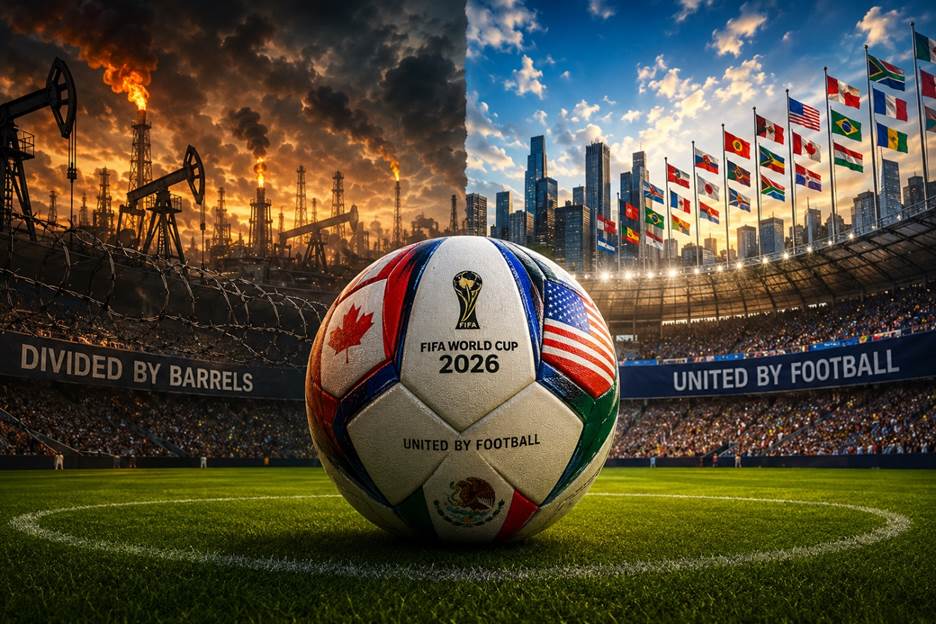
As geopolitical tensions continue to shape global discourse, from instability in the Middle East and concerns surrounding the Strait of Hormuz to growing strategic rivalries among major powers, the world is increasingly searching for common ground that transcends politics, ideology, and national interests. Amid these uncertainties, the 2026 FIFA World Cup offers a reminder that sports remain one of humanity’s most powerful tools for diplomacy, international cooperation, and cultural exchange.
Scheduled to kick off in Mexico City on June 11, 2026, the tournament will be historic in multiple respects. For the first time, 48 nations will compete, and for the first time, three countries, the United States, Canada, and Mexico, will jointly host the competition. While attention often focuses on tourism revenues, infrastructure development, and job creation, the deeper significance lies in the tournament’s ability to bring nations together in ways that formal diplomacy often struggles to achieve.
Sports have long served as an informal channel of international relations. Decades before the concept of “soft power” became widely used, sporting exchanges were already easing tensions and building trust among nations. The most cited example remains “Ping Pong Diplomacy” in the 1970s, when table tennis exchanges between the United States and China helped open channels of communication and contributed to the normalization of relations.
Similarly, the Olympic Games have repeatedly shown that even countries in political conflict can still share space under the same flagless arena of sport. The FIFA World Cup extends this principle further by allowing national identities to be expressed in a controlled, peaceful, and globally shared environment.
However, the relevance of sports diplomacy today is not only in its history, but in its continued utility in a more fragmented world.
In many cases, sports achieve what traditional diplomacy cannot. Governments negotiate through formal and often rigid channels, while sports connect societies at the level of people. Fans crossing borders, athletes competing with mutual respect, and global audiences sharing the same moments of excitement create a form of citizen diplomacy that operates outside official constraints.
Read also: 2026 FIFA World Cup: Group stage fixtures, venues and Nigeria’s kick-off times
The 2026 World Cup is particularly significant because it is being jointly hosted by three North American countries with distinct political systems and policy priorities. At a time when migration, trade disputes, border security, and industrial competition dominate regional politics, the tournament demonstrates that structured cooperation remains possible. The coordination required among the United States, Canada, and Mexico sends a subtle but important signal: competition between states does not eliminate the possibility of collaboration.
Beyond diplomacy, sports have also become a tool of economic signalling. Major tournaments attract foreign investment, stimulate tourism, accelerate infrastructure development, and strengthen global visibility. Increasingly, hosting rights are not only about sport, but about projecting stability, capability, and openness to the world.
For developing economies, these dynamics carry particular weight. Events such as the FIFA World Cup, the African Cup of Nations, and the Olympic Games provide platforms to reshape global perceptions, attract investment, and strengthen international partnerships. Countries that effectively leverage such events can improve their diplomatic standing and expand economic linkages.
Africa’s experience is instructive. South Africa’s successful hosting of the 2010 FIFA World Cup demonstrated that mega sporting events can reshape narratives about a continent often viewed through the lens of instability. It also showed that sport can function as both an economic catalyst and a reputational reset mechanism in global affairs.
Yet the power of sports diplomacy should not be overstated. Its impact is often symbolic rather than structural. While it can open doors and soften tensions, it rarely resolves deep geopolitical conflicts on its own. In an era marked by sanctions, trade fragmentation, and security competition, sports operate more as a bridge of engagement than a solution to political disagreement.
As an economist and soccer enthusiast living in the United States, I am particularly interested in this intersection of sports, economics, and diplomacy. The 2026 FIFA World Cup will undoubtedly generate billions of dollars in economic activity. However, its more enduring legacy may lie in its less quantifiable outcomes: strengthened cross-border relationships, cultural familiarity, and a reminder of shared human experience.
Recent developments surrounding Iran’s participation in the tournament illustrate this dynamic. Despite heightened tensions between the United States and Iran, speculation about geopolitical interference in the World Cup has persisted. However, when asked about Iran’s participation, President Donald Trump responded in a notably informal tone, asking whether Iran had a strong football team rather than focusing on political considerations.
The exchange was brief, but revealing. It momentarily shifted attention away from geopolitical confrontation toward sporting competition, highlighting how football can temporarily reframe even the most politically charged narratives.
In a world increasingly defined by fragmentation, nationalism, and strategic rivalry, sports remain one of the few global languages that still cuts across borders, cultures, and ideologies. The World Cup reminds us that competition does not have to translate into conflict, and that national pride can coexist with international cooperation.
Ultimately, football is not only about the game itself. It is about diplomacy without diplomats, dialogue without negotiations, and unity without uniformity.
As attention turns to North America this weekend, policymakers would do well to remember that sports are not merely entertainment. They are a parallel channel of global engagement, imperfect, symbolic, but still powerful.
The world may remain divided by barrels, but it is still occasionally united by football.
Olugbenga Olaoye is a seasoned professional with extensive experience in the oil and gas industry. He has a PhD in Economics from Covenant University, specializing in Energy Economics and holds a master’s degree in public service from the Clinton School of Public Service, USA and an Executive MBA from the Lagos Business School. He is also a member of USAEE. He writes from Fort Worth, Texas. USA.
Join BusinessDay whatsapp Channel, to stay up to date
Open In Whatsapp