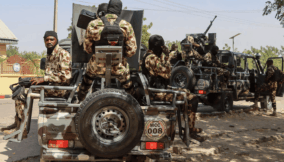
In every society, there are bound to be deviants who disobey the laws of the society. This is why certain agencies are set up to regulate the behaviour of people and preserve the general interest of the society. Hence, in Nigeria, the armed forces, the Police, Immigration, Customs and the State Security Service (SSS) are put in place for that purpose.

According to the Nigerian Constitution, the Police Force is to maintain law and order and ensure public safety in the country. The police are to prevent crime by detecting and arresting any suspicious person. The police also are to enforce the law by conducting prosecution before the courts. Police are also involved in community support and outreach programmes on a range of intervention activities such as drug awareness.

The Police Force is empowered by the Constitution of Federal Republic of Nigeria to investigate, arrest and detain suspicious individuals. It is also the constitution that gives the armed forces the task of defending the country’s territorial integrity against external aggression and to protect Nigerian territory on land, sea and air. The main function of the SSS is the preservation of national security. To do this, they move around to get information about the activities of citizens or foreigners which may likely undermine the security of the country. Such information is collected, collated and sent to government for appropriate action. As for the Nigeria Customs Service (NCS), its major function is to ensure that the country is secure by preventing prohibited goods from being smuggled into or taken out of the country, while the Immigration Service prevents foreigners from illegally entering or staying in the country unlawfully.

Disturbingly, there is a myriad of problems presently confronting Nigeria that suggests systemic failure of our security agencies. Law and order appear to have broken down inexorably. Criminal tendencies and practices are on the increase in both the urban and the rural areas. From mushroom gangs, hoodlums are conveniently and comfortably growing into terror organizations. Things have been turned upside down such that while innocent citizens fear and despise security agencies, the police fear armed robbers, fraudsters, drug peddlers and currency traffickers. While the ill-equipped and ill-motivated police fear the superior fire-power of criminals, innocents are treated by some of them like animals and subjected to diverse kinds of humiliation.

There is also the issue of corruption and embezzlement of public fund in both the public and private sectors. It has got so bad that to be corrupt is to be in the social-political mainstream of the country. The security agencies have been ensnared in the wider web of corruption, making them part of the national problem. Also, some Customs officials encourage corruption while some SSS officials weave web of lies and extraordinary tell-tales about innocent people in order to get promotion. The Immigration Service is also culpable for the large number of illegal foreigners that we have in our midst. Just imagine the number of illegal immigrants that make up the Boko Haram terrorist group.

There has to be a holistic reform of the police and other security agencies in the spirit of the change that we are witnessing in the country. Going by the very obvious direct relationship between security agencies, corruption and insecurity in the country, one very fundamental issue germane to a progressive change is getting the security apparatus right. It seems logical that any effort to tackle corruption and maintain national security by the Muhammadu Buhari administration must start with sanitizing the police and other security agencies with constitutional mandate of detecting, arresting and prosecuting criminals.

Plainly put, reforming the security agencies must start with the provision of good governance by government at all levels. If corruption is to be totally eradicated, or at least reduced to the barest, the social, business, bureaucratic environment and judicial system must be hostile to corruption. Here, enlightened citizens, who can utilize human-right instruments to check and monitor governance, are vital.

Tied to reforming the security agencies is the recruitment process, qualification and education of the personnel. Indeed, some of the personnel in the security forces, especially the so-called ‘rank and file’, have no business handling our security. No serious entrepreneur would entrust his/her business to unsound minds as we do with our security. It is expected, and expediently so, that the new administration will look into the quality of officers already in the system and how new ones are recruited.

Equally important is the factor of welfare package, motivation and remuneration of security agencies. The answer should be quality recruitment and quality welfare packages. This will instil in the security personnel the quality of upholding the principles of truth, justice, respect for human life and compassion towards other human beings in the society. These are virtues one cannot expect from those dubiously recruited through a questionable process.

The fulcrum of efficient security organization in the modern world is intelligence gathering. Hence, Nigeria should give the country’s law enforcement agencies the leeway to use electronic intelligence-gathering techniques to monitor civil and criminal offences across the country. There is a need for government to establish a well-funded Anti-Corruption Intelligence Agency (ACIA), which can be a stand-alone agency that could have a relationship with the present ICPC and EFCC, but which preferably should report to the minister of justice and attorney general of the federation.

However, fighting corruption, an obviously tough task, starts and ends with the police or other security agencies, but logically corruption cannot be fought with corruptors. This is where the challenge of fighting corruption and ensuring national security lies. The question now is: Is it possible to make the police and other security agencies the face of change in the Buhari democratic dispensation? Unless we want to deceive ourselves, the police, as it is presently constituted, structured, financed and organized, cannot combat any crime let alone record any meaningful service in the fight against corruption.

Here, I will like to align with the postulation of Lanre Arogundade, director, International Press Centre, on the need for the Nigerian media to monitor the Buhari administration. This is not that one is expecting a miracle where nobody is ready for change while everybody is expecting change. It is because fighting corruption is the focal point of the new government’s campaign message. People also have to change their attitudes that dispose them to offering bribe to security personnel.

The new government must enlighten the public on the nature of corruption as well as its negative effects on the polity. This is a job that the National Orientation Agency (NOA), as well as the Federal and State Ministries of Information, must undertake. At the same time, the citizenry must be conscious of the stiff penalties that await those that engage in corrupt practices. To this end, certain legal instruments must be put in place to enable unfettered corruption detection, arraignment and conviction to be facilitated.

Rasak Musbau

Nigeria's leading finance and market intelligence news report. Also home to expert opinion and commentary on politics, sports, lifestyle, and more

Join BusinessDay whatsapp Channel, to stay up to date

Open In Whatsapp