Last week it was Africa week at Cambridge University followed a few days later by a similar event at Oxford University. It was inevitable that Nigeria, tagged the “Giant of Africa”, would occupy centre stage. It is just as well that the ex-partners of KPMG who are still awaiting their gratuity and pension shelved all other commitments in order to honour the invitation so graciously extended to them to learn at first hand from scholars who had devoted the last thirty years (and more) to the political economy of our continent (Africa) in general and Nigeria in particular. Even more remarkable were the scholars whose area of specialisation is Northern Nigeria.
One of them had been an adviser to late Sir Ahmadu Bello, the Sardauna of Sokoto who was tragically assassinated during Nigeria’s first coup d’etat on 15th January 1966. The vastness and depth of their knowledge about our beloved country left us speechless. This is not to suggest that our own scholars are any less endowed or competent. It could well be that our own scholars are severely handicapped by the turmoil, turbulence and distractions of our environment as well as obvious infrastructural deficits – libraries, archives, technology, as well as access to information and documents. Of course, funding remains a major issue.
Anyway, the consistent and overarching theme was that history itself is neutral but it curves towards justice and accountability – as a preamble to the sanctity of facts and the enduring recognition of the distinction between the record of events and the interpretation of their context as well as their projection as the basis for understanding the present or pre-empting the future. Unless we misunderstood the scholars, their message was very clear – history as a subject is not the same as historians who are free to interpret history based on their research and conviction.
Anyway, just when matters were becoming more abstractive than substantive, it was time to break for lunch at the Bay Tree Hotel, Sheep Street, Burford, Oxfordshire OX18 4LW. It was the good fortune of the ex-KPMG partners to be seated at the same table as Prof Marcus Van Der BranLeer-Bedford who read History at Oxford (Trinity College) and his twin brother Prof David Van Der BrandLeer-Bedford who still teaches Engineering at Cambridge University (King’s College). They have patented a magical application which is a combination of Instagram and UBS Memory Stick. They were able to replay the entire six hundred days of the Buhari/Idiagbon regime which lasted from 31st December, 1983 to 27th August, 1985 on their “HisRanGram”. Here are some snippets.
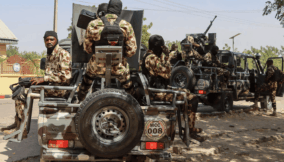
In 1983 Chadian soldiers invaded and took 19 islands in Lake Chad within Nigerian territory. The then Brigadier Buhari, who was the General Officer Commanding of the 3rd Armoured Division (which he did from November 1981-December 1983), successfully carried out a blockade of Chad, after which all the territories were returned. The Nigerian Army under Buhari then pursued the Chadian Army as far as 50km into Chadian territory. The 21st Armoured Brigade carried out the blockade and the fighting.
Major-General Buhari was selected to lead the country by middle and high-ranking military officers after a successful military coup d’etat that overthrew civilian President Shehu Shagari on December 31, 1983. He was appointed Head of State and Commander-in-Chief of the Armed Forces, and Tunde Idiagbon was appointed Chief of General Staff (the de facto #2 in the administration). Buhari justified the military’s seizure of power by castigating the civilian government as hopelessly corrupt, and his administration subsequently initiated a public campaign against indiscipline known as “War Against Indiscipline (WAI)”. Despite authoritarian tendencies, the campaign is still lauded by many to have instilled the most orderly conduct of public and private affairs in Nigeria since its independence in 1960.
Buhari was himself overthrown in a coup led by General Ibrahim Babangida on August 27, 1985 and other members of the ruling Supreme Military Council (SMC) ostensibly because he insisted on investigating allegations of fraudulent award of contracts in the Ministry of Defence. If that investigation had been carried through, it is believed that many senior military officers would have been implicated.
Buhari’s insistence on this investigation was to become his fait accompli. A palace coup was planned and carried out by Gen Ibrahim Babangida and some senior military officers whose necks were heading for the chopping block following the conclusion of the investigation. Without a doubt, this would have become Buhari’s and Idiagbon’s most bitter and shocking lesson on how endemic and widespread corruption had become in Nigeria.
Buhari served as the chairman of the Petroleum Trust Fund, a body created by the government of General Abacha, and funded from the revenue generated by the increase in prices of petroleum products to pursue developmental projects around the country. His transparent and efficient handling of this agency endeared him to Nigerians.
In 2003, Buhari contested the presidential election as the candidate of the All Nigeria People’s Party (ANPP). He was defeated by the People’s Democratic Party nominee, President Olusegun Obasanjo, by a margin of more than eleven million votes. It was claimed by Buhari’s supporters and other members of the opposition that in some states, like Ebonyi, there were more votes than there were actually registered voters. Although some allegations of fraud were conclusively proven in the courts, the court decided that the level of proven electoral fraud was not sufficient to affect the outcome of the election and to warrant the cancellation of the whole presidential election.
On 18 December, 2006, Gen. Buhari was nominated as the consensus candidate of the All Nigeria People’s Party and he lost again in the April 2007 polls to the ruling PDP candidate, Umaru Yar’Adua, who also hailed from the same home state – Katsina – as Buhari. In the election, Buhari officially took 18 percent of the vote against 70 percent for Yar’Adua, but Buhari rejected these results. After Yar’Adua took office, the ANPP agreed to join his government, but Buhari denounced this agreement. The election was adjudged the worst in Nigeria’s history.
Buhari left ANPP with his associates to form the Congress for Progressive Change (CPC). He was the party’s presidential candidate for the April 2011 election.
Nigeria has known many military leaders, but few have had Buhari’s foresight; fewer, indeed, have been as straightforward, as shrewd, as introspective, as peaceful and in the end as quiet, as placid and as respected. Some people are born great; others have greatness thrust upon them. Some become great by dint of hard work, discipline, honesty, purposefulness and trust in God. Buhari achieved greatness by this route.
J.K Randle

Join BusinessDay whatsapp Channel, to stay up to date
Open In Whatsapp