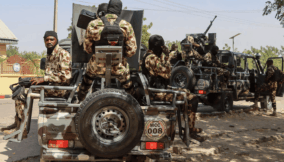
Every solution to a problem starts by defining the problem, be it military, political economical or/and social. From my perspective, I have realized that the Boko Haram issue has remained unresolved and even got worse because we seem not have defined what the issue is.
The situation gets worse when you try to solve the problem internally. That is what is happening to us on Boko Haram – those in government going it all alone. When you are too close to the forest, you don’t see the trees. That is one reason why successful corporations engage consultants. The government of President Goodluck Jonathan is not an exception. The situation has reached the point the President must look outward for resources to help him manage and resolve the Boko Haram challenge.
Because of space and time, I will regard Boko Haram activities as an insurgency. So we start the problem-solving with some definitions.
An insurgency is organized movement aimed at the overthrow of a constituted government through use of subversion, armed conflict and violence. (So let us stop deceiving ourselves that Boko Haram’s objective is not to unseat the President.) It is a protracted politico-military struggle designed to weaken government control and legitimacy while increasing insurgent control. Political power is the central issue in most insurgencies. In the case of Boko Haram, there is clear absence of political power for now. All they are saying, if I am right, is that they don’t want Western Education (especially for girls, perhaps.)
Each insurgency has its own unique characteristics based on its strategic objectives, its operational environment, available resources, operational method, and tactics. Insurgencies frequently seek to overthrow the existing social order and reallocate power within the country. This is what seems to be Boko Haram’s hidden agenda. Presently they are using violence to instill fear in us without coming out with their true objectives.
The goal of an insurgency is to mobilize human and material resources in order to form an alternative to the state. (The President should accept this and do the right thing to stop them.) This alternative is called the counterstate. (He can’t afford to let this happen.) The counterstate may have much of the infrastructure possessed by the state itself, but this must normally be hidden, since it is illegal. (Fortunately, Boko Haram doesn’t seem to.) Thus the counterstate is often referred to by the term “clandestine infrastructure.” (Boko Haram seems to have good clandestine infrastructure – military arsenal.)
An insurgent organization normally consists of four elements: Leadership, Combatants (main forces, regional forces, local forces), Cadre (local political leaders that are also called the militants) and Mass base (the bulk of the membership).
I believe we have defined the problem and having done so, the next thing is to analyze them by asking essential questions revolving around – who, why, where, when, how, what, which, etc. Answers to these questions will form the basis of the resolution of the problem.
There are seven dynamics that are common to most insurgencies. These dynamics provide analytical framework that can reveal the insurgency’s strengths and weaknesses. Knowing your adversary’s strength and weaknesses puts you in a strategically advantageous position over them.
The President should assemble a team of analysts who will examine these dynamics individually. Apart from analyzing them separately, they must also study their interaction to fully understand the way of Boko Haram. If we know their way, they can’t be taking us unawares, the way they are doing now! These seven dynamics are: Leadership, Ideology, Objectives, Environment and geography, External support, Phasing, and Timing.
After the analyses comes the plan of action – the counterinsurgency. Many theories have been advanced and touted on curtailing the excesses of Boko Haram. None has worked. The military chiefs have been summoned severally and given orders to bring their nefarious activities to an end. In fact, Boko Haram seems to wax stronger with each Presidential order to stop them. The main reason why these plans don’t seem to work again revolves around the lack of definition of the problem.
Counterinsurgency is those military, paramilitary, political, economic, psychological, and civic actions taken by a government to defeat insurgency. It is an offensive approach involving all elements of national power; it can take place across the range of operations and spectrum of conflict. What we see here is the isolation of more than 70% of those that should be incorporated into the war against Boko Haram. How can we then succeed when it is only the military that is in charge out of the myriad of national resources available to meet the challenges of Boko Haram?
A successful counterinsurgency results in the neutralization by the state, of the insurgency and its effort to form a counter state. You can not do it with the military alone. While many abortive insurgencies are defeated by military and police actions alone, if an insurgency has tapped into serious grievances and has mobilized a significant portion of the population, simply returning to the status quo may not be an option.
Reform may be necessary, but reform is a matter for the state, using all of its human and material resources. Security forces are only one such resource. The response must be multifaceted and coordinated, but what we are doing is typically charge our security forces with waging counterinsurgency. This the security forces cannot do alone!
The counterinsurgency plan analyzes the basis of the insurgency in order to determine its form, centers of gravity, and insurgent vulnerabilities. These dictate the most effective type force to employ (either police, militia, and military; or even civil defense) in dealing with them.
The counterinsurgency plan details the scheme to reclaim what has been lost and establish priority of effort and timelines. Concurrently, it should outline how the government intends to secure the critical infrastructure of the state and the government’s centers of power. Let us work together in achieving this. We must together manage the Boko Haram challenge.
Agwu Kalu

Join BusinessDay whatsapp Channel, to stay up to date
Open In Whatsapp