The recent campaign by the Federal Government on yam export has failed to address the issue of logistics weaknesses which is very vital for the success of the produce export initiative.
According to experts, Nigeria can only realise its export potential and diversify its revenue through agriculture when agro commodity that are bulky can be transported at cheaper rate to help reduce production cost thereby making it compete favourably at the international market.
“Infrastructure impacts export competitiveness. If we do not do anything about our infrastructural gaps we won’t get anywhere economically,” said Madu Obiora, former chairman, export group, Lagos Chamber of Commerce and Industry (LCCI) told BusinessDay in a telephone response to questions.
Obiora said that the country do not have an effective cold chain infrastructure, stating that the yam export drive can only be successful with adequate infrastructural facilities such as storage, good road networks amongst others.
“We need to activate various means of transportation to facilitate trade and competitiveness. The yam flag was really not necessary because it will create a psychological increase of yam prices in the market,” he said.
After few days of heavy rainfalls most farming areas and markets becomes totally impassable and this has continued to impact negatively on the prices of food items across the country.
Samson Akwah, organising secretary-yam section, Mile 12 market said that since the collapse of the Mokwa-Jebba route which have broken down completely, their transportation cost of yam using a Mercedes Bens truck (911) from the middle belt region has increased from N350,000 to N700,000.
According to him, the customers will have to pay for the additional transportation cost, noting it as the reason for recent price increase in yams in the market.
Currently, Nigeria ranks as the world largest yam producer, churning out 40 million metric tons per annum. Despite this, the staple food is gradually getting beyond the reach of an average Nigerian, owing to the persistent rise in price of the commodity and key inputs.
In 2010, Nasarawa exported about 118 metric tons of yams to the United States and recorded a post-harvest loss of 40 percent then.
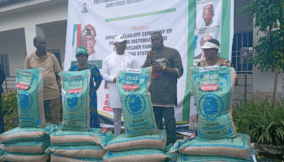
“Nasarawa state was the first to export yam out of the country in 2010 to the USA. We experienced 40 percent loss due to some logistics problems such as preservation, storage and the likes, said Muhammed Jamil Zakari, commissioner for agriculture,” Nasarawa state said during the yam flag-off held in Lagos.
AfricanFarmer Mogaji, chief executive officer, X-ray Farms Limited said “the export move is a right one but the timing is very wrong. Before we talk about yam export we must first increase our yield per hectare and improve on our storage facilities.”
“We cannot benefit from the yam export if we fail to improve storage and logistics facilities in the country. To transport yam tubers from the North to the South is still very expensive which increase the cost of production and makes it less competitive,” Mogaji said.
A visit to Mile 12 reveals that a price of a small tuber of old yam is currently being sold between N450 and N600 while a medium size tuber is sold between N700 and N900; big size tuber is sold for N1, 300 and N1, 500.
Martin Enahoro, deputy director, Peniel Gerar International, said “the yam export is going to increase local price because farmers are already using it as a price factor against the artificial and epileptic export dollar market awareness.”
“We need to increase our yield per hectare and develop high ratio propagation technologies such as aeroponics, bioreactor and vine cutting to address the problem of quality and multiplication in seed yam production because this is the key,” Enahoro added.
Josephine Okojie

Join BusinessDay whatsapp Channel, to stay up to date
Open In Whatsapp