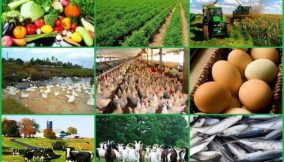
To support the current diversification drive of the Federal Government and mitigate the impact of oil price on the Nigerian economy, Haske &Williams Limited, a dominant player in the Nigerian agribusiness sector, has proposed commercial agricultural projects that will help boost agricultural productivity in rice and cassava to ensure food security in the country.
The project is expected to contribute to the development of smallholder farming in the country through the development and implementation of sustainable strategies aimed at boosting productivity.
Under the commercial agricultural projects, smallholder farmers will be provided with access to quality inputs, mechanisation equipment, rentals, technical capacity building services, irrigation facilities, infrastructural development and management.
“In the Demsa integrated rice project, we have gone away from the tradition lease or land acquisition structure to a structure where 28 percent of the land we develop with infrastructure for irrigation will be leased out to small farm holders,” said Oladipo Williams, executive vice president and co-founder, Haske &Williams Limited in an interview with BusinessDay.
“We have aligned our company’s goals and objectives with the agricultural transformation agenda of the new government and we believe it is important for us to conceptualise and develop model projects which can serve as evidence to Nigerians and the international community that Nigeria can diversify its economy from oil and gas to other sectors,” Williams said.
According to him, the construction work for the project will commence first quarter of 2017 and that about a thousand smallholder farmers have already registered for the project with registration still ongoing.
The company has acquired about 5,000 hectares of land in Adamawa and Kwara states for its rice and cassava integrated projects. “Under this project we are developing a total of 5,000 hectares of land with irrigation infrastructure out of it .1500 hectares will be allocated to smallholder farmers. We will also provide a complete system for farmers where we provide the entire services for them,” he added.
Farmers continue to suffer low levels of agricultural productivity due to the inability to get quality farm inputs, dependence on rainfall and access to mechanisation services, which reduce their profit and capacity to expand.
Abdullahi Bashir, president and founder, Haske &Williams Limited, said: “The potential in agric is enormous and we choose to be different. We partnered with FGM Expert Farmer to introduce a systematic and knowledge-based approach to commercial agriculture which analyses critical aspects of agricultural production value chain and troubleshoots existing conditions to ensure bespoke solutions are developed that optimise the value chain.”
Bashir noted that the company has invested between $ 5 and $10 million dollars putting together fund raising and equity contribution and that the company hopes to invest about $50 million dollars within the next 5 and 10 years.
Despite being a pioneer of the country’s new agricultural revolution, the company stated that the country would not be able to achieve self-sufficiency in rice production in 2018 as set in the Green Revolution- the country’s agricultural road map.
“I don’t think Nigeria will be self-sufficient in rice production by 2018 despite the momentum that rice production is gaining currently. But if the country can maintain the momentum of investments and commitment by the government in rice production, the county will make a giant strive towards self sufficiency,” Williams said.
“A lot have been done at the moment, but there is still some key things that need to be done to achieve sufficiency in rice production. We are going to need more entrepreneurs and more private sector involvement because the government cannot do it alone,” he added.
Currently, Nigeria domestic demand for rice is put at 6.3 million metric tonnes, while the country produces only 2.3 million metric tonnes annually, leaving a supply –demand gap of four million metric tons, according to the Federal Ministry of Agriculture and Rural Development (FMARD).
The company also invested massively in the country’s cassava value chain through its Kaiama Cassava Starch Integrated Rice Production Project in Kwara State with the objective of adding value to the cassava crop to produce by products like starch and ethanol.
Josephine Okojie

Join BusinessDay whatsapp Channel, to stay up to date
Open In Whatsapp