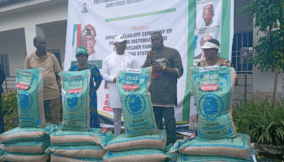
Officials of the National Agricultural Seeds Council (NASC) have seized some consignments of seeds from notable seed markets recently during its sensitisation and public awareness road show in Ibadan.
The seeds seized were those that failed to meet the regulatory standards of the agency. The exercise, according to Philip Olusegun Ojo, director general of NASC, was part of a nationwide campaign against seed adulteration.
The exercise, which focused on seed dealers and seed protection chemicals stockists, led to the discovery and seizure of nearly expiring maize seeds, stocked by a popular seed company during the exercise.
The director general explained during the raid that NASC was in Ibadan to educate and enlighten the seed dealers on how to package and store seeds. “Seed dealers are supposed to be conversant with labelling and being able to differentiate between good and bad quality seeds,” he said.
“This is to send signal to the people that the council can both bark and bite. After this time out, the seed inspectors would return to do surveillance and raid, to do away with adulterated products.
Moreover, “the activity in Ibadan, Oyo State, was only for that part of the Southwest area. The regional offices of the Council would go to all the states of the federation. From the regional level, the state offices would swing into action as well,” he added.
On what penalty NASC would do to companies whose products were impounded for lack of registration during the raid, Ojo referred to the National Agricultural Seeds Act No. 72 of1992, which says that anyone to be involved in getting seeds to the market must be registered.
“Companies or individual producing and marketing seeds without registration are infringing on the law and would be made to face its wrath. For now, we are telling the people what should be done, then action to deal with erring persons or companies would be initiated,” Ojo said.
Explaining the rational for choosing February, Ojo said that, although the education and enlightenment campaign is on-going; there are activities everywhere as the planting season is set to take off. He added that, at the beginning of the rains, there would be another round of surveillance and raids, where necessary.
During the enlightenment campaign at Ibadan, it became obvious that many farmers and some dealers could not distinguish between seed for planting and mere grain.
The director general said seeds should not be sold in open containers; seeds should be in closed containers with two labels – the seed company’s and the certification tag of the Seed Council.
According to him, the tag is a third party guaranty that covers the seller buying the product, assuring that the container has passed through the processes required.
“Any seed that is not in seed containers and does not have certification tags and company label is no seed,” Ojo disclosed, advising farmers to go to the appropriate seed sellers and agencies to purchase seeds.

Join BusinessDay whatsapp Channel, to stay up to date
Open In Whatsapp