As the Federal Government’s rice sufficiency scheme gains traction, Mahesh Nimje, project coordinator of Olam Rice Farms, said with the right kind of support, the Central Bank of Nigeria’s Anchor Borrower’s Scheme could close the supply gap of 2.5 million of rice, in addition to pushing down the huge price tag of rice in the country.
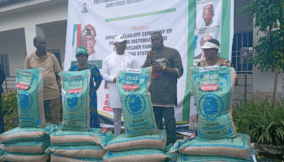
Nimije, while conducting some select journalists around Olams Farms in Rukubi village in Doma Local Government Area of Nassarawa State, last week, said the scheme had been supporting 500 farmers currently cultivating 5,000 hectares under the Olams out-growers programme.
“Olams in partnership with the Bank of Agriculture has succeeded in registering and assisting them access whatever inputs that the Central Bank of Nigeria offers to them. We serve as anchor for the farmers and our out-growers are in Nassarawa and Benue State.
“We have a total of 13,500 hectares of farmland in Olams farms. We have 4,500 currently under cultivation. The rice seed variety in CT90 quality could compete far better than imported rice in the country.
“Currently, we have 4,500 hectare under cultivation in a two-cycle seasons farming of wet and dry, which makes harvest yield of 40,000 metric tons of paddy rice annually,” he said.
Speaking on possible cut on high price of rice in the country, he said, “The government could consider slight importation of rice to augment the supply gap of 2.5 million metric tons of rice annually, which could make the forces of demand and supply balance the price of rice in the market.
“The supply gap of 2.5 million is still very high, and the demand is still on the rising side. We need more programmes like the anchor borrowers and more support to farms by IFAD and other international supports to encourage more local production.
“The forces of demand and supply are still a major factor affecting the price of rice in the country. Input cost is also a major concern. The inputs like seed price, fertilizer price and even the cost of power generation are some of the issues that affects price.
“The support our out-growers get from the CBN is mainly on access to inputs, training, availability of cheap funds, and availability of agricultural inputs, to fertilizers at subsidised rate.”
Meanwhile, Nigeria’s importation of rice, a major staple, accounts for over N400 billion out of a food import bill now in excess of N1.5 trillion, is expected to reduce drastically as farmers across the country, particularly in the North, expand operations and improve on their farm yields.
The price of rice has gone up astronomically since the beginning of this year when a 50kg bag was sold for N10,000, but now sells for as much as N23,000. The importation of rice, done mostly through illegal smuggling routes, has considerably added to the pressure on the naira, as more demand is made for the dollar used to import the commodity.
Available data from the Federal Ministry of Agriculture show that rice production in the country, which stands at 2.3 million metric tons, has a 4-million ton deficit from the 6.3 million metric tons demand. The deficit has been attributed to insufficient supply chain integration, which remains a nagging issue in achieving sustenance.

Join BusinessDay whatsapp Channel, to stay up to date
Open In Whatsapp