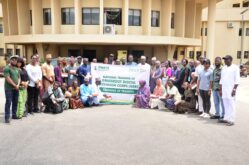
In a bid to improve farmers’ livelihood and boost their sales, Aller Aqua Limited has trained fish farmers on innovative marketing to boost local production and reduce the country’s annual fish import.
Aller Aqua organises training yearly for fish farmers across the country on different aspect of fish production to educate them on techniques to make them remain profitable in business.
“Despite Nigeria being the largest catfish producer, farmers’ livelihood is yet to be impacted on, and this is because their profit margins are being eroded by the monopoly market they sell in,” Nurudeen Lasisi, managing director and country manager, Aller Aqua Limited said during the training in Agege – Lagos.
“On this note, we are training farmers on the value chain and how to diversify their marketing by using innovation, social media and other platforms to sell their fish instead of just relying solely on the monopoly market which is the fish mongers,” Lasisi said.
“We are training them on how they can diversify their sales to improve their return on investment,” he added.
He stated that Nigerians consume less catfish because they see it as luxury or for special occasion, saying that farmers are now being encouraged to grow smaller size for households to drive local consumption.
Speaking also during the training, Tiamiyu Nurudeen, a facilitator and vice president of Tilapia Aquaculture Developers Association of Nigeria (TADAN), said that one of the greatest challenges confronting aquaculture production in the country was the market.
“The greatest challenge to fish farmers is the market. Nigeria has a deficit of about 2.4 million metric tons, so you would expect that there should be a market for your fish but this is not the case for farmers and this is because of the high rate of fish imported into the country that are cheaper,” Nurudeen said.
“Farmers have to create their own market for their fish to remain in business. We have to do things differently. We realise that it is the fish mongers that are making the profit out of the sweat of the farmers.
“So now the farmers need to use that same structure that the market women have used over the years to create their own market and eliminate the market mongers by putting their own structure in place to service the same market they service at a better percentage to remain in business,” he further said.
He said that the training was to teach farmers to use different models in getting their fish across to consumers at cheaper prices than the market women are currently doing .
He noted that in the long run farmers would increase their production as they find more market for their produce.
Nurudeen debunked the belief that catfish consumption makes consumers prone to cancer, saying that Nigerian farmers do not use anti-biotics in their fish production but pro-biotics.
He stated that the Nigerian catfish are very safe for consumption and that the association was working to put a modality in place to accredit farms that are adhering to global best practices in fish production.
Lanre Ogunshina, a fish famer and a consultant to farms, who was one of the facilitators for the training, said that farmers are trained on how bridge the gap and get across to the consumers directly.
“If farmers adhere to the ways they have been trained to produce catfish, it will bring down their production cost and all their products can compete effectively and efficiently with imported fish,” Ogunshina said.
“This will make more Nigerians consume cat fish and reduce the country’s reliance on imported fish,” he said.
Other facilitators spoke on practicing fish processing as a business and sustainable dinning for catfish farming in partnership with the Development Finance Office, Central Bank of Nigeria.
Josephine Okojie

Join BusinessDay whatsapp Channel, to stay up to date
Open In Whatsapp