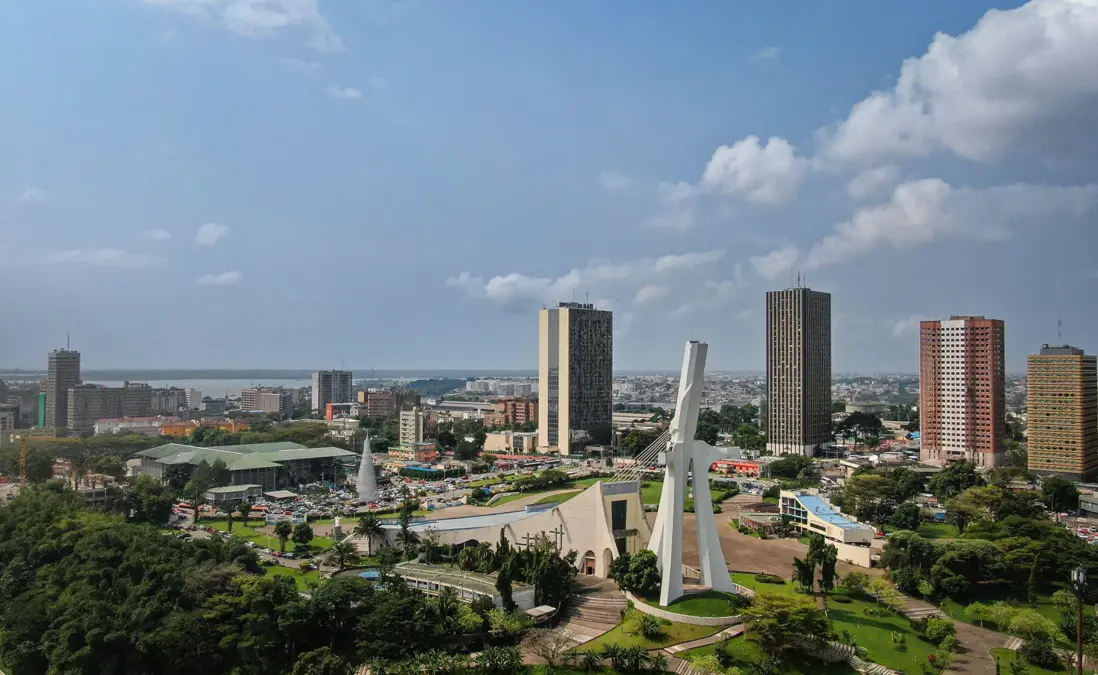
Côte d’Ivoire is hardly the obvious place to find Africa’s next banking boom.
The world’s largest cocoa and cashew producer remains on the Financial Action Task Force (FATF) grey list, faces security threats along its northern border and has experienced periods of political instability over the past two decades. Yet those challenges have done little to deter Africa’s biggest lenders.
Instead, they are arriving.
Barely two months after Nigeria’s Zenith Bank opened its first-ever Francophone African subsidiary in Côte d’Ivoir on April 29, 2026, Mauritius Commercial Bank (MCB), one of the Indian Ocean nation’s largest lenders, announced plans to establish operations in the country.
The back-to-back expansion plans are the latest evidence that Africa’s banking heavyweights are converging on Abidjan, betting that the country’s industrial transformation and investment boom will power the next phase of banking growth in West Africa.
For Zenith, the move is about more than adding another country to its footprint. It is a strategic push to strengthen intra-African trade and position itself closer to one of the continent’s fastest-growing investment destinations.
“Opening a strategic corridor into Francophone West Africa reinforces our commitment to facilitating trade, investment and enterprise growth across the continent,” said Adaora Umeoji at the launch of the bank.
Her comments capture a broader shift taking place across African banking. Regional lenders are no longer expanding simply to attract retail deposits. They are following trade corridors, industrialisation and investment flows as African companies increasingly expand beyond their home markets under the African Continental Free Trade Area (AfCFTA).
Over the past decade, Moroccan banking giants—including Attijariwafa Bank, Banque Centrale Populaire and Bank of Africa—have steadily expanded across Francophone Africa, building dominant positions in the West African nation and neighbouring markets.
Regional lenders such as Ecobank, NSIA Banque, Orabank, Coris Bank International and Vista Group have also strengthened their presence, turning the West African nation into one of Africa’s most competitive banking markets.
Their growing footprint tells a much bigger story than individual expansion plans.
It reflects a fundamental shift in African banking.
Banks do not expand into new markets simply because an economy is growing. They follow investment, trade, and business. When manufacturers build factories, exporters increase shipments, infrastructure projects multiply, and foreign investors commit billions of dollars; banks inevitably follow. Every new industrial park, logistics hub and manufacturing plant creates demand for trade finance, project finance, treasury services, foreign exchange and working capital.
That is precisely what is happening in Côte d’Ivoire. According to the International Monetary Fund (IMF), several African economies will remain among the world’s fastest-growing this year, led by Ethiopia, Guinea, Uganda, Rwanda, Benin and Côte d’Ivoire. Cote is projected to grow to 6.2 percent.
“Agriculture contributes roughly 17 percent of its GDP, while the sector accounts for close to 10 percent of tax revenue,” said Godfred Bokpin, professor of finance at the University of Ghana Business School, during a regional economic outlook webinar. “That suggests the country is doing something right, particularly through commercial production of cocoa, palm oil and other cash crops.”
African banks are filling a growing void
The rush into Côte d’Ivoire is unfolding against another profound shift in African finance: the steady retreat of international lenders from the continent.
For decades, European and international banks dominated African corporate banking. Institutions such as Standard Chartered, BNP Paribas, Barclays, HSBC and Société Générale financed trade, supported multinational corporations and provided much of the foreign currency liquidity that underpinned cross-border commerce.
That landscape is changing.
Many international lenders since 2015 have scaled back operations across Africa as they reassessed returns, tightened compliance requirements, and redirected capital towards larger and more profitable markets.
A recent report by Moody’s noted that many Western banks that once viewed Africa as “the next frontier” have become increasingly disappointed by returns.
“Profitability, when adjusted for currency movements and capital weighting, has often fallen short of expectations,” the rating agency said.
Weak profitability, rising compliance costs, tighter regulation and growing competition from fintech firms have accelerated the retreat of global lenders, creating opportunities for African banks to fill the gap.
Rather than merely replacing departing international banks, regional lenders are positioning themselves to finance Africa’s next generation of manufacturers, exporters, infrastructure developers and multinational companies.
Banks follow investment
The timing of these expansion plans is no coincidence.
According to Rand Merchant Bank’s latest Where to Invest in Africa report, Côte d’Ivoire recorded the biggest improvement among 31 African economies, climbing eight places from 16th to eighth in the investment attractiveness rankings.
“Côte d’Ivoire stands out as the highest climber in the rankings,” the report noted, citing strong economic growth, industrial expansion and improving infrastructure.
The country’s rising appeal is also reflected in investment flows.
The latest UN Trade and Development report shows that Foreign Direct Investment into the country jumped 53 percent to $3.8 billion in 2024, making it one of Africa’s second highest destinations for long-term capital.
Unlike many commodity-dependent economies, it has spent the past decade deliberately changing its growth model.
Instead of exporting raw cocoa beans and cashew nuts, the government has introduced incentives to encourage domestic processing through industrial parks, tax breaks, export support programmes and infrastructure investment.
The strategy is attracting global manufacturers.
Singapore-based Olam has continued expanding its agro-processing footprint, while the UAE’s Al Sayegh Group invested €22 million in a cashew-processing facility employing around 2,000 workers. Singapore’s Valency International has also commissioned a $40 million processing plant, while India’s Arise Integrated Industrial Platforms is developing industrial parks focused on agricultural value chains with support from the African Development Bank.
These investments are creating exactly the type of commercial ecosystem banks seek.
Factories need long-term financing. Exporters require trade finance. Manufacturers depend on treasury management, payroll services, and foreign exchange solutions. Infrastructure developers require project finance, while growing supply chains need working capital.
For banks, industrialisation creates long-term clients rather than short-term transactions.
It is these opportunities—not simply population size or headline GDP growth—that are drawing Africa’s banking giants into Côte d’Ivoire.
Why Abidjan is winning the race
Côte d’Ivoire’s appeal extends far beyond its strong economic growth.
Its greatest advantage is that it offers banks a gateway not just to one country but to an integrated regional market.
Operating from Abidjan gives financial institutions access to the eight-member West African Economic and Monetary Union (WAEMU), comprising Benin, Burkina Faso, Côte d’Ivoire, Guinea-Bissau, Mali, Niger, Senegal and Togo. Together, the bloc represents a market of more than 145 million people sharing the CFA franc, a common central bank and harmonised banking regulations.
That integration significantly lowers the cost and complexity of cross-border banking.
Unlike many African markets where banks must navigate multiple currencies and regulatory systems, WAEMU offers monetary stability and a unified supervisory framework, making regional expansion more efficient.
Abidjan’s position is further reinforced by its role as home to the Bourse Régionale des Valeurs Mobilières (BRVM), the regional stock exchange serving all eight WAEMU member states. Combined with one of West Africa’s busiest ports, expanding transport infrastructure and the regional headquarters of numerous multinational companies, the city has steadily evolved into the commercial and financial capital of Francophone West Africa.
These advantages explain why Africa’s largest lenders increasingly view Abidjan—not just Lagos, Nairobi or Johannesburg—as one of the continent’s most strategic banking markets.
A battle for corporate Africa
The competition unfolding in Côte d’Ivoire is not about opening more retail branches.
It is about financing Africa’s corporate economy.
Manufacturers need project finance. Exporters require trade finance and foreign exchange services. Infrastructure developers seek syndicated loans, while agribusinesses, logistics companies and energy firms require working capital and treasury solutions.
These are precisely the businesses driving the country’s economic transformation.
For Zenith Bank, its Ivorian subsidiary provides a platform to support Nigerian companies investing across Francophone West Africa while expanding its regional corporate banking franchise.
For MCB, Côte d’Ivoire offers access to one of Africa’s fastest-growing corporate markets and strengthens its ambition to connect African trade with the Indian Ocean and Asian markets.
Yet both institutions are entering one of Africa’s most competitive banking landscapes.
Moroccan banks established their presence years before many regional rivals recognised the opportunity. Attijariwafa Bank, through Société Ivoirienne de Banque, has become one of the country’s leading corporate lenders. Banque Centrale Populaire expanded through Banque Atlantique, while Bank of Africa has built one of the largest banking networks across the region.
Regional champions have been equally aggressive. Ecobank leverages its presence in more than 30 African markets to serve multinational clients, while NSIA Banque, Orabank, Coris Bank International and Vista Group continue to expand their corporate and SME banking businesses across WAEMU.
The race is no longer about who has the largest branch network.
It is about who can become the financial partner of Africa’s next generation of exporters, manufacturers, and infrastructure developers.
A market with room to grow
Despite the growing competition, Côte d’Ivoire’s banking market remains far from saturated.
According to the WAEMU Banking Commission, the country accounts for more than one-third of total banking assets within the monetary union, making it the bloc’s largest banking market.
Credit to the private sector has continued to grow, supported by industrial expansion, infrastructure spending and rising corporate investment.
Yet banking penetration remains relatively low, with millions of Ivorians still outside the formal financial system. That presents opportunities not only in corporate banking but also in digital finance, SME lending and consumer banking.
For lenders with long-term ambitions, the opportunity lies not simply in taking market share from competitors but in growing alongside one of Africa’s fastest-expanding economies.
Growth comes with risks
Côte d’Ivoire’s investment story is not without challenges.
The economy remains exposed to swings in global cocoa prices, climate-related shocks affecting agricultural production and security risks linked to instability in the wider Sahel region.
Its continued presence on the FATF grey list also highlights the need to strengthen anti-money laundering and counter-terrorism financing controls.
Political stability will remain essential to sustaining investor confidence, particularly as the government seeks to accelerate industrialisation and attract more long-term private capital.
Even so, many investors believe the country’s structural strengths outweigh those risks.
Consistent economic growth, improving infrastructure, expanding manufacturing capacity and a deliberate shift towards value-added exports continue to reinforce Côte d’Ivoire’s appeal.
The country’s successful return to the international Eurobond market in 2024—raising $2.6 billion from an order book exceeding $8 billion—offered another strong vote of confidence from global investors.
Redrawing Africa’s banking map
The arrival of Zenith Bank and the planned expansion of MCB tell a much bigger story than two institutions opening new subsidiaries.
They illustrate how Africa’s financial landscape is changing.
As international lenders retreat, African banks are increasingly becoming the continent’s principal financiers of trade, infrastructure and industrialisation.
At the same time, capital is flowing towards economies that have invested in manufacturing, logistics, energy and value-added exports rather than relying solely on raw commodities.
Banks are following that capital.
A decade ago, discussions about Africa’s financial centres focused almost exclusively on Johannesburg, Lagos and Nairobi.
Today, Abidjan has emerged as a serious contender.
Its combination of sustained economic growth, regional integration, industrial policy and improving infrastructure has transformed it into the financial gateway to Francophone West Africa.
For Africa’s banking giants, the race into Côte d’Ivoire is not simply about opening another office.
It is a strategic bet on where the continent’s next wave of trade, investment, and industrial growth will be financed.
Join BusinessDay whatsapp Channel, to stay up to date
Open In Whatsapp