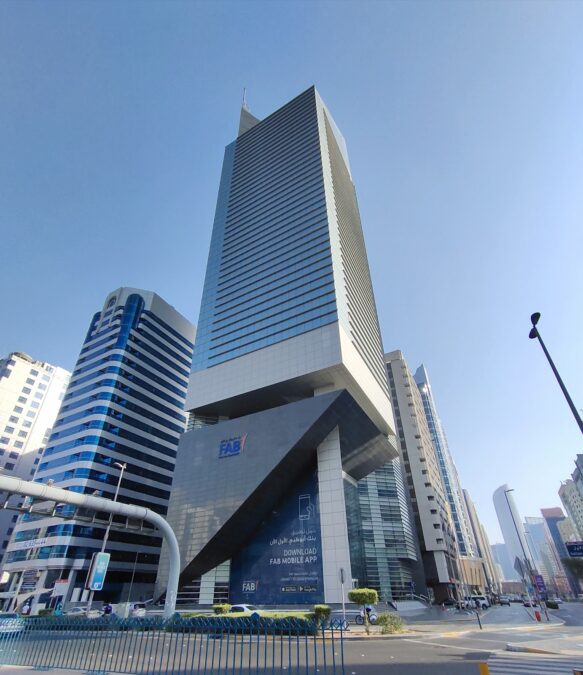
First Abu Dhabi Bank (FAB), the United Arab Emirates’ largest lender, has confirmed plans to seek a banking licence in South Africa, potentially extending its African footprint after opening a representative office in Nigeria earlier this year.
FAB’s move would bring a major Gulf lender into Africa’s largest and most sophisticated banking market at a time when several European banks are scaling back or exiting the country.
According to Business Day South Africa, FAB disclosed its intentions during a trademark dispute with FirstRand, South Africa’s largest banking group by market value. The Abu Dhabi-based lender successfully defended its trademark application before South Africa’s Supreme Court of Appeal after FirstRand argued that the FAB name could infringe the trademark of its flagship retail bank, FNB.
The court’s majority judgment, handed down on Tuesday, said there was no reason to doubt that FAB would comply with all legal requirements to operate in South Africa, including applying for a banking licence, if its trademarks are registered.
FAB told the court that securing trademark protection was the first step in its planned expansion into the South African market. The lender said it was financially prudent to complete the trademark process before pursuing a banking licence, rather than “putting the cart before the horse”.
The development comes less than two months after HSBC formally ended its last official presence in South Africa. On May 15, the South African Reserve Bank cancelled HSBC’s foreign-exchange dealing licence, completing the British lender’s exit from the country.
HSBC had operated in the country largely as a corporate and investment bank, serving large companies rather than retail customers. The lender announced in September 2024 that it would withdraw from the market to focus on faster-growing Asian markets. It sold its corporate banking business to FirstRand’s Rand Merchant Bank and its equities business to Absa, with the final transaction completed in May.
HSBC’s exit is part of a wider retreat by foreign lenders from South Africa. BNP Paribas and Barclays have reduced or exited parts of their African operations in recent years, while Standard Chartered has also scaled back its presence across the continent.
FAB’s prospective entry therefore stands out as a countertrend, reflecting the growing appetite of Gulf financial institutions for African trade, infrastructure, energy and corporate banking opportunities.
With $406 billion in assets, FAB is larger than Standard Bank and FirstRand combined. The group operates across corporate, consumer, private and investment banking, as well as payments, wealth management, Islamic banking and real estate.
FAB already operates in Cairo and Libya and expanded into West Africa in February with the opening of a representative office in Lagos. A South African banking licence would give the lender a presence across North, West and Southern Africa, linking three of the continent’s most important commercial and financial hubs.
The expansion would position FAB to compete for corporate, trade-finance and investment-banking business across a continent where Gulf lenders are seeking a larger role, even as European banks reduce their exposure. The lender was formed in 2017 through the merger of National Bank of Abu Dhabi and First Gulf Bank. It is majority-owned by Mubadala Investment Company and members of Abu Dhabi’s ruling family.
Sheikh Tahnoon bin Zayed Al Nahyan, Abu Dhabi’s deputy ruler and the UAE’s national security adviser, chairs FAB. He also chairs the Abu Dhabi Investment Authority, one of the world’s largest sovereign wealth funds.
The planned expansion comes as investment ties between the UAE and South Africa deepen. The UAE is South Africa’s largest trading partner among Gulf Co-operation Council countries, while South Africa is the UAE’s second-largest trading partner in Africa.
This week, Adnoc Distribution, an entity linked to Abu Dhabi’s ruling family, emerged as the preferred bidder for Shell’s network of about 600 fuel stations in South Africa in a deal valued at about $1 billion, its largest foreign investment to date.
South African banks are also positioning for stronger Gulf-Africa trade flows. Standard Bank, Africa’s largest lender by assets, opened a representative office in Egypt to support clients pursuing opportunities across North Africa and the Middle East.
FAB’s proposed move will test whether a Gulf lender can gain ground in a market where foreign banks have historically struggled to compete with entrenched domestic players such as Standard Bank, FirstRand, Absa and Nedbank.
The trademark ruling does not guarantee a banking licence. But it gives FAB an important legal opening as it considers a deeper move into South Africa’s corporate and investment banking market.

Join BusinessDay whatsapp Channel, to stay up to date
Open In Whatsapp