…five of eight major economies contract as inflation, external shocks bite

Africa’s private-sector recovery is showing signs of strain as the number of major economies reporting business contractions more than doubled in three months, raising concerns that inflation, rising fuel costs, and renewed geopolitical tensions are beginning to undermine the continent’s economic rebound.

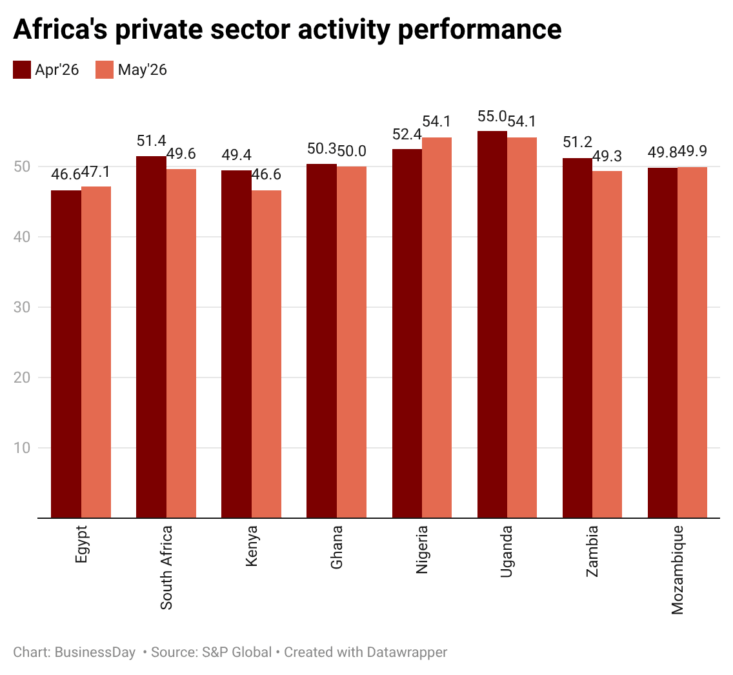
BusinessDay’s analysis of the latest Purchasing Managers’ Index (PMI) reports from eight African economies showed that five economies recorded contractions in May, up from three in April and two in March. The trend points to a weakening business environment as companies grapple with rising operating costs, softer demand and growing uncertainty.

The deterioration comes despite strong performances in a handful of economies, particularly Nigeria and Uganda, which posted the highest PMI readings on the continent at 54.1.

A PMI reading above 50 indicates an improvement in business conditions, while a reading below 50 signals contraction. The index is widely regarded as a leading indicator of economic activity and often provides an early signal of future GDP trends.

The latest data also reveals that the continent’s recovery remains uneven, with stronger domestic demand supporting activity in some economies while others struggle with inflationary pressures, rising transportation costs and weaker consumer spending.

“After a strong 2025, sub-Saharan Africa (SSA) entered 2026 poised to build on hard-won macroeconomic stabilisation gains. However, the war in the Middle East has clouded the outlook, driving up prices of oil, gas and fertilisers, while higher shipping costs have disrupted trade flows and heightened economic uncertainty,” the World Bank said in its regional economic outlook for SSA released in April.

The multilateral lender said the conflict is expected to shave 0.3 percentage points off the region’s growth outlook, with Sub-Saharan Africa’s economy now projected to expand by 4.3 percent in 2026, below earlier forecasts.

“Oil-importing, non-resource-rich economies face deteriorating trade balances and rising living costs, while oil exporters stand to benefit from higher export revenues but remain vulnerable to commodity-price volatility and procyclical policy risks. Downside risks remain elevated amid heightened global uncertainty and persistent macroeconomic vulnerabilities across the region,” the Bank added.

More economies slide into contraction

Kenya recorded the sharpest deterioration in business conditions among the economies surveyed, with its PMI falling 5.67 percent to 46.6 in May from 49.4 in April. Zambia followed with a 3.71 percent decline, while South Africa’s PMI fell 3.50 percent. Uganda and Ghana also posted declines of 1.64 percent and 0.59 percent respectively.

Nigeria recorded the strongest month-on-month improvement, with its PMI rising 3.24 percent to 54.1 in May from 52.4 in April, marking its highest reading in 13 months. Egypt posted the second-largest increase, with its PMI rising 1.07 percent to 47.1, while Mozambique’s index edged up 0.20 percent to 49.9.

In April, only Egypt, Zambia and Mozambique recorded contractions in private-sector activity, while South Africa, Kenya, Ghana, Nigeria and Uganda remained in expansion territory. By May, however, the number of contracting economies had risen sharply, underscoring the fragility of the continent’s recovery.

Nigeria’s performance was driven by stronger customer demand and new product launches, according to S&P Global.

“This impressive business condition was primarily due to accelerated expansion in both output and new orders, with evidence pointing to improving customer demand and the launch of new products,” said Muyiwa Oni, head of Equity Research West Africa at Stanbic IBTC Bank.

He added that while input costs continued to rise, inflationary pressures moderated for a second consecutive month. “This is also reflected in higher output prices, with the steepest increase seen in the manufacturing and agriculture sectors.”

The PMI survey, which covers agriculture, mining, manufacturing, construction, wholesale, retail and services, is compiled from responses from around 400 private-sector companies.

Kenya, South Africa and others face mounting pressure

While Nigeria and Uganda remained bright spots, business conditions weakened across much of East and Southern Africa.

Kenya’s PMI fell to a 10-month low as inflation accelerated to 6.7 percent in May from 5.6 percent in April, according to the Kenya National Bureau of Statistics.

According to Christopher Legilisho, economist at Standard Bank, softer sales, cash-flow constraints and rising costs weighed heavily on business activity.

“These declines may stem from the week-long disruption to business activity because of nationwide protests by transportation sector players that constrained movement,” he said.

Legilisho noted that rising fuel and transportation costs had intensified inflationary pressures and weakened consumer demand.

“Still, despite subdued business momentum, firms remain optimistic about future conditions,” he added.

Inflation and Middle East tensions cloud outlook

Since the outbreak of the Middle East conflict in Febuary, disruptions to shipping through the Strait of Hormuz, a critical route for global oil, gas and fertiliser exports, have driven up energy, transport and fertiliser costs, complicating inflation outlooks and increasing operating expenses for businesses across the continent.

The World Bank has warned that the conflict could undermine recent progress in reducing inflation across Sub-Saharan Africa. The lender expects energy prices to rise by 24 percent this year, while fertiliser prices could increase by more than 30 percent as supply disruptions persist.

Read also: Inside Tatum Bank’s plan to build Nigeria’s next SME banking powerhouse

Higher fuel and fertiliser costs pose a particular risk for African economies that rely heavily on imports, threatening both business profitability and food production. Rising input costs could also delay interest rate cuts across several economies as central banks seek to contain inflationary pressures.

In Nigeria, headline inflation rose for a second consecutive month to 15.69 percent in April, the highest level in five months, reversing an 11-month disinflation trend. Food inflation also accelerated to 16.06 percent as higher fuel costs and supply-chain disruptions filtered through to consumer prices.

Economists expect inflationary pressures to intensify further following another increase in domestic fuel prices, potentially complicating the policy outlook for the Central Bank of Nigeria, which left its Monetary Policy Rate unchanged at 26.75 percent last month.

“Increasing fuel costs following the outbreak of war in the Middle East continued to drive up purchase prices in May,” authors of the Nigeria PMI report said.

They added that purchase costs continued to rise sharply, although the overall pace of inflation eased to a three-month low. “Where companies increased staff pay, this was often to provide help with higher living costs, and those for transportation in particular.”


Bunmi holds a degree in Economics from the University of Lagos and has over eight years of experience in content writing and journalism. Her career spans roles as a financial and business journalist at BusinessDay Media and TechCabal, and as Head of Research at SBM Intelligence, an Africa-focused market intelligence and strategic consulting firm. She also served as Editor at Finance in Africa, a subsidiary of Businessfront and is currently Assistant Editor, Finance (Africa), at BusinessDay.

Join BusinessDay whatsapp Channel, to stay up to date

Open In Whatsapp