From Ethiopia’s efforts to deepen capital market reforms and Morocco’s emergence as Africa’s leading industrial economy to rising borrowing costs, inflationary pressures in Kenya and Botswana’s latest diversification push, the continent’s major economies are increasingly repositioning for long-term growth amid mounting global uncertainty.
Here are the stories shaping the first week of June
Ethio Telecom becomes first non-bank listing on Ethiopia’s new stock exchange
Ethio Telecom has officially begun trading on the Ethiopian Securities Exchange (ESX), becoming the first major non-financial company to join the country’s fledgling capital market. The listing follows the government’s partial privatisation of the telecom operator, during which 47,377 investors purchased 10.7 million shares worth 3.2 billion birr ($20 million).
Why it matters: The listing marks a major milestone in Ethiopia’s long-delayed capital market reforms and signals growing efforts by the government to open the economy to private investment. It also broadens the ESX beyond financial institutions, potentially paving the way for future listings from sectors such as telecoms, manufacturing and energy in one of Africa’s largest untapped markets.
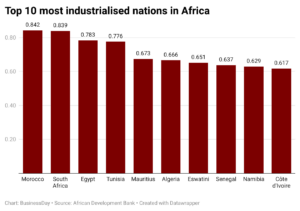
Morocco overtakes South Africa as Africa’s industrial powerhouse after 15 years
Morocco has overtaken South Africa as Africa’s leading industrial economy for the first time in 15 years, according to the African Development Bank’s 2025 Africa Industrialisation Index. The North African country climbed to the top spot following years of aggressive industrial policy, expanding manufacturing exports, infrastructure investment and economic diversification.
Why it matters: The shift highlights the changing geography of industrial growth in Africa. While Morocco has positioned itself as a global manufacturing and export hub for sectors such as automotive, aerospace and renewables, South Africa’s industrial competitiveness has weakened due to power shortages, logistics bottlenecks and slower economic growth.
Africa keeps world’s highest borrowing costs as central banks delay rate cuts
African countries are maintaining some of the world’s highest interest rates as of May 2026 as the Iran war fuels fresh inflation concerns, rising oil prices and currency pressures. Data compiled by Trading Economics showed benchmark interest rates ranging from 35 percent in Zimbabwe to 1.75 percent in Seychelles, reflecting a widening divergence in monetary policy across the continent.
Why it matters: Persistently high interest rates are increasing borrowing costs for businesses and households across Africa, potentially slowing investment and economic growth. The cautious stance also reflects how global geopolitical tensions and imported inflation risks continue to complicate monetary policy decisions for African central banks already battling currency volatility and food inflation.
Kenya inflation hits two-year high as fuel prices surge
Kenya’s annual inflation accelerated to 6.7 percent in May from 5.6 percent in April, reaching its highest level since January 2024, according to data from the Kenya National Bureau of Statistics. The increase was largely driven by higher fuel prices amid rising global energy costs linked to tensions involving Iran.
Why it matters: The sharp rise in inflation could complicate Kenya’s monetary policy outlook and increase pressure on households already facing higher living costs. It also highlights how geopolitical tensions in the Middle East are feeding into African economies through energy prices, transport costs and imported inflation.
Botswana taps ex-AfDB chief Adesina to lead diamond diversification fund
Akinwumi Adesina, former president of the African Development Bank, has been appointed chairman of Botswana’s Diamonds for Development Fund, a new initiative created by the Botswana government and De Beers Group to use diamond revenues to drive economic diversification, job creation and long-term development.
Why it matters: The appointment reflects Botswana’s growing push to reduce dependence on diamond exports and build a more diversified economy. It also signals increasing focus across resource-rich African countries on using commodity wealth to finance industrialisation, infrastructure and broader economic transformation beyond extractive industries.
Chart of the Week

Join BusinessDay whatsapp Channel, to stay up to date
Open In Whatsapp