The current administration has not hidden the country’s bold attempt at deepening interest-free access to education financing since the official commencement of the Nigerian Education Loan Fund (NELFUND) in May 2024.
For the government, the mandate to managers of the fund was clear from the set go: democratize access to higher education and skill development through sustainable financing.
This was seen by many as a bold and lofty mandate; one that comes with immense expectations, and hope.
Hope for that market woman whose daughter dreams of becoming a doctor. Hope for the young man from a rural community who aspires to build software solutions that can change the world.
That mandate also comes with hopes for families across Nigeria who simply want their children to have a better chance at tertiary education to improve their family standing in the society.

“Since we opened our application portal in May 2024, we have made remarkable progress, progress that is both measurable and meaningful,” Akintunde Sawyerr, managing director/chief executive, Nigerian Education Loan Fund (NELFUND), said during the hybrid media parley held on Thursday, July 17, 2025, for the NELFUND media engagement 2025.
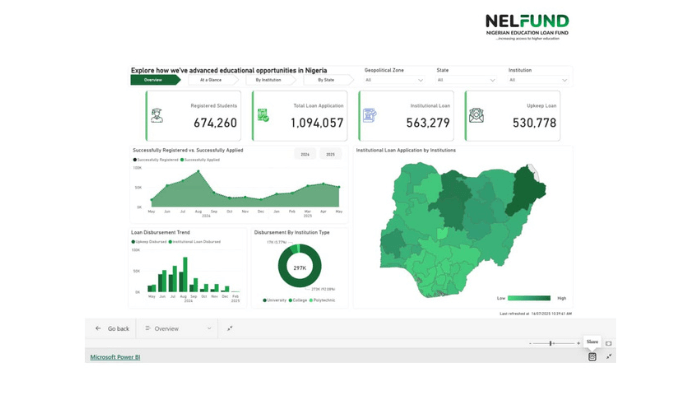
According to him, over 645,692 applications have been received from eligible students across Nigeria’s 36 states and the FCT.
He also disclosed that NELFUND have successfully disbursed tuition and upkeep interest-free loans to over 396,252 students, many of whom are first-generation students in tertiary institutions.
“We have deployed a fully digital, transparent loan portal, built to global standards, to ensure seamless processing, tracking, and verification,” Sawyerr said.
According to him, the NELFUND has expanded its framework to include students in technical and vocational training institutions, aligning with the country’s national employment and skills development goals.
Similarly, the management of NELFUND responded rapidly to issues around digital wallets and banking limitations by enabling account updates and migrating disbursements to commercial bank accounts.
“Behind each of these numbers are real people, young Nigerians whose dreams were once delayed or denied by circumstance, but who now carry a renewed sense of possibility.
“I have personally received letters, messages, and stories from students and parents expressing their gratitude, their relief, and perhaps most movingly their renewed confidence in their country,” Sawyerr said.
Teething challenges
Like every bold attempt at change and upward trajectory, access to Nigeria’s first ever interest-free education finance’s journey has not been without its challenges in the last one year.
Since May 2024, the NELFUND have encountered issues with some institutional data integrity, delays in verification processes, and widespread misinformation.
“Yet, through it all, we’ve remained steadfast in improving our systems, engaging directly with applicants, training institutional focal points, and responding swiftly to tickets, concerns, and grievances,” Sawyerr said.
According to him, managers of Nigeria’s interest-free education financing model are custodians of national trust; and that trust demands humility, responsiveness, and a long-term view.
“Our ethos at NELFUND is simple: listen, learn, adapt. We are not just administrators of a loan scheme,” he said.
Need for consistent engagement on Nigeria’s interest-free education loan
Sawyerr’s engagement with the media, the first in the last one year, was an attempt by management of NELFUND to deepen accountability and transparency of loan disbursement.
But, beyond the engagement is the political will to also carry the public along, and throw open the books for all stakeholders across the country.
“Today’s engagement is not a routine event. It is a moment for reflection, transparency, and honest dialogue,” Sawyerr said, acknowledging the need to hold public institutions accountable and informing the citizenry.
According to him, the engagement offers managers of Nigeria’s interest-free education loan a moment to tell its story not just through metrics and milestones but through the lived experiences of Nigerian students who, for the first time in the nation’s history, are gaining structured, interest-free access to education finance through a national public fund.
He also acknowledged the leadership and political will of President Bola Ahmed Tinubu, whose Renewed Hope Agenda continues to inspire bold reforms in governance. “The establishment of NELFUND is a direct result of that vision, a vision that places the Nigerian youth at the heart of national development,” he said.

Join BusinessDay whatsapp Channel, to stay up to date
Open In Whatsapp