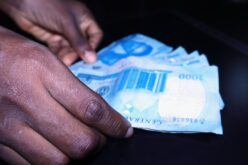
The naira on Wednesday climbed to a two-month high of N1,565.46 per dollar at the official foreign exchange (FX) market, maintaining a trajectory of relative stability that has persisted in recent months.
The last time the local currency traded near this level was on April 4, 2024, when the dollar exchanged at N1,567.02 in the Nigerian Foreign Exchange Market (NFEM), according to data published by the Central Bank of Nigeria (CBN).
By the close of trading on Wednesday, the naira had appreciated by N13.82 against the dollar, with the greenback quoted at N1,565.46. This represents a 0.9% gain when compared to the N1,579.28 recorded on Tuesday in the official FX window.
Read also: Naira gains across markets as FPIs, non-bank corporates drive dollar inflows
In the parallel segment of the market, commonly referred to as the black market, the naira also posted gains. The local currency strengthened by N5 to close at N1,605 per dollar, an improvement over the N1,610 recorded on both Monday and Tuesday.
According to Olayemi Cardoso, Governor of the CBN, the renewed level of stability in the naira is the result of deliberate and disciplined reform efforts undertaken by the apex bank. He pointed out that the gap between the official and parallel exchange rates had largely been eliminated, highlighting it as one of the most significant changes in Nigeria’s foreign exchange landscape in recent memory.
Cardoso credited this development to what he described as the Federal Government’s unwavering commitment to reform and the emergence of greater clarity in policy direction.
“Thanks to our sustained reforms and enhanced policy transparency, the naira has stabilised at a far more sustainable level relative to the U.S. dollar. For the first time in years, the disparity between the official and parallel market rates has virtually disappeared, and speculative arbitrage opportunities have been drastically reduced,” Cardoso stated. He added that these reforms have effectively reduced distortions in the FX market.
The CBN Governor further emphasised that the return of relative currency stability had played a major role in rebuilding investor confidence. He noted that it had, in turn, encouraged a rise in autonomous FX inflows through official channels, helping to diversify Nigeria’s foreign exchange sources beyond its long-standing dependence on oil.
Read also: Naira devaluation boosted local raw materials sourcing – FG
Cardoso also drew attention to the strengthening of Nigeria’s external reserves, a key indicator of economic resilience. “Our foreign exchange reserves have now risen to over $38 billion, giving us close to 10 months of import coverage. This provides the country with a more robust buffer to withstand external shocks such as falling oil prices or global market volatility, thereby protecting the economy,” he explained.
Meanwhile, analysts at the research division of FSDH Merchant Bank Limited urged the CBN to remain proactive in managing the FX market. They stressed the importance of staying the course on reforms that enhance investor trust and improve market liquidity.
Nevertheless, the analysts warned that monetary measures alone will not be sufficient to anchor long-term economic stability. In their latest economic report, they pointed out that structural adjustments and stronger fiscal discipline would also be vital in combating inflation, promoting macroeconomic balance, and ensuring the sustainability of growth.

Join BusinessDay whatsapp Channel, to stay up to date
Open In Whatsapp