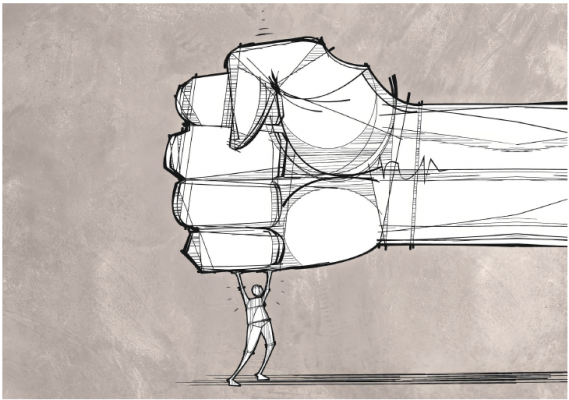
Nigeria presents itself as an enigma – a nation whose problems appear intractable, where each successive government seems worse than its predecessor, and where solutions proven elsewhere fail comprehensively when applied to the Nigerian context. This apparent inscrutability has led many to mystify the country’s challenges, resulting in illogical approaches and abandonment of human agency in favour of prayers and supernatural interventions.
Is Nigeria truly an enigma, or are we examining it through outdated lenses? The evidence suggests we may be analysing new Nigerian realities with obsolete tropes, proposing solutions for a society that no longer exists. We have maintained a static image of Nigerian society from colonial times, failing to acknowledge how profoundly the social landscape has evolved since independence in 1960.
Our understanding remains limited by fossilised ethnolinguistic mapping, questionable data parameters, negotiated census figures, and inaccurate interpretations of cultural processes. We force identity definitions upon individuals who have no fraternal relationships with their assigned groups. Most critically, the geospatial correlations of religion, ethnicity and identities that underpin governance and development planning have lost validity, rendering our models of development and methodology of governance increasingly disconnected from reality.
Nigeria’s diversity is more nuanced than commonly portrayed. While often described as a patchwork of over 525 languages and 250 ethnic groups, closer examination reveals only about 120 distinct language groups based on mutual intelligibility. More practically, just five languages (Yoruba, Hausa, Igbo, English, Nigerian Pidgin) can facilitate communication with over 95 percent of Nigerians. This perspective alone suggests the possibility of greater cohesion than our conventional wisdom acknowledges.
Yet Nigeria’s socio-political landscape remains fractious. Citizenship is bifurcated between indigenes and settlers, legitimised by law. Claims of marginalisation echo across all ethnic groups while attention has shifted from development to entitlement, from cooperation to competition. Cultural diversity, while potentially unifying, has led to divisive politics, as evident in recent elections that showed sharp divisions between major political parties.
Several historical developments have contributed to this predicament. The Nigerian civil war and years of military rule devalued human life and normalized impunity. The education system’s decline reordered mentalities and subordinated substance to superficial display. National incidents like Expo 77 (mass examination leakage) and Oluyole 79 (sports cheating) institutionalised academic and athletic fraud.
The colonial legacy further complicates matters. British rule disrupted traditional socio-political structures, undermined indigenous governance systems, and fostered divisions that continue to influence Nigeria’s development. The amalgamation of diverse ethnic groups under one administrative umbrella in 1914 created artificial boundaries that still generate tension today.
The informal sector, constituting approximately 58.2 percent of Nigeria’s economy and employing up to 90 percent of the workforce, has become dominant in shaping national mentalities. Its patterns of cartelism, cultism, and disorder have been mainstreamed, creating economic management challenges at odds with modern societal requirements. Though vibrant and entrepreneurial, this sector operates largely outside formal structures that could enhance its productivity and contribution to national development.
Governance deficits manifest in widespread corruption, bureaucratic inefficiency, and inadequate provision of basic services. These deficits erode public trust in state institutions, exacerbate social inequalities, and undermine citizens’ confidence in the government’s ability to protect their rights and interests. The dysfunctional governance provided by successive administrations is directly responsible for Nigeria’s current developmental failures.
To move forward, we must recalibrate our understanding of Nigeria’s authentic cultural looms, social fabrics, and ideological tapestry. We need a new approach to Nigerian diversity – one that shifts from fixed land areas correlated with historical ethnicities to more dynamic, population-based analyses.
What must change? First, we need a fundamental reassessment of our national narrative, breaking free from colonial frameworks that no longer serve our understanding. Second, we must develop new analytical tools that account for Nigeria’s dynamic socio-cultural realities rather than reinforcing artificial divisions. Third, governance models must evolve to emphasise production over resource distribution, shifting from entitlement mentality to development orientation.
Fourth, educational and cultural institutions must actively counter the normalisation of deviance and rebuild faith in merit and hard work. Fifth, economic policies must bridge the divide between formal and informal sectors, bringing regulatory frameworks that support rather than suppress indigenous entrepreneurship.
Without these transformations, succeeding generations will inherit an increasingly inexplicable enigma rather than a comprehensible nation. Nigeria’s future depends not on mystifying its challenges but on clearly understanding them through contemporary lenses that reflect its actual, rather than imagined, realities. Only then can solutions emerge that respond to the Nigeria that exists today, not the one preserved in outdated colonial imagery.


Join BusinessDay whatsapp Channel, to stay up to date
Open In Whatsapp