Economy
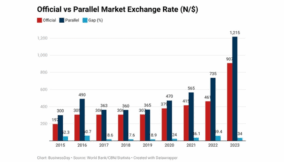
Enhancing effectiveness and simply reducing the cost of governance, which could yield savings of over N1 trillion, will be necessary but not sufficient to financing the social welfare programmes over the short-to-medium term. Shared FAAC revenue, however, already slumped by nearly half in six months. The emerging deep fiscal holes are symptomatic of near-term vulnerabilities of a slowing economy, with a real GDP growth rate that decelerated by more than a third from the rate achieved in 2014 and oil exports projected to be 40 percent lower in 2015 compared to 2014, putting pressures on reserves and exchange rates, with a restrictive MPR of 13 percent.
The constraint of an almost empty treasury is also due in part to fiscal leakages. Prior to the economy being buffeted by a permanent oil prices shock, which declined from $115 to below $50 in six months, it has been estimated that of the $100 per barrel earned, half is wasted or lost through fraud. According to the IMF, the ratio of oil revenue to the market value of oil lifting declined from 47.2 percent in 2011 to 39.5 percent in 2014 due to quantity theft, secular decline in oil investment and production, and lower yield from NNPC Joint Venture (JV) lifting arrangements. It is estimated that about 100,000 barrels of oil per day is lost, amounting to $5 billion or N1 trillion per annum. Restructuring the NNPC and passing immediately the Petroleum Industry Bill (PIB) will seek to ensure equitable management and allocation of oil resources.
The sharp decline in oil prices exposed the paucity of non-oil fiscal revenue, which is about 4.0 percent of non-oil GDP, three times lower than in peer economies and ten times lower than in some OECD countries. According to estimates, increasing non-oil fiscal revenue to 10 percent of GDP will yield about N9.5 trillion, compared to N3.4 trillion in 2014, and close to gross federally collected projected revenue of N9.8 trillion in 2015 budget. Doubling VAT rate from 5 percent, one of the lowest in Africa, and improving collections efficiency by a third by tightening exemptions and increasing compliance, VAT revenue could triple to N3 trillion. Our Corporate Income Tax rate is comparable to peers, but its revenue as a ratio of GDP is half of peers due also to low tax collections efficiency and abuse of tax holidays. Nigeria will also face revenue constraint arising from harmonization of customs and excise tax within ECOWAS.
All revenue-generating and collection agencies including the FIRS, Customs and NNPC should remit their entire revenues to the Federation Account. Raising non-oil revenues will require increasing tax rates as well as broadening the tax base of non-oil GDP through an enhanced tax administration reform of collections, compliance and enforcement. The burden of taxation should, however, fall more on the wealthy with an enhanced progressive tax structure.
Efficiency
Over the long term, improving the efficiency of productive resources will be needed to grow a dynamic market economy capable of sustaining the welfare of a majority of the people within a social democratic state. The incoming administration is targeting GDP growth-rate of 10-12 percent annually, nearly three times the most recent growth rate. It is difficult to achieve this with a capital expenditure of 10 percent of GDP, the lowest among the BRIC and MINT countries and compared to over 30 percent in Indonesia and 45 percent in China. Inadequate infrastructure alone cuts economic growth by more than 2 percent, while electricity shortage increases business costs by over 15 percent.
The administration plans an infrastructure spending programme of N18 trillion to construct 5,000 km of super-highway and up to 6,800 km of modern railway, N5 trillion for electricity, and N100 billion for petroleum refinery. In addition, N16 trillion will be required for a National Mortgage Scheme. Of immediate priority is reviving the petroleum refinery to perform to optimum capacity. Financing the infrastructure programmes requires an investment of over N5 trillion a year. As public sector investment alone is not sufficient, public private partnership, commercialization, and privatizations, Diaspora infrastructure bonds, and long-term external financing from multilateral and bilateral sources will be crucial to meeting the financing requirements.
While economic diversification is underway with services sector contributing half of GDP, premature de-industrialization is manifested in the farm-to-factory move being bypassed for hawking and informal retail trade services in cities. Nigeria has the smallest share of manufacturing to GDP among the BRICS and MINT countries. It is essential to boost agriculture productivity and triple the share of manufacturing, especially from small-scale enterprises, value added to GDP from about 7 percent to over 20 percent by enhancing synergies with metals and mineral processing, agri-business, food processing, and petro-chemical processing through appropriate investment climate incentives and industrial vocational skills. The APC plans to tackle economic diversification and ensure labour-intensive manufacturing and agro-processing with SMEs Loan Guarantee of N10 trillion or $50 billion and agriculture commodity trade board of N250 billion or $1.25 billion.
Prioritization
The vision of a social-democratic welfare state with a dynamic market economy is a noble one. The immediate social inclusion equity programmes for achieving it partly work through fiscal stimulus to consumption and aggregate demand, Keynesian economics style. On the other hand, the efficiency-related programmes are geared towards removing long-term supply-side constraints to the economy through structural reforms for competitiveness and enhancing infrastructure investment-led productive growth.
The total cost of implementing the APC manifesto amount to about N60 trillion or $300 billion (60 percent of GDP), with the equity portion accounting for a fifth; the efficiency portion (38 percent), and guarantees (42 percent). The equity portion alone requires an annual expenditure of about N12 trillion. The total annual revenue for the Federation Account is less than N10 trillion. From reducing the cost of governance, the effectiveness pillar could yield N1 trillion. The extra burden will then fall on the economy pillar with efforts made to plug the fiscal leakages from oil revenue and more non-oil revenue will need to be raised from increasing the tax rate, broadening the tax base, and increasing collection efficiency.
Buharinomics faces a quadrilemma in trying to achieve equity, efficiency and effectiveness in a slowing economy. As the administration faces difficult short-to-medium term policy choices and opportunity costs requiring trade-offs with long-term consequences, prioritization and sequencing of its policies and programmes are in order.
Temitope Oshikoya

Join BusinessDay whatsapp Channel, to stay up to date
Open In Whatsapp