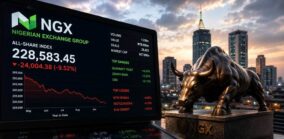
The pendulum of Nigerian stock market may further swing southwards this week as there is little to expected changes around the recent factors that have contributed in dampening investors’ appetite.
Recently, stock investors on Customs Street took advantage of the high valuations placed on some stocks and made short-term gains, thereby pushing stock market further south.
Despite that release of impressive corporate earnings (though unlikely) is capable of ushering in stock buyers to take position in stocks ahead of their corporate rewards, most investment analysts’ overall equity strategy still suggests waiting out of the equity market to ensure recent depressed valuations fully compensate for risk.
Some factors have continued to dampen investors’ appetite for investment at the Nigerian Stock Exchange. These include: drop in global oil prices, profit-taking at the Nigerian Stock Exchange, uncertainty ahead of upcoming general election, weakening naira at the forex market, and increasing violence in the North-East driven by activities of insurgents.
Amid these circumstances, the stock market stands to witness renewed bargain hunting activities in the short-to-medium term as recent decline in stock value creates buy prospects for bargain hunters.
The reign of negative indicators
Just last week, the stock market recorded negative 20.41% in Year-to-Date (YtD) return. Barely six weeks into 2015, the Nigerian stock market lost over N2.3 trillion. The value of listed equities which stood at N11.478 trillion at the beginning of this year declined to N9.204 trillion last weekend. Also, the NSE ASI which was 34,657.15 points as of January 2, 2015 dropped to 27,585.26 points.
Month-to-Date (MtD), the NSE ASI shows a negative return of 6.69 percent; NSE 30 Index (-7.13%); the NSE Banking Index stood negative at 6.51 percent; NSE Insurance Index (-2.02%); NSE Consumer Goods Index (-7.74); NSE Oil/Gas Index (0.25%); NSE Lotus II Index (-2.14%), and NSE Industrial Goods Index (-6.20%).
Read also: Nigeria debt to rise on low oil prices, says Okonjo-Iweala
In the trading week to February 13, 2015, only 11 equities appreciated in price, lower than 42 equities in the preceding week. Fifty-three equities depreciated in price, higher than 29 equities in the preceding week, while 132 equities remained unchanged higher than 125 equities recorded in the preceding week.
Analysts’ sentiments not favourable
“Forward looking events suggest significant risk lies on the horizon as market starts to grapple with the aftershocks of the events that already drove current declines,” according to research analysts at Lagos-based investment house, ARM.
“Burgeoning asset quality issues for banks, multi-faceted earning pressures for FMCGs and higher input costs for traders are all issues that are yet to fully manifest and with an undercurrent that could strengthen as events unfold. Along these same lines, the overall response of economic players and the FGN in particular to the current challenges have their own reverberations. For instance, FGN’s tax drive in response to its revenue shortfalls includes an effort to review corporate usage of the pioneer tax status with a about N40 billion to be raised. That’s an amount directly coming out of corporate earnings. In a nutshell, we see no floor yet for the equity market as a whole,” the analysts said.
“Heightened uncertainty in the political space triggered sell-offs in the local bourse last week, leading to a predominantly bearish week with the All Share Index returning -8.0 percent w/w with a -20.4 percent YtD return. This week, we expect the market to close negative amidst bargain hunting and speculation. Political and macroeconomic uncertainties will continue to trigger sell-offs and apathy in the equities market,” said research analysts at United Capital plc.
“The postponement of the elections has a fiscal dimension in addition to the turmoil it has caused in domestic financial markets,” said investment analysts at Lagos-based FBN Capital.
“Investors remain cautious as the election draw closer and oil prices continue to dwindle,” said analysts at Financial Derivatives Company Limited, who also noted that the buildup to the election had been fierce, thus spurring high levels of uncertainties about its eventual outcome.
Analysts at Financial Derivatives further said: “The outcome will be a major determinant of the direction for the country‘s economy and the stock market, as this may lead to key policy adjustments. Most investors have opted for fixed income assets, cash or forex over equities, highlighting the extent of risk averseness of investors as a result of this trend. It is likely that the current downturn in the market will be sustained in the coming month.”
Iheanyi Nwachukwu

Join BusinessDay whatsapp Channel, to stay up to date
Open In Whatsapp